Analysis of the Impact of the Rapid Development of the HarmonyOS Ecosystem on Domestic AI Application Developers
Unlock More Features
Login to access AI-powered analysis, deep research reports and more advanced features
About us: Ginlix AI is the AI Investment Copilot powered by real data, bridging advanced AI with professional financial databases to provide verifiable, truth-based answers. Please use the chat box below to ask any financial question.
Huawei’s HarmonyOS has become the world’s third-largest mobile operating system after iOS and Android, performing particularly strongly in the Chinese market. In Q3 2025, HarmonyOS’s market share in China reached 18%, continuing to surpass iOS[2]. This achievement is mainly due to the growth momentum of the Huawei nova 14 series and the good performance of foldable screen products.
In terms of ecosystem building, Huawei has attracted over 10,000 developers through events like the 2025 HarmonyOS Innovation Contest, resulting in 86 innovative Apps/AI Agents/Meta Services[1]. These applications fully utilize HarmonyOS’s innovative features such as full-scenario continuity, edge AI, multi-device collaboration, and Xiaoyi AI Agent.
According to QuestMobile’s Q3 2025 AI Application Industry Report, the current Chinese AI application market shows the following pattern:
- ByteDance’s Doubao tops the list with 172 million monthly active users (MAUs)
- Deepseek ranks second with 144 million MAUs
- Tencent Yuanbao ranks third with 32.86 million MAUs, which is not in the same league as the top two[4]
Alibaba once had a weak presence in the C-end AI application market, but now it has expanded its layout through products like Qianwen, Lingguang, and Kuaike. However, it faces competition from Doubao-led entrants and strong rivals such as Kimi, Wenxin, and Yuanbao[4].
Surveys show that 53% of young people aged 18-29 use AI more than once a day, far higher than the 30% of the 65+ group[6]. Over 60% of young people use AI daily, reflecting Generation Z’s high dependence on AI tools.
HarmonyOS provides new system-level entrances for AI applications. According to QuestMobile’s data calculation, in September 2025, the total user scale of AI assistants from six major mobile phone manufacturers increased by 65 million in one year, reaching 535 million overall, which is nearly twice the total user scale of 287 million for native Apps of Internet/AI technology enterprises[5].
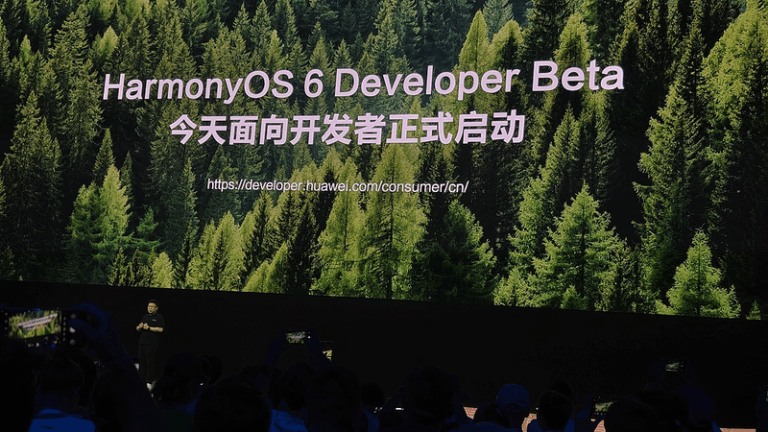
HarmonyOS 6 integrates the capabilities of the system base, massive applications, and AI agents through Harmony Intelligence, providing strong edge computing support for AI applications[1]. This enables AI applications to better achieve the feature of “develop once, deploy across multiple ends” and reduce development costs.
The traditional Internet model relying on advertising revenue is facing challenges. Doubao Mobile’s GUI Agent technology operates Apps by “looking at the screen and clicking buttons”, bypassing the AI license authorization process of the application, and directly completing user tasks without opening the original App[5]. This poses a threat to Internet giants that rely on user retention and advertising revenue.
- Service Card Economy:HarmonyOS’s service cards provide new display and interaction forms for AI applications
- Cross-end Collaboration:Multi-device collaboration capabilities create new usage scenarios for AI applications
- AI Agent Ecosystem:System-level AI assistants such as Xiaoyi AI Agent provide integration opportunities for third-party AI applications
- Advantages:Alibaba deeply integrates the Qianwen large model with core ecosystems such as Alipay, Amap, and Taobao through Kuaike AI Glasses, building life scenario integration capabilities[3]
- Challenges:Need to solve the “non-AI native” problem and find a differentiated position in the HarmonyOS ecosystem
- Current Status:Still has a market in the B-end, but is still constrained by “search thinking” in C-end applications[4]
- Opportunities:The edge AI capabilities of the HarmonyOS ecosystem may help Wenxin break through the limitations of mobile experience
- Strong Position:Already the most active AI application among Chinese users, with a daily active user (DAU) count of 56.7 million[4]
- System-level Competition:The success of Doubao Mobile Assistant shows that ByteDance is penetrating into the operating system level, forming a complex relationship of both cooperation and competition with HarmonyOS
Major manufacturers are focusing on edge AI:
- Huawei launched the emotional companion AI toy “Smart Hanhan”, which is connected to the Xiaoyi large model and integrated into the HarmonyOS ecosystem[3]
- ByteDance cooperates with mobile phone manufacturers such as ZTE in the form of “Doubao Mobile Assistant”[3]
- Alibaba brings AI from the digital world to the physical world through Kuaike AI Glasses[3]
The imagination space of edge AI is no longer limited to traditional consumer electronics forms, but is deeply integrated with automobiles, home furnishings, and even broader life scenarios[3]. This cross-border trend indicates that the success of AI applications increasingly depends on deep integration with hardware and operating systems.
The rapid development of the HarmonyOS ecosystem brings both opportunities and challenges to domestic AI application developers:
- New system-level entrances and user reach channels
- Edge AI capabilities improve application experience
- Cross-device collaboration creates new usage scenarios
- New interaction forms such as service cards
- Competition with system-level AI assistants
- Traditional commercial models are impacted
- Need to adapt to the technical specifications of the HarmonyOS ecosystem
AI application developers should:
- Deeply integrate HarmonyOS features instead of simple transplantation
- Explore new business models and reduce reliance on traditional advertising
- Use HarmonyOS’s edge AI capabilities to improve user experience
- Pay attention to new scenario opportunities created by cross-device collaboration
In the competition of the AI era, developers who can better adapt to changes in the HarmonyOS ecosystem and iterate quickly will gain a larger market share and commercial success.
[1] Huawei - “Tens of Thousands of Developers Compete for Million-Dollar Prizes, 2025 HarmonyOS Innovation Contest Results Announced” (https://www.huawei.com/cn/news/harmonyos-innovation-competition)
[2] Sina Finance - “Sharing the World with iOS and Android! Huawei HarmonyOS’s Q3 Market Share Increases to 18%” (https://finance.sina.com.cn/tech/roll/2025-11-28/doc-infyxfin8604141.shtml)
[3] The Paper - “2025 China AI Large Model Platform Ranking | November” (https://m.thepaper.cn/newsDetail_forward_32154871)
[4] OFweek AI Network - “Qianwen Surges, Will Alibaba AI Break Through?” (https://m.ofweek.com/ai/2025-12/ART-201700-8420-30676126.html)
[5] 36Kr - “Doubao Mobile Touches the ‘Inverse Scale’ of Big Factory Apps” (https://m.36kr.com/p/3596837650595843)
[6] Sina Finance - “Harvard’s Latest Survey: 59% Feel Threatened by AI, Over Half Can’t Live Without It!” (https://finance.sina.com.cn/stock/t/2025-12-14/doc-inhatpfm5211180.shtml)
Insights are generated using AI models and historical data for informational purposes only. They do not constitute investment advice or recommendations. Past performance is not indicative of future results.
About us: Ginlix AI is the AI Investment Copilot powered by real data, bridging advanced AI with professional financial databases to provide verifiable, truth-based answers. Please use the chat box below to ask any financial question.