
Analysis of Valuation Logic Reconstruction for Tesla's Transition from Electric Vehicle Manufacturer to AI Autonomous Driving Company
About us: Ginlix AI is the AI Investment Copilot powered by real data, bridging advanced AI with professional financial databases to provide verifiable, truth-based answers. Please use the chat box below to ask any financial question.
Related Stocks
Tesla’s stock price performed strongly in 2025, with a year-to-date increase of 23.20% and a market capitalization reaching 1.5 trillion USD [0]. However, the traditional DCF valuation model shows its intrinsic value is only 141-188 USD, far lower than the current market price of 467 USD. This huge discrepancy precisely reflects that the market is re-evaluating Tesla’s business model and growth logic [0].

From a technical perspective, Tesla’s stock price shows a sideways consolidation trend, with support at 438 USD and resistance at 477 USD [0]. The current P/E ratio of 286x is far higher than that of traditional automakers, indicating that the market no longer simply views it as a car manufacturer [0].
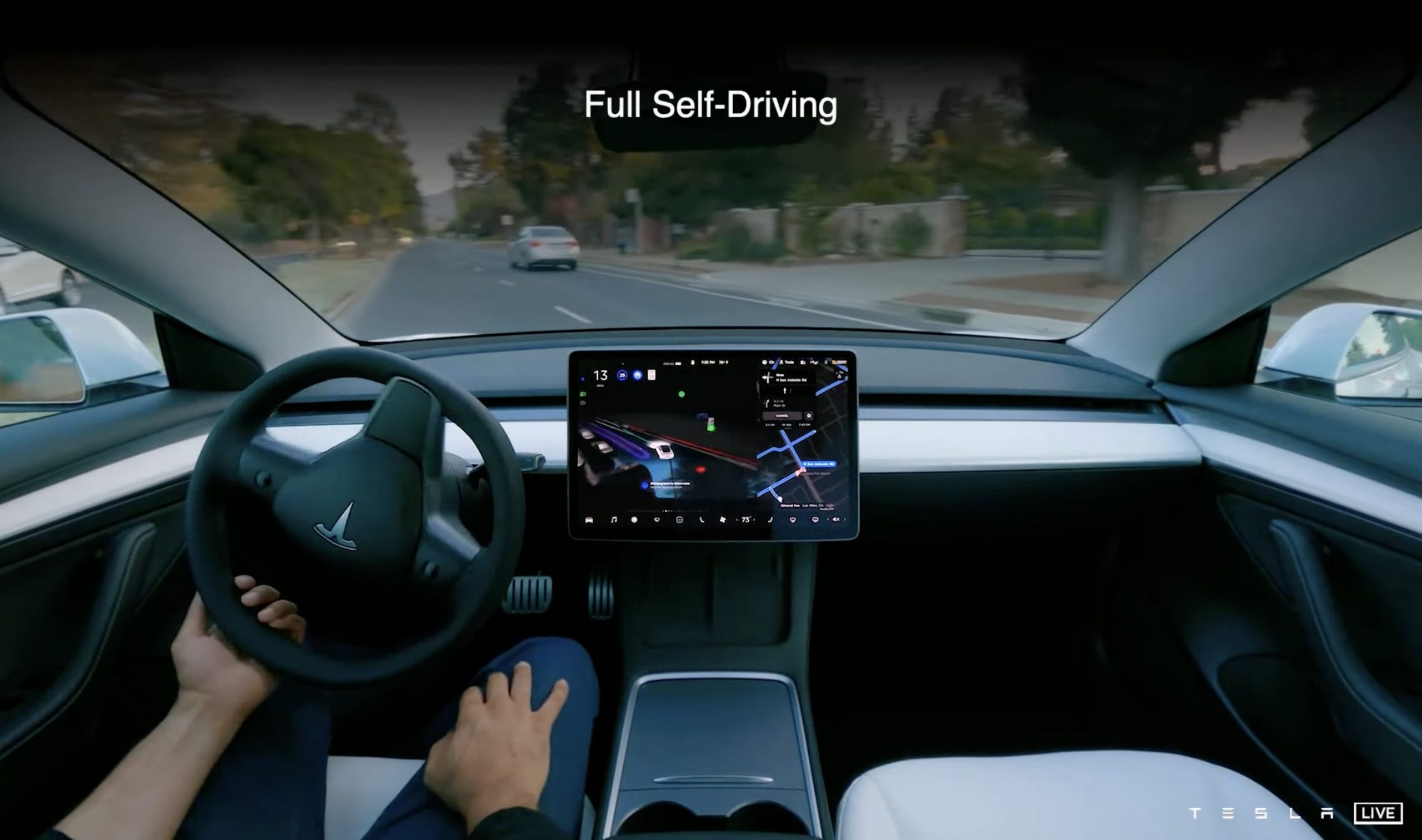
Tesla adheres to a pure vision approach, forming a differentiated competition with the industry’s commonly used lidar fusion route [1]. The unique advantages of this approach include:
In 2025, Tesla’s fully autonomous driving system achieved a safety score of 98.5% in tests in Austin, based on millions of miles of test data, which has exceeded the average level of human drivers [2]. This milestone progress has greatly boosted market confidence in FSD commercialization.
Tesla’s iteration from AI4 to AI6 processors has significantly improved inference throughput, reduced latency, and enhanced energy efficiency—all necessary prerequisites for realizing vision-based unsupervised autonomous driving [3]. The deep collaboration between dedicated AI chips and end-to-end large models has formed system-level optimization integrating hardware and software, creating an insurmountable technical barrier [5].
Although still facing regulatory challenges, California DMV’s controversial ruling has instead highlighted the advanced nature of FSD technology [1]. While adhering to its technical route, Tesla has actively responded to regulatory requirements by adding ‘(Supervised)’ labels, demonstrating a pragmatic strategy for technology commercialization.
Divide Tesla’s business into three independent segments for separate valuation:
- Automotive Business: Traditional P/E multiple, 8-12x
- FSD/Robotaxi Business: SaaS model, based on revenue multiple, 15-20x
- AI/Robotics Business: Valuation based on potential, similar to OpenAI model
The massive driving data accumulated by Tesla not only supports autonomous driving but also provides a training foundation for Optimus humanoid robots. The value of this data asset needs to be reassessed [4].
The energy business (Megapack) serves as infrastructure for the AI era, providing energy supply support for autonomous driving fleets and robot clusters. This ecosystem synergy effect provides additional support for valuation [4].
Despite significant progress, fully L5 autonomous driving still needs to overcome technical challenges such as complex scenarios and extreme weather.
Autonomous driving regulatory policies vary greatly across regions globally, which may affect the commercialization timeline.
Traditional automakers and tech giants are accelerating their autonomous driving layouts, and Tesla’s first-mover advantage is facing challenges.
Tesla’s transition from an electric vehicle manufacturer to an AI autonomous driving company is underway, and the improvement in FSD technology’s product capabilities can indeed support a high valuation premium relative to traditional automakers. The key points are:
- Irreplicable Data Barrier: The world’s largest-scale real driving dataset forms an insurmountable competitive advantage
- Disruptive Business Model: Shifting from one-time sales revenue to recurring service revenue requires a fundamental reconstruction of the valuation system
- Synergy Effect of AI Ecosystem: The three businesses of automotive, robotics, and energy form a virtuous cycle, enhancing overall value
The current high valuation of Tesla reflects optimistic market expectations for its AI transition prospects, but investors need to pay attention to technological commercialization progress and changes in the regulatory environment to avoid excessive optimism. It is recommended to use a segmented valuation method to evaluate the value of each business segment separately for a more accurate valuation judgment.
[0] Jinling API Data - Tesla Stock Price, Financial Data and Technical Analysis
[1] “Tesla’s Dangerous Doors” - Bloomberg (2025-12-17)
[2] “Robotaxi is coming, will taxi drivers lose their jobs? Tesla launches ‘driverless’ era in Austin” - Auto Trend Life (2025-12-15)
[3] “Tesla’s AI Sales Strategy: Neural Networks Transform Car Sales” - Articsledge (2025-12-17)
[4] “Tesla Decides to Change Its Way of Living” - Huxiu (2025-12-17)
[5] “Not Making Cars but Targeting Tesla: Horizon Robotics’ Three Cards” - Electronic Engineering Album (2025-12-11)
Insights are generated using AI models and historical data for informational purposes only. They do not constitute investment advice or recommendations. Past performance is not indicative of future results.
About us: Ginlix AI is the AI Investment Copilot powered by real data, bridging advanced AI with professional financial databases to provide verifiable, truth-based answers. Please use the chat box below to ask any financial question.