
Analysis of Competitive Barriers for Domestic GPUs Based on Moore Thread's Heavy-Asset R&D Strategy
Unlock More Features
Login to access AI-powered analysis, deep research reports and more advanced features
About us: Ginlix AI is the AI Investment Copilot powered by real data, bridging advanced AI with professional financial databases to provide verifiable, truth-based answers. Please use the chat box below to ask any financial question.
Related Stocks
Moore Thread’s cumulative R&D investment from 2022 to 2024 reached 3.81 billion yuan, exceeding 500 million yuan in the first half of 2025, with a total of over 4.3 billion yuan [1][2], ranking in the first tier of domestic GPU R&D investment, far surpassing competitors such as Cambricon and Jingjia Micro [3][4]. In terms of products, it launched at least one mass-produced GPU chip each year from 2022 to 2024, covering general-purpose, consumer-grade, data center, and AI intelligent computing fields [1][2]. The mass production rhythm of ‘Moore Speed’ is relatively prominent in the domestic GPU camp; in contrast, products from Cambricon, Jingjia Micro, and Muxi have slower iteration rhythms [1][2].
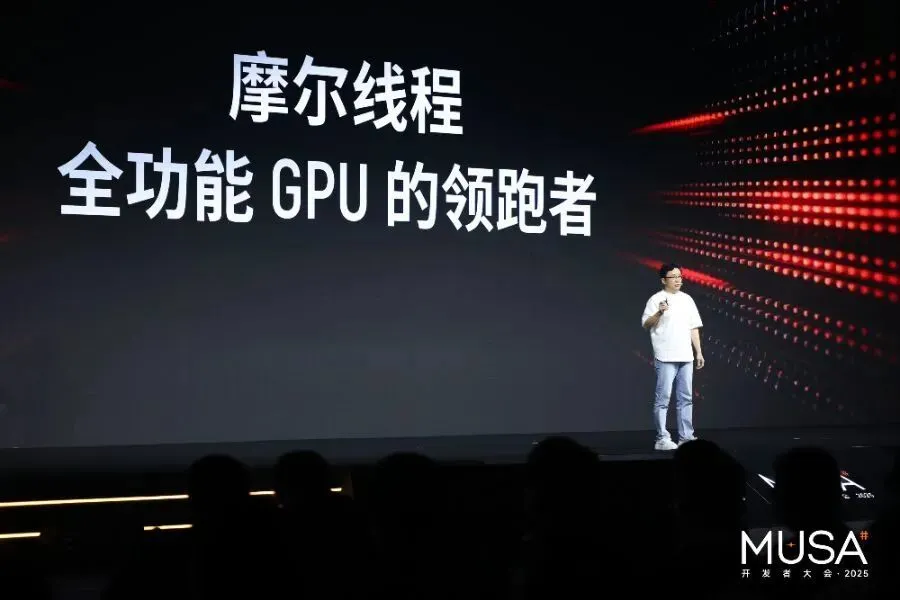
Moore Thread focuses on full-function GPUs, integrating four core capabilities: AI computing acceleration, graphics rendering, physical simulation, and ultra-high-definition video encoding and decoding [2], making it one of the very few domestic companies adopting this strategy. Muxi focuses on high-performance computing in data centers; Cambricon emphasizes cloud-side inference; Jingjia Micro specializes in military and edge AI scenarios [3][4][5]. Moore Thread has formed clear differentiation from competitors through its long-term strategy of full-function GPU + independent and controllable ecosystem [2].
Moore Thread’s stock rose by more than 425% on its first day of listing in December 2025, known as the ‘first domestic GPU stock’ [1]. Cambricon (688256.SS) has seen a 105.41% increase in stock price since 2025, with a market value of 55.688 billion US dollars and strong commercialization capabilities [0]. Jingjia Micro (300474.SZ) has seen a 16.89% drop in stock price since 2025, with a negative net profit margin, greatly affected by R&D investment [0]. The market holds a cautiously optimistic attitude towards Moore Thread’s heavy-asset strategy, recognizing its strategic direction and product iteration capabilities, but worrying about issues such as continuous losses (cumulative loss of 5.939 billion yuan from 2022 to the third quarter of 2025 [1]), valuation bubbles (PS ratio of 300 times [5]), and cash flow pressure.
Moore Thread’s heavy-asset R&D strategy has supported rapid product iteration and technical accumulation in the short term, helping to establish technical barriers and differentiated positioning. However, continuous high investment has also led to huge losses and cash flow pressure, so its capital utilization efficiency and commercialization implementation capabilities need to be watched.
Moore Thread’s full-function GPU layout covers multiple application scenarios, which aligns with the breadth of domestic substitution demand, while competitors mostly focus on segmented fields. This strategic positioning provides Moore Thread with a unique competitive advantage in the domestic GPU track, but also places higher requirements on its technical R&D and ecosystem construction.
Although Moore Thread has made rapid progress in hardware R&D, there is still a gap compared with NVIDIA’s CUDA ecosystem [5]. Insufficient maturity of the software ecosystem may become a key factor restricting its commercialization, so continuous investment in ecosystem construction is needed.
- Continuous Losses and Cash Flow Pressure: Cumulative loss of 5.939 billion yuan from 2022 to the third quarter of 2025 [1]; continuous high R&D investment may lead to cash flow tension.
- Valuation Bubble: PS ratio reaches 300 times [5]; overvaluation has a risk of correction.
- Intensified Market Competition: Faces fierce competition from companies such as Muxi, Biren, and Hygon Information.
- Software Ecosystem Gap: It still takes time to make up for the gap with NVIDIA’s CUDA ecosystem [5].
- Domestic Substitution Demand: The strategic direction of full-function GPU + independent and controllable ecosystem aligns with domestic substitution demand, with broad market space.
- Technical Accumulation and Product Iteration: The product iteration and technical accumulation of ‘Moore Speed’ help to quickly seize market share.
- Differentiated Positioning: The full-function GPU strategy forms differentiation from competitors and can cover more application scenarios.
Moore Thread has achieved rapid product iteration and technical accumulation through its heavy-asset R&D strategy, and has formed differentiated positioning from competitors with a full-function GPU + independent and controllable ecosystem strategy, possessing certain competitive advantages in the domestic GPU track. However, it also faces risks such as continuous losses, valuation bubbles, software ecosystem gaps, and intensified market competition. The market sentiment is cautiously optimistic. In the future, attention should be paid to its commercialization implementation capabilities, ecosystem construction progress, and capital utilization efficiency.
Insights are generated using AI models and historical data for informational purposes only. They do not constitute investment advice or recommendations. Past performance is not indicative of future results.
About us: Ginlix AI is the AI Investment Copilot powered by real data, bridging advanced AI with professional financial databases to provide verifiable, truth-based answers. Please use the chat box below to ask any financial question.