Tax Advantage Ambiguity for Prediction Markets vs. Traditional Sportsbooks
Unlock More Features
Login to access AI-powered analysis, deep research reports and more advanced features
About us: Ginlix AI is the AI Investment Copilot powered by real data, bridging advanced AI with professional financial databases to provide verifiable, truth-based answers. Please use the chat box below to ask any financial question.
Related Stocks
On December 27, 2025, Barrons reported that prediction markets like Kalshi and Polymarket may offer a tax advantage over traditional sportsbooks until the IRS clarifies tax treatment rules [1]. The core distinction lies in IRS classification ambiguity: traditional sports betting winnings are categorized as “gambling income,” where losses can only offset gambling gains (and starting in 2026, only 90% of losses under The One Big Beautiful Bill Act) [2]. In contrast, prediction market winnings could be treated as capital gains/losses (similar to stocks), allowing losses to offset gains and up to $3,000 of ordinary income annually [2].
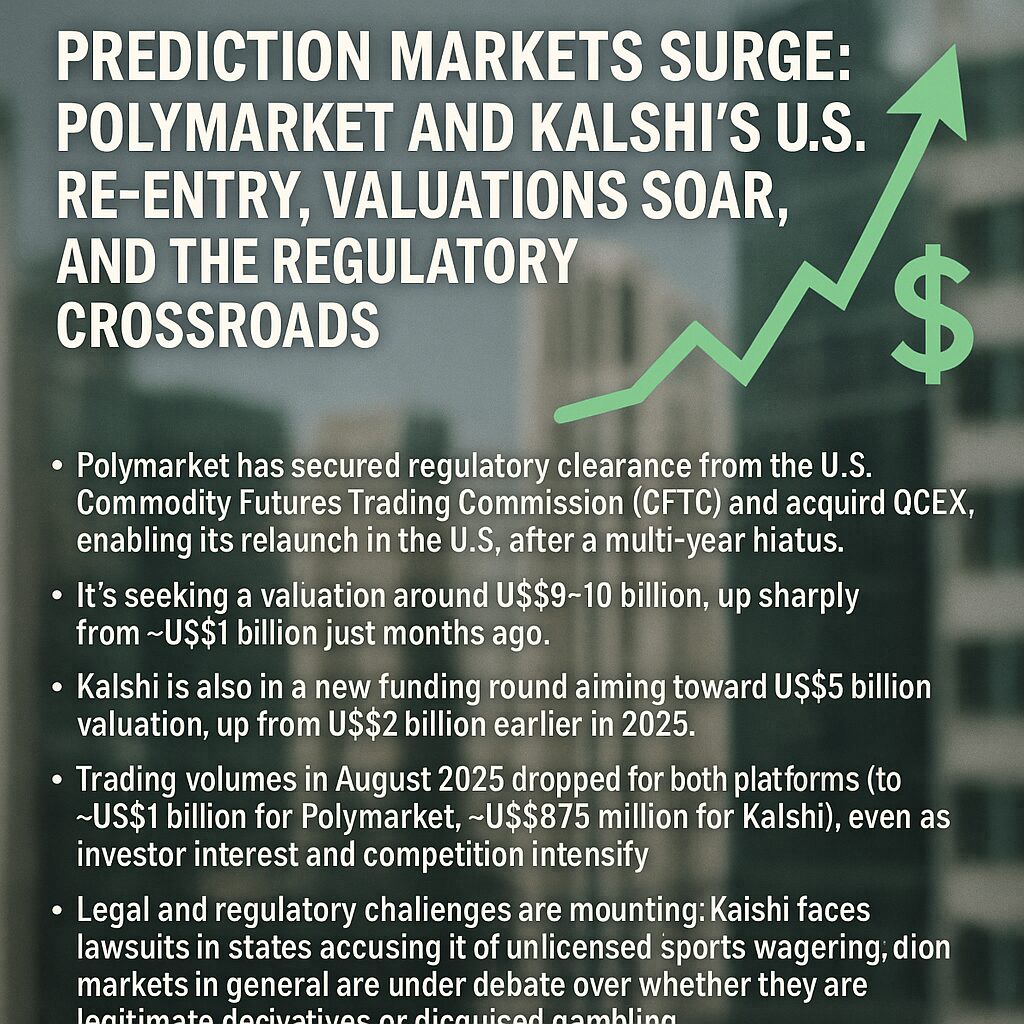
Prediction markets have grown exponentially in 2025: Kalshi achieved $50 billion in annualized volume (up from $300 million in 2024) with 60% global market share, while Polymarket facilitated ~$18 billion in cumulative volume [4][5]. The sector also attracted $2.7 billion in funding (87% of all-time funding), including a $2 billion investment from ICE (NYSE parent) in Polymarket [4]. Traditional sportsbook stocks (DKNG, MGM) showed mild pre-event gains on December 26, 2025 (DKNG: +1.45%, MGM: +1.18%), likely due to broader market conditions rather than anticipation of the article [0].
However, regulatory pushback from the AGA—lobbying for traditional sportsbooks—poses a counterforce. The AGA has launched ad campaigns framing prediction markets as unregulated or risky [3].
- Tax Policy as a Disruption Driver: Ambiguous IRS rules create a short-term structural advantage for prediction markets, potentially shifting bettor behavior and revenue from traditional sportsbooks.
- Institutional Validation: Major investments (ICE’s $2B in Polymarket) signal growing institutional confidence in prediction markets despite regulatory uncertainty.
- Lobbying Power Balance: The AGA’s efforts to restrict prediction markets highlight the traditional sports betting industry’s ability to influence regulatory outcomes, which could mitigate long-term disruption.
- Risks for Traditional Sportsbooks: A significant bettor shift to prediction markets could reduce revenue growth; publicly traded stocks (DKNG, MGM) may experience short-term volatility [0].
- Risks for Prediction Markets: The IRS could reclassify winnings as gambling income, eliminating the tax advantage; AGA lobbying may lead to stricter regulations [3].
- Opportunities for Prediction Markets: Sustained tax advantages could accelerate market share gains and funding, solidifying their role in sports betting alternatives.
The tax ambiguity between prediction markets and traditional sportsbooks creates a dynamic market scenario. Decision-makers should monitor:
- IRS communications regarding prediction market tax classification [1]
- AGA lobbying efforts and potential regulatory changes [3]
- Prediction market volume growth and bettor adoption rates [4][5]
- Market reactions of traditional sportsbook stocks in the post-event trading session
No prescriptive investment recommendations are provided; this summary aims to present objective context for informed decision-making.
华联控股(000036)涨停动因、市场情绪与走势分析
Insights are generated using AI models and historical data for informational purposes only. They do not constitute investment advice or recommendations. Past performance is not indicative of future results.
About us: Ginlix AI is the AI Investment Copilot powered by real data, bridging advanced AI with professional financial databases to provide verifiable, truth-based answers. Please use the chat box below to ask any financial question.