Unitree Technology IPO Valuation Analysis: Commercialization Dilemma from the Perspective of Discounted Cash Flow
Unlock More Features
Login to access AI-powered analysis, deep research reports and more advanced features
About us: Ginlix AI is the AI Investment Copilot powered by real data, bridging advanced AI with professional financial databases to provide verifiable, truth-based answers. Please use the chat box below to ask any financial question.
As a leading enterprise in China’s humanoid robot field, Unitree Technology is rushing to list on the STAR Market IPO and is expected to become the first humanoid robot stock in A-shares [1][2]. The company has completed 132 days of IPO counseling and is expected to formally submit its listing application between October and December 2025. Its valuation after the C round of financing is about 12 billion yuan [2][3].
However, the commercialization prospects of the humanoid robot industry still have significant uncertainties. As of December 16, 2025, the overall increase of the A-share humanoid robot concept sector reached 54.98%, showing the market’s high attention to this track [1]. But at the same time, the industry faces equally severe challenges: most enterprises are still in the “burning money for R&D” stage, the average product cost is as high as 500,000 to 1 million yuan, while the market acceptance is generally below 200,000 yuan, forming a serious “cost inversion” phenomenon [4][5].
Based on Unitree Technology’s publicly disclosed financial data—2024 revenue exceeding 1 billion yuan, having achieved five consecutive years of profitability [2][3]—we conducted a three-scenario Discounted Cash Flow (DCF) valuation analysis of the company.
| Scenario | First 5-year Growth Rate | 5-10 Year Growth Rate | Perpetual Growth Rate | WACC Discount Rate |
|---|---|---|---|---|
| Conservative | 25% | 15% | 3% | 12% |
| Base Case | 40% | 20% | 4% | 10% |
| Optimistic | 60% | 25% | 5% | 8% |
- Conservative Scenario: Enterprise value is about 3.123 billion yuan, implying a P/E ratio of about 3.1x
- Base Case: Enterprise value is about 9.775 billion yuan, implying a P/E ratio of about 9.8x
- Optimistic Scenario: Enterprise value is about 47.534 billion yuan, implying a P/E ratio of about 47.5x
- WACC Sensitivity: When the discount rate rises from 8% to13%, the enterprise value drops from15.855 billion yuan to5.844 billion yuan, with a fluctuation range of159%
- Growth Rate Sensitivity: For every10 percentage points increase in the first5-year growth rate, the enterprise value increases by about30% to65%
##3. Analysis of the Gap Between Valuation and Market Expectations
Unitree Technology’s IPO target valuation is as high as70 billion yuan, which is a
- Growth Premium: Market expectations for the company’s high-speed revenue growth in the next few years (CAGR above60%)
- Industry Premium: Capital market scarcity premium as the “first humanoid robot stock”
- Concept Premium: Benefiting from embodied intelligence policy support and market speculation enthusiasm
However, current DCF analysis shows that supporting a70 billion yuan valuation requires meeting the following almost harsh conditions:
- Maintain a CAGR of more than50% in revenue for the next10 years
- Sustained healthy conversion of free cash flow into profits
- Perpetual growth rate maintained at around5% (far exceeding GDP growth rate)
- Discount rate below8% (reflecting extremely low risk premium)
##4. Core Challenges in the Commercialization Path
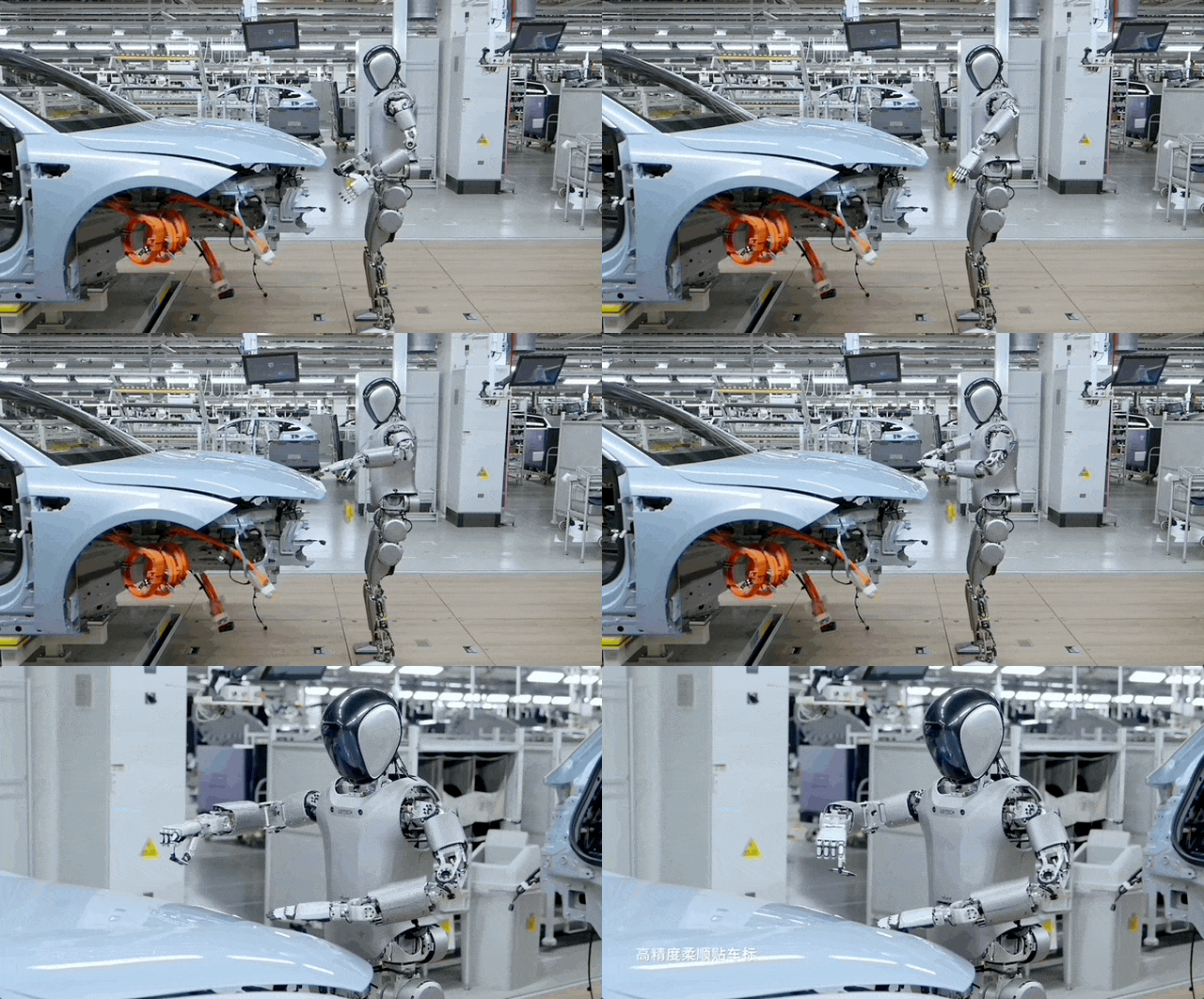
Currently, there is a huge gap between humanoid robot products and market acceptance. Unitree Technology’s G1 humanoid robot retails for99,000 yuan and sells for about$21,600 at Walmart in the US [7], but the market’s psychological price for consumer-grade humanoid robots is generally below200,000 yuan [4][5].
The industry still focuses on displays and performances, such as pre-set actions like exhibition guidance and somersaults, lacking human-like autonomous learning and extension capabilities [5][8]. Wang Xingxing, founder of Unitree Technology, admitted that the consumer demand for robots to do housework is “currently unlikely to be realized” because actions like opening doors and mopping floors are very complex for humanoid robots [8].
In2025, more than150 domestic humanoid robot companies have received financing [5][9], but industry consolidation has begun: K-Scale Labs announced the suspension of operations in November2025 [1], and Yixing Robot also reported dissolution news [1]. The National Development and Reform Commission has clearly reminded of the risk that the “commercialization model is not yet fully mature” [4].
##5. Investment Risks and Recommendations
- Valuation Risk: The IPO target valuation of70 billion yuan has a premium of more than6 times compared to the DCF base valuation, which needs to rely on sustained high growth for support
- Commercialization Risk: Humanoid robots have no large-scale commercial implementation scenarios, and the profit model is unclear
- Competition Risk: The industry has entered a consolidation period, and only10 to20 companies may eventually survive among more than100 [5]
- Technology Risk: The “AGI moment” of embodied intelligence has not yet arrived, and spatial large models still need to be broken through
Based on prudent discounted cash flow analysis, Unitree Technology’s reasonable valuation range should be
[1] Phoenix News - Humanoid Robots in2025: Half Misty Forest, Half Stars and Sea (https://h5.ifeng.com/c/vivoArticle/v002PEqrooFVSxNw-_GFYVvtUGlbURQmlL--bJgiiOVbAxgzw__?isNews=1&showComments=0)
[2]36Kr - Robots Racing Against Time: The Fierce Competition for Spring Festival Gala, Commercialization, and Listing Window (https://eu.36kr.com/zh/p/3612251724956933)
[3] Yicai -2026 Great Shuffle: Which Chinese Humanoid Robot Companies Will Stay? (https://m.yicai.com/news/102974406.html)
[4] The Paper - Pouring Cold Water on the Humanoid Robot Industry: Where Will “Unitree” Go? (https://m.thepaper.cn/newsDetail_forward_32083487)
[5] CBNData - “Unitree and Others” This Year: Showing Off on Stage While Raising Funds for Listing (https://www.cbndata.com/information/294828)
[6] AInvest - Unitree’s $7B IPO: A Market Test for Tesla’s Optimus Ambitions (https://www.ainvest.com/news/unitree-7b-ipo-market-test-tesla-optimus-ambitions-2512/)
[7] Baidu Encyclopedia - Unitree G1 Humanoid Robot (https://baike.baidu.com/item/宇树Unitree G1人形机器人/64416799)
[8] Tracxn - Unitree Company Profile (https://tracxn.com/d/companies/unitree/__o1e8b3ZlyUCcjIECfbM9csfhnJyv1_fOku8o_K8gCYg)
[9] Interface News - Unitree Technology Targets STAR Market Listing: Valuation and Financing Summary (https://www.traderabc.com/company/Unitree)
三只松鼠(300783)投资价值分析报告
Insights are generated using AI models and historical data for informational purposes only. They do not constitute investment advice or recommendations. Past performance is not indicative of future results.
About us: Ginlix AI is the AI Investment Copilot powered by real data, bridging advanced AI with professional financial databases to provide verifiable, truth-based answers. Please use the chat box below to ask any financial question.