Market Disconnect: Why Stocks Thrive While Consumer Spending Falters
Unlock More Features
Login to access AI-powered analysis, deep research reports and more advanced features
About us: Ginlix AI is the AI Investment Copilot powered by real data, bridging advanced AI with professional financial databases to provide verifiable, truth-based answers. Please use the chat box below to ask any financial question.
Reddit users on r/stocks and related investing forums have identified several key explanations for the market-consumer disconnect:
-
Stock-Economy Decoupling: Multiple users argue that stocks have been fundamentally decoupled from the real economy for years, with market performance driven by factors unrelated to average consumer spending patterns[1]
-
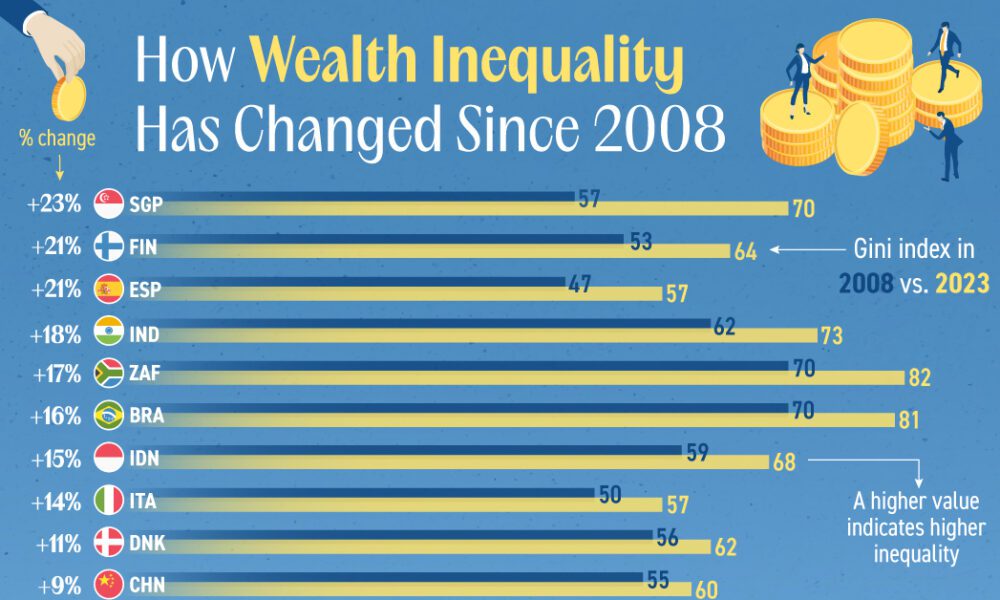
Wealth Inequality Dynamics: Users emphasize that the top 10-20% of households control the majority of market activity and consumer spending, creating a bifurcated economy where market gains don’t reflect broader economic conditions[1]
-
AI and Tech Dominance: Commenters identify AI capital expenditure and technology companies as the primary market drivers, noting that only AI-related stocks are performing well while consumer-facing stocks like Disney and Starbucks remain flat[1]
-
K-Shaped Recovery: Users describe a two-tier economy where wealthy consumers continue spending on travel and discretionary items while working-class households reduce tipping, face layoffs, and cut back on non-essential purchases[1]
-
Sector-Specific Performance: Some users point to counter-evidence like Expedia’s strong Q3 2025 earnings, suggesting travel spending remains robust even as other consumer sectors struggle[1]
Market and economic data confirm the Reddit observations while providing additional context:
- S&P 500 Q3 2025 earnings grew 10.7% year-over-year, marking the ninth consecutive quarter of expansion[2]
- Technology sector earnings surged 26.5%, with AI-focused “Magnificent 7” companies propelling major indices to record highs[2]
- Forward 12-month P/E ratio stands at 22.9x, above five-year and ten-year averages, indicating elevated valuations[2]
- Sector performance varies dramatically: Communication Services (+22.37% YTD) and Information Technology (+21.88% YTD) significantly outperform Consumer Staples (+0.11% YTD)[2]
- University of Michigan Consumer Sentiment Index dropped to 50.3 in November 2025, near the lowest level since 1978[3]
- 71% of respondents expect unemployment to rise, with 43% perceiving personal job loss risk[4]
- Long-term unemployment rose sharply from 21.5% to 25.7% of total unemployed[4]
- Buying conditions for big-ticket goods are at their worst since mid-2022[5]
- The richest 10% of Americans now account for 50% of all consumer spending[6]
- Retail same-store sales increased 5.7% year-over-year in October 2025, but growth was driven primarily by price increases rather than unit volumes[7]
- Travel industry remains strong while other discretionary sectors face significant pressure[8]
The Reddit community’s analysis aligns closely with empirical data, revealing a structural market disconnect driven by several factors:
- Both Reddit users and research data confirm that AI and technology sectors are the primary market drivers, not broad consumer spending
- The K-shaped recovery narrative is supported by data showing wealthier households driving disproportionate market and consumer activity
- Sector-specific performance disparities validate observations that only certain segments of the economy are thriving
The market’s resilience despite consumer stress reflects a fundamental shift in what drives stock valuations. Corporate earnings growth, particularly in technology and AI, has decoupled from Main Street economic health. This creates a situation where:
- Market Performance ≠ Economic Health: Record stock highs coexist with near-record low consumer sentiment
- Wealth Concentration Effects: A small percentage of high-net-worth individuals can sustain both market valuations and consumer spending statistics
- Sector Divergence: Technology and AI investments create wealth effects that don’t translate to broader economic prosperity
- Valuation Stretched: Forward P/E of 22.9x suggests markets may be vulnerable to corrections if AI earnings growth disappoints[2]
- Consumer Debt Stress: Rising credit card debt among lower-income households could trigger broader economic weakness[4]
- Policy Uncertainty: Government shutdowns and geopolitical risks could impact corporate earnings and investor sentiment[2]
- AI Infrastructure Plays: Continued AI capital expenditure could benefit semiconductor, cloud computing, and data center companies[2]
- Luxury and Travel: High-end consumer spending remains resilient, benefiting premium brands and travel companies[8]
- Financial Services: Wealth management and investment firms may benefit from continued market participation by high-net-worth individuals
The current environment favors sector-specific investing over broad market exposure. Technology and AI-related companies continue to show strong fundamentals, while consumer discretionary stocks face headwinds from reduced spending among middle and lower-income households. Investors should consider the two-tier economy structure when making allocation decisions, focusing on companies serving high-net-worth consumers or participating in AI infrastructure buildout.
Insights are generated using AI models and historical data for informational purposes only. They do not constitute investment advice or recommendations. Past performance is not indicative of future results.
About us: Ginlix AI is the AI Investment Copilot powered by real data, bridging advanced AI with professional financial databases to provide verifiable, truth-based answers. Please use the chat box below to ask any financial question.