
Analysis of Cyclical Bottom Characteristics and Investment Timing in the Baijiu Industry
Unlock More Features
Login to access AI-powered analysis, deep research reports and more advanced features
About us: Ginlix AI is the AI Investment Copilot powered by real data, bridging advanced AI with professional financial databases to provide verifiable, truth-based answers. Please use the chat box below to ask any financial question.
Related Stocks
As of December 27, 2025, the baijiu sector as a whole is in a deep adjustment period:
| Company Name | Stock Code | Current Price | YTD Change | 52-Week Range | P/E Ratio |
|---|---|---|---|---|---|
| Kweichow Moutai | 600519.SS | 1,414.13 CNY | -16.08% |
1,383.18-1,657.99 | 19.68x |
| Wuliangye | 000858.SZ | 109.78 CNY | -19.28% |
108.78-143.60 | 13.04x |
| Luzhou Laojiao | 000568.SZ | 119.39 CNY | -30.94% |
106.75-146.72 | 13.88x |
From the data, the three leading baijiu companies have all seen significant declines since 2024, with Luzhou Laojiao having the largest drop of over 30%[0].
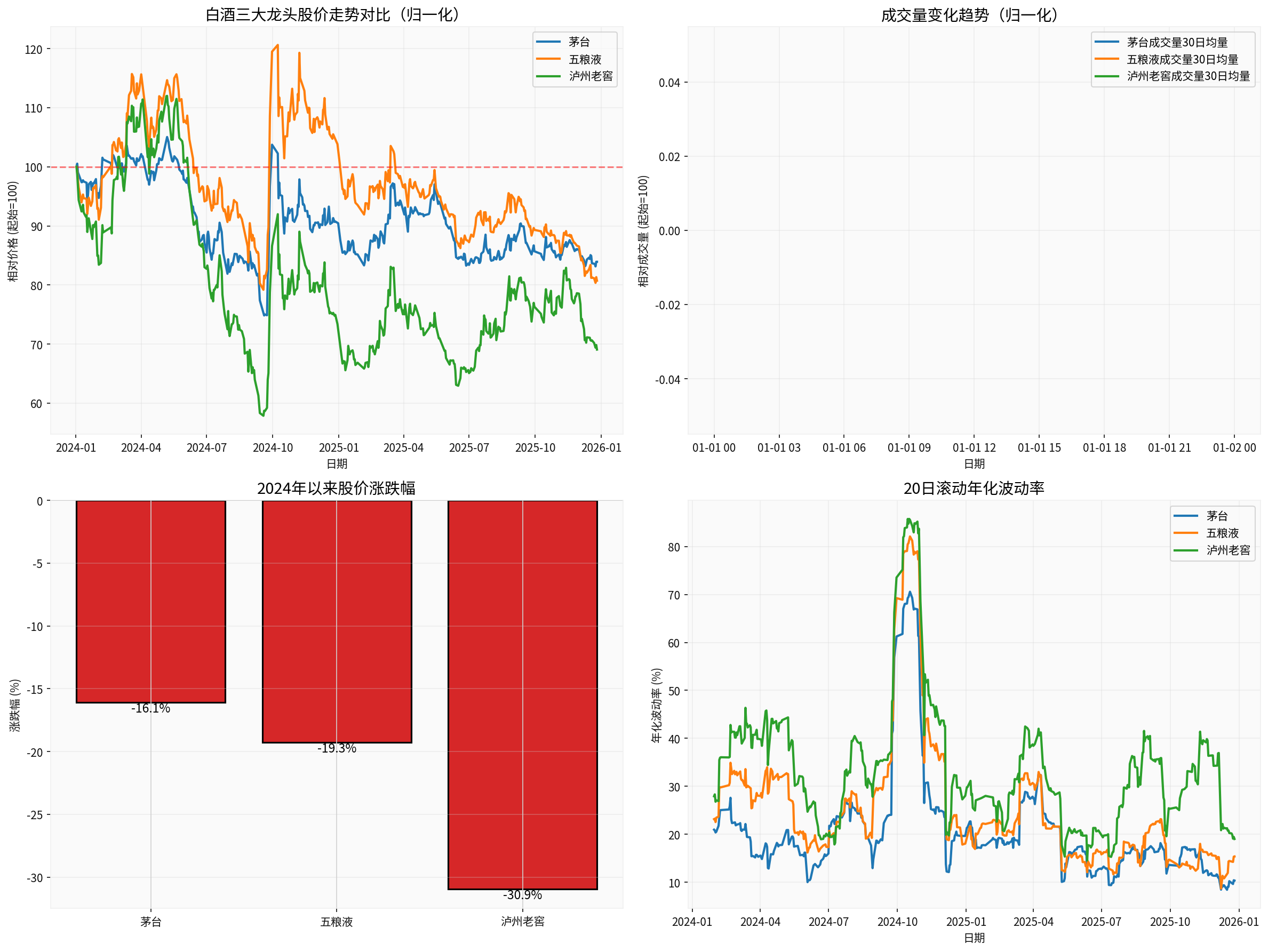
Chart shows: Since 2024, the stock prices of the three leading baijiu companies have all shown a downward trend, with Luzhou Laojiao having the largest drop (-30.94%) and Moutai being relatively resilient (-16.08%). The 20-day rolling volatility shows that market fluctuations have intensified since the second half of the year, reflecting increased investor divergence.
The current baijiu industry faces serious channel inventory problems:
- Price inversion is common:E-commerce platform data shows that the price of the 8th generation Wuliangye on Tmall Mall is only 820-850 CNY, and the JD self-operated price is 845 CNY,far below the ex-factory price
- Dealers sell inventory to recover funds:Dealers sell inventory that cannot be digested in offline channels online to quickly get paid, further lowering market prices
- Impact of alcohol ban on demand:In May 2025, the central government issued an “alcohol ban” requiring that high-end alcohol not be provided in official receptions. Combined with the downturn in other industries, this led to weak baijiu sales and channel inventory backlog[4]
According to technical analysis data and market performance, the baijiu sector shows the following characteristics:
- Volume contraction:Moutai’s average daily trading volume dropped from 32.1 million to 1.78 million (current level), a contraction of nearly 45%
- Weak technical indicators:Wuliangye’s MACD has no crossover (bearish signal), and the KDJ indicator shows an oversold zone (22.7/23.8/20.5)
- Increased volatility:Luzhou Laojiao’s 20-day rolling annualized volatility has increased significantly, indicating intensified market panic[0]
| Valuation Indicator | Moutai | Wuliangye | Luzhou Laojiao |
|---|---|---|---|
| P/E Ratio | 19.68x | 13.04x | 13.88x |
| P/B Ratio | 6.89x | 2.99x | - |
| EV/OCF | 20.09x | - | - |
| ROE | 36.48% | - | - |
The valuations of leading baijiu companies have dropped to historically low levels. Wuliangye and Luzhou Laojiao’s P/E ratios are in the range of 13-14x, with a certain margin of safety[0].
According to the analysis framework mentioned in your post, manufacturer policy is an important leading indicator for judging the industry bottom:
| Signal Type | Specific Performance | Current Status |
|---|---|---|
| Cut production to maintain price | Feitian Moutai production cut | Not yet appeared |
| Lower investment standards | Dealer threshold reduction | Partially appeared (Wuliangye price cut is a disguised benefit) |
| Channel subsidies | Manufacturer provides subsidies to dealers | Appeared (Wuliangye subsidy policy) |
Wuliangye’s disguised price cut is called a “very pragmatic decision” by industry experts, aiming to ease channel capital and inventory pressure and direct resources to the real consumption link[4]. This indicates that manufacturers have begun to actively adjust policies to deal with industry difficulties.
An important point mentioned in your post:
- Aged Moutai represents real consumption demand:15-year Moutai is mainly used for banquets and collections, and its price better reflects real high-end consumption demand
- Sub-new Feitian is greatly affected by channel disturbances:Sub-new Feitian prices are easily affected by dealers selling inventory and cannot truly reflect terminal demand
- Current 15-year Moutai price is stable:Although sub-new Feitian prices continue to decline, the price of 15-year Moutai is relatively stable, indicating that high-end consumption demand still exists
According to the latest DCF valuation analysis, the intrinsic value of Moutai under different scenarios is [0]:
| Scenario | Intrinsic Value | Relative to Current Price | Key Assumptions |
|---|---|---|---|
| Conservative | 1,088.56 CNY | -23.0% |
0% revenue growth, 75.1% EBITDA margin |
| Base | 1,577.11 CNY | +11.5% |
20% revenue growth,79.1% EBITDA margin |
| Optimistic | 2,565.42 CNY | +81.4% |
23% revenue growth,83.1% EBITDA margin |
-
Current price is between conservative and base scenarios(1,414.13 CNY), and the market has partially priced in pessimistic expectations
-
Probability-weighted intrinsic value is 1,743.70 CNY, with a 23.3% upside potential compared to the current price
-
WACC is 9.4%, assuming beta is 0.72, risk premium is7%, risk-free rate is4.5%
-
Analyst expectations:2029 EPS range is111.78-124.51 CNY, corresponding to PE of about11-13x (assuming stock price is1400 CNY)
Combined with the above analysis, the baijiu industry is currently in the
✅
- Price system collapse (Moutai breaks guide price, Wuliangye price cut)
- Valuation at historical low
- Extremely low market sentiment
- Partial manufacturer policy adjustment (Wuliangye subsidizes dealers)
❌
- Substantial negative growth in Moutai’s performance
- Feitian Moutai production cut
- Divergence after market consensus bearish
- Complete clearing of channel inventory
| Investment Strategy | Applicable Timing | Risk-Return Characteristics |
|---|---|---|
Left-side trading (buy more as it falls) |
Current stage | Contrarian layout, bear short-term volatility, seek long-term excess returns |
Right-side trading (wait for confirmation) |
After bottom signals are clear | Miss the lowest point, but more certain, lower risk |
Wait and see |
Wait for more signals | Avoid being trapped, but may miss the best buying point |
It is recommended to consider building positions after the following signals appear:
- The first quarter-on-quarter improvement after Moutai’s quarterly performance shows negative growth
- Feitian Moutai loose bottle price stabilizes and rebounds below 1499 CNY
- Channel inventory is cleared and wholesale prices are stable
- Clear reversal signals appear on the technical side (MACD golden cross and RSI>50)
You can consider building positions in batches currently, and it is recommended to use the “pyramid buying method”:
- First tier (around current price of 1,400 CNY):Establish 30% position
- Second tier (around 1,300 CNY):Add 30% position
- Third tier (around 1,200 CNY):Add 40% position
- Single stock position does not exceed 20% of total funds
- Set stop-loss line at 1,000 CNY (10% below conservative scenario valuation)
- Reserve sufficient cash to cope with further declines
- Spring Festival sales movement situation (February 2026)
- Feitian Moutai wholesale price trend
- Dealer inventory level
- Fund holding changes
- 2025 annual report performance (April 2026)
- 2026 Q1 performance forecast
- Channel reform progress
- Signs of consumption recovery
- Whether high-end baijiu demand continues
- Changes in industry competition pattern
- Whether Moutai’s brand moat is stable
- Improvement of macroeconomic environment
-
Macroeconomic downturn risk:If economic recovery is less than expected, high-end consumption demand will remain weak
-
Industry adjustment exceeds expectations:This round of baijiu adjustment may be longer than 2013-2014, and inventory clearing will take longer
-
Policy risk:If the “alcohol ban” further expands the scope of implementation, it will continue to suppress baijiu demand
-
Increased competition risk:Other high-end baijiu brands may launch price wars, further compressing industry profit margins
-
Changes in consumption habits:Young consumers’ preference for baijiu decreases, and long-term demand may be structurally weakened
The baijiu industry is currently in the
- Long-term view:Moutai’s brand moat and pricing power are still strong, with ample cash flow (ROE reaching 36.48%), and it is still a high-quality asset in A-shares
- Mid-term view:Industry adjustment will continue for 1-2 quarters, and it is necessary to wait for channel inventory clearing and consumption demand stabilization
- Short-term view:The stock price may fluctuate in the range of 1,300-1,500 CNY, waiting for catalysts
Conservative investors are advised to
Although the baijiu industry faces phased challenges, the long-term logic remains unchanged. For long-term investors who can bear short-term volatility, the current period may be an opportunity window to gradually layout high-quality leading baijiu companies. But remember:
[0] Gilin AI Financial Data System (https://www.jilinai.com)
- Kweichow Moutai (600519.SS) real-time quotes, technical analysis, financial data, DCF valuation
- Wuliangye (000858.SZ), Luzhou Laojiao (000568.SZ) real-time quotes, technical analysis
- Baijiu sector historical price data, financial indicators
[1] Yahoo Finance - “Wuliangye reduces price by 119 CNY per bottle, first time in ten years” (https://hk.finance.yahoo.com/news/五糧液每瓶減價119元十年首見)
- Wuliangye reduces price by 119 CNY in disguise, the first official price cut in ten years
[2] Yahoo Finance - “Baijiu Feitian Moutai breaks 1499 CNY guide price” (https://hk.finance.yahoo.com/news/白酒飛天茅台跌破1499元指導價)
- Feitian Moutai loose bottle price breaks 1499 CNY guide price, dropping to 1485 CNY
[3] Xinhua Silk Road - “Chinese baijiu maker convenes meeting to seize chances in changing market” (https://ca.finance.yahoo.com/news/xinhua-silk-road-chinese-baijiu-104300315.html)
- Wuliangye holds annual meeting to respond to changes in the baijiu industry
[4] Chinese Baijiu Industry Data Analysis Chart - Baijiu Production Cycle and Industry Bottom Characteristics (Source: Internet search results)
Insights are generated using AI models and historical data for informational purposes only. They do not constitute investment advice or recommendations. Past performance is not indicative of future results.
About us: Ginlix AI is the AI Investment Copilot powered by real data, bridging advanced AI with professional financial databases to provide verifiable, truth-based answers. Please use the chat box below to ask any financial question.