Analysis of Bawang Cha Ji's Caffeine Controversy and Its Impact on Overseas Expansion
Unlock More Features
Login to access AI-powered analysis, deep research reports and more advanced features
About us: Ginlix AI is the AI Investment Copilot powered by real data, bridging advanced AI with professional financial databases to provide verifiable, truth-based answers. Please use the chat box below to ask any financial question.
Based on the latest information found, I analyze Bawang Cha Ji’s caffeine controversy and its potential impact on overseas expansion plans for you:
On December 26, 2025, Bawang Cha Ji sparked heated online discussions and trending on Weibo due to caffeine content issues in some of its drinks. The cause was netizens reporting discomfort symptoms such as insomnia and palpitations after consumption [1][2]. Affected by this news, Bawang Cha Ji’s U.S. stock plummeted by over 14% at one point that day, hitting a new low since its listing; it finally closed down 2.54% at $11.9 per share, with a total market value of $2.21 billion [2].
The company subsequently issued a long statement in response, emphasizing that its caffeine content is equivalent to that of lattes and significantly lower than American coffee, and pointed out that tea contains various beneficial ingredients such as茶多酚 (tea polyphenols), amino acids, and minerals, which form a mild balance in synergy with caffeine [2]. Notably, this is the second time Bawang Cha Ji has been controversial over caffeine issues; its “Wanli Magnolia” product also received attention due to similar complaints in May last year [2].
From the data perspective, Bawang Cha Ji’s overseas business is in a period of rapid growth. In the third quarter of 2025, overseas GMV reached 300 million yuan, up 75.3% year-on-year and 27.7% quarter-on-quarter, marking the second consecutive quarter with growth exceeding 75% [1][3]. As of the end of the third quarter, the company had 262 overseas stores in Southeast Asia and North America, with a net increase of 54 stores in the third quarter alone [1].
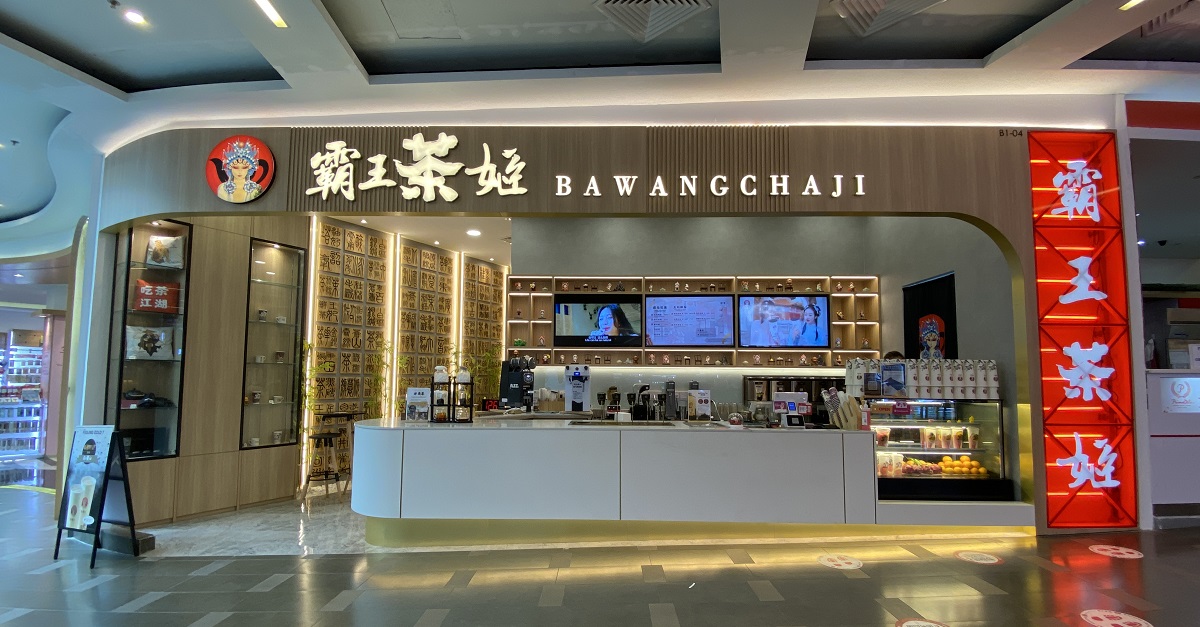
In terms of overseas market positioning, Bawang Cha Ji has adopted a differentiated strategy of “building scale domestically and establishing brand overseas”. The average customer unit price of overseas stores is generally higher than that in China, with single-store revenue reaching more than 1.5 times that of domestic stores [3]. The company opened its first store in the U.S. at Westfield Century City mall in Los Angeles in April 2025, located adjacent to Beverly Hills, focusing on high-end positioning [1][4].
Founder Zhang Junjie has publicly elaborated on his globalization concept, emphasizing that “going overseas is not a matter for one company alone, but the entire industry chain going out together” [1]. The company has formed a localized product R&D team in the Asia-Pacific market, adjusting product names and formulas according to the cultural backgrounds of different countries. For example, it launched “Yinshan Moqing” in Malaysia, tried new products like “Orchid Biluochun” in Singapore, and changed the name of “Boya Juexian” in the U.S. to “BO·YA Tea Lattle” (tea latte) [3].
From the perspective of industry competition pattern, the competition among Chinese new tea brands going overseas is becoming increasingly fierce. Mixue Ice Cream & Tea has laid out about 4,700 stores overseas, covering 13 countries; brands like Luckin Coffee, Heytea, and Nayuki Tea are also accelerating their overseas layout [1][4]. The North American market is considered the most difficult but with the largest growth space; if Bawang Cha Ji can gain a foothold in this market, it will be of great significance to its globalization strategy [1].
Comprehensive analysis shows that the caffeine controversy may have a certain short-term impact on Bawang Cha Ji’s brand image and stock price. Although the company responded promptly, market confidence has been affected to some extent. As a new tea brand that has just been listed for half a year, stock price fluctuations may affect its capital support and investor confidence for overseas expansion.
In the context of intensified domestic market competition and declining same-store sales, Bawang Cha Ji needs to properly handle this controversy, maintain brand reputation, and ensure the continued growth of overseas business as a growth engine. The future success of the company in overseas markets will largely depend on its ability to effectively balance multiple challenges such as product innovation, localized operations, and brand trust building.
[1] Caifuhao - Is Bawang Cha Ji Losing Its Appeal? Behind the Caffeine Controversy: Failure of Blockbusters and Franchisee Dilemmas (https://caifuhao.eastmoney.com/news/20251229124454057390710)
[2] The Paper - Stock Price Plummets, Trending on Weibo! Some People Said “Couldn’t Sleep All Night After Drinking”, Bawang Cha Ji Issues Long Statement in Response (https://www.nbd.com.cn/articles/2025-12-28/4198419.html)
[3] 36Kr - Price Wars Can’t Kill Bawang Cha Ji (https://m.36kr.com/p/3575596783139976)
[4] Ebang Power - Mixue’s 4-Yuan Lemonade Enters North America (https://m.ebrun.com/630812.html)
Insights are generated using AI models and historical data for informational purposes only. They do not constitute investment advice or recommendations. Past performance is not indicative of future results.
About us: Ginlix AI is the AI Investment Copilot powered by real data, bridging advanced AI with professional financial databases to provide verifiable, truth-based answers. Please use the chat box below to ask any financial question.