US Approval of Samsung's Chip Equipment Exports to China: Impacts Analysis
Unlock More Features
Login to access AI-powered analysis, deep research reports and more advanced features
About us: Ginlix AI is the AI Investment Copilot powered by real data, bridging advanced AI with professional financial databases to provide verifiable, truth-based answers. Please use the chat box below to ask any financial question.
Related Stocks
The following is a comprehensive analysis of the policy change regarding the US approval of Samsung’s chip equipment exports to China and its impacts:
-
Latest Policy Relaxation Signals:
- The U.S. Department of Commerce has approved the export license for NVIDIA H200 chips to China, which is seen as a policy relaxation signal after the Trump administration reached some form of reconciliation with China in the tech sector [1].
- The policy allows the export of high-performance chips whose performance is about 18 months behind the most advanced products, while retaining priority supply of the latest technology to U.S. customers [2].
- One of the driving factors for the relaxed policy is that Chinese companies like Huawei have developed AI chips with comparable performance, leading the U.S. side to believe that the marginal benefits of restrictive measures are declining [3].
-
Logic Behind Samsung and Equipment Exports:
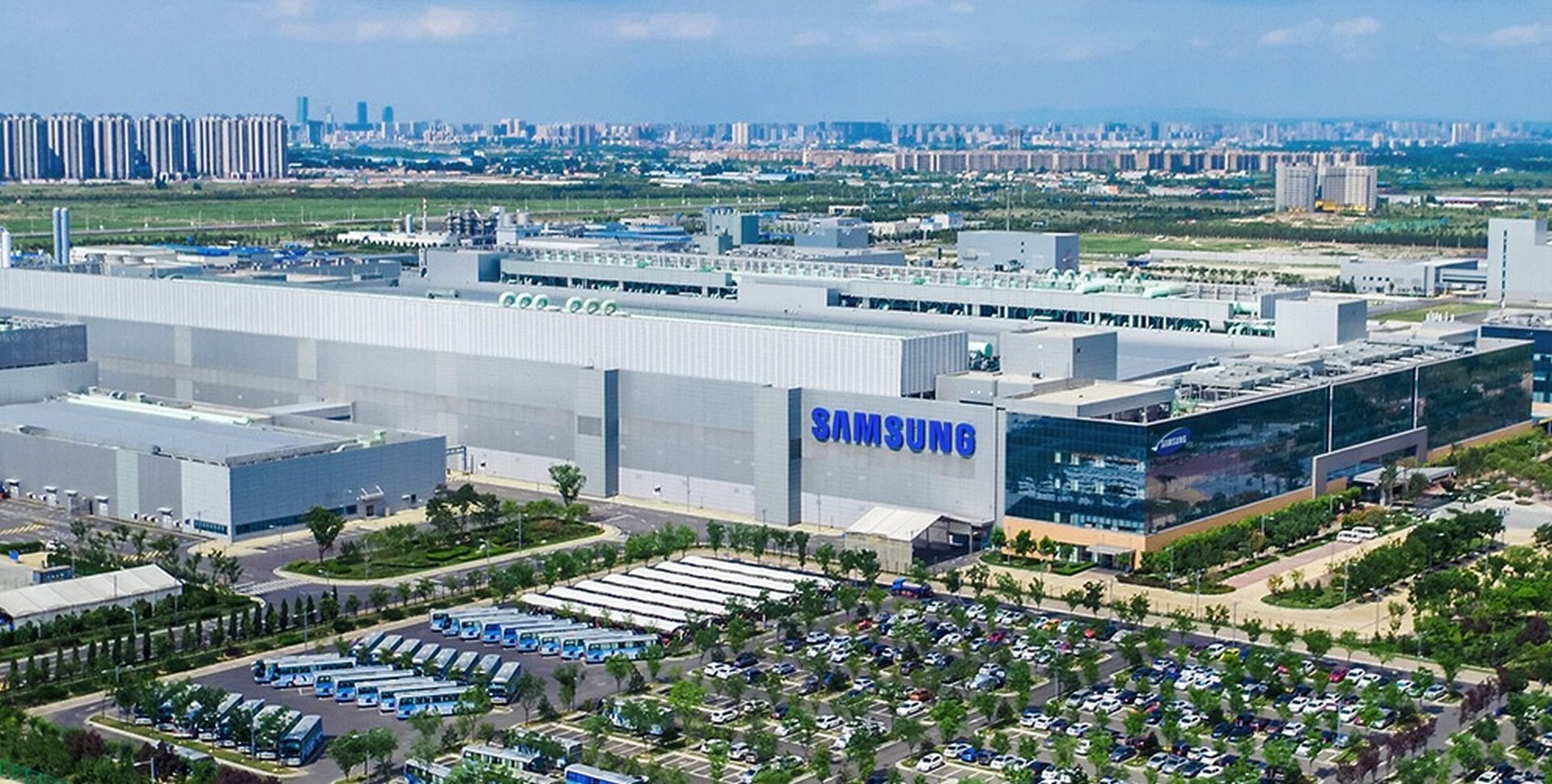
- Although specific public information on Samsung’s equipment export license is limited, it can be inferred that against the backdrop of the global supply chain’s high dependence on Chinese manufacturing, there is practical necessity for the relaxation of equipment exports targeting Samsung. A significant portion of Samsung’s global production capacity for memory chips (DRAM and NAND) is located in its Chinese factories (as shown in the charts, their contribution to global DRAM and NAND capacity) [4][5].
- Relaxing equipment exports to Samsung will help these Chinese factories expand capacity and upgrade technology around 2026, thereby having an important impact on the global memory supply-demand balance.
-
Capacity Expansion and Supply Chain Continuity:
- Relaxing export restrictions will directly support Samsung’s equipment procurement and capacity expansion at its Chinese factories, avoiding supply disruptions caused by equipment shortages.
- For the global memory chip market (DRAM and NAND), this will help ease the supply tightness in 2025-2026 and support storage demand from data centers and AI applications.
- For foundries, similar equipment export relaxations can increase global advanced and mature process capacity, improving supply security in areas such as AI, automotive electronics, and industrial control.
-
Regional Supply Chain Restructuring:
- Policy relaxation is beneficial for U.S., European, Japanese, and South Korean equipment companies to continue exporting to the Chinese market, slowing down the regionalization and fragmentation trend of the global supply chain.
- At the same time, it also buys a time window for China in advanced manufacturing equipment, which may accelerate the process of domestic substitution (e.g., local equipment vendors like SMEE have already obtained local orders) [6].
-
Overall Sector Performance and Outlook:
- The semiconductor equipment sector overall performed strongly in 2025, with related ETFs like SOXX rising 40.26% since the start of the year [7].
- Leading equipment companies have seen significant gains in the past month: Applied Materials (AMAT) +17.33%, Lam Research (LRCX) +19.39%, ASML +6.10% [8][9][10].
- This performance reflects the market’s optimistic expectations for a global capital expenditure upturn in 2025-2026.
-
Key Equipment Company Analysis:
-
Applied Materials (AMAT):
- China is its largest market, with FY2024 China revenue accounting for 37.2% ($10.12B) [11].
- Recently, its stock price has risen 60.52% year-to-date, with a market capitalization exceeding $200 billion [11].
- Policy relaxation will help sustain its sales in China, especially equipment supply to Samsung’s Chinese factories.
-
Lam Research (LRCX):
- It has advantages in key process equipment such as etching, benefiting from the DRAM and NAND expansion cycle.
- Its stock price has performed strongly recently, with a market capitalization exceeding $220 billion [12].
- Policy relaxation is favorable for its equipment orders with Samsung.
-
ASML:
- The global monopolist of extreme ultraviolet lithography (EUV) equipment, holding over 90% share in the high-end market [13].
- Although restricted from exporting the most advanced EUV equipment to China, there is still some room for DUV equipment in China.
- The company remains positive about its 2026 outlook, with orders and shipments expected to continue growing [14].
-
-
Market Sentiment and Valuation:
- The equipment sector’s valuation is already at a high level (AMAT P/E ~29.85x, LRCX P/E ~38.91x) [15][16].
- Policy relaxation may further boost sentiment and push up stock prices in the short term, but investors need to be alert to correction risks.
-
Policy Reversal Risk:
- U.S. tech export policies to China are uncertain and may tighten again during government transitions or tense international relations.
-
Geopolitics and Competition:
- China’s accelerated semiconductor localization may reduce medium-to-long-term demand for overseas equipment.
- Technological progress of domestic equipment may gradually form competitive pressure.
-
Industry Cycle Fluctuations:
- Semiconductor demand fluctuations may affect the rhythm of equipment orders, especially when AI and memory demand slows down periodically.
-
Short-term Strategy:
- Focus on the performance guidance and Chinese market share changes of leading equipment companies (AMAT, LRCX, ASML).
- Pay close attention to the implementation of China-related orders and the expansion plans of international giants like Samsung at their Chinese factories.
-
Medium-to-long-term Perspective:
- AI and memory are the core drivers of semiconductor capital expenditure in the next few years, and the long-term growth logic of the equipment sector remains unchanged.
- Policy relaxation is conducive to global supply chain optimization, bringing broader market space for equipment companies.
-
Portfolio Allocation:
- Prioritize targets with both technical barriers and Chinese exposure, such as Applied Materials and Lam Research.
- At the same time, opportunities in the substitution process of local equipment enterprises can be considered.
The policy relaxation of the U.S. approval for Samsung’s chip equipment exports to China is an important adjustment to the global semiconductor industry chain. It will help alleviate equipment supply bottlenecks, stabilize the pace of global capacity expansion, and further enhance the performance prospects of semiconductor equipment companies. However, investors need to pay attention to policy continuity and industry cycle fluctuations, and carefully evaluate the valuation and risk-return ratio.
[1] Bloomberg: Trump’s Nvidia H200 Reprieve Spurred by Huawei’s AI Gains (https://www.bloomberg.com/news/articles/2025-12-09/trump-s-reprieve-for-nvidia-s-h200-spurred-by-huawei-s-ai-gains)
[2] Semafor: Commerce to open up exports of NVIDIA H200 Chips to China (https://www.semafor.com/article/12/08/2025/commerce-to-open-up-exports-of-nvidia-h200-chips-to-china)
[3] Reuters: US prepared to open up exports of Nvidia H200 chips to China (https://www.reuters.com/world/china/us-open-up-exports-nvidia-h200-chips-china-semafor-reports-2025-12-08/)
[4] Yahoo Finance: Memory industry reliance on Chinese factories (https://s.yimg.com/kZCE4YLvNzsufbTQUKWSig)
[5] Yahoo Finance: Samsung building signage (https://s.yimg.com/ulfjBjrbU7XANgRrVQtdYQ)
[6] DIGITIMES: SMEE wins China lithography order, yet ASML still controls advanced-node tools (https://www.digitimes.com/news/a20251226PD229/smee-asml-government-manufacturing-equipment.html)
[7] Jinling API Data: SOXX ETF 2025 Annual Price Data
[8] Jinling API Data: AMAT Monthly Price Data (Past Month)
[9] Jinling API Data: LRCX Monthly Price Data (Past Month)
[10] Jinling API Data: ASML Monthly Price Data (Past Month)
[11] Jinling API Data: AMAT Company Profile and Financial Indicators
[12] Jinling API Data: LRCX Real-time Quotes and Financial Indicators
[13] Jinling API Data: ASML Real-time Quotes and Financial Indicators
[14] Jinling API Data: ASML Related News Summary
[15] Jinling API Data: AMAT Valuation Indicators
[16] Jinling API Data: LRCX Valuation Indicators
美国批准三星向中国工厂运送芯片设备的深远影响分析
Insights are generated using AI models and historical data for informational purposes only. They do not constitute investment advice or recommendations. Past performance is not indicative of future results.
About us: Ginlix AI is the AI Investment Copilot powered by real data, bridging advanced AI with professional financial databases to provide verifiable, truth-based answers. Please use the chat box below to ask any financial question.