U.S. Stock Funds Reach 12% Year-to-Date Gains Driven by Tech Sector Strength
Unlock More Features
Login to access AI-powered analysis, deep research reports and more advanced features
About us: Ginlix AI is the AI Investment Copilot powered by real data, bridging advanced AI with professional financial databases to provide verifiable, truth-based answers. Please use the chat box below to ask any financial question.
Related Stocks
This analysis is based on the Wall Street Journal report [1] published on November 9, 2025, which highlighted that U.S. stock funds pushed year-to-date gains to 12%, driven primarily by continued strength in technology stocks and large-cap growth funds.
The market performance data reveals a clear technology sector leadership pattern that has characterized 2025 market dynamics. Major indices show strong gains over the past 60 trading days (August 20 - November 12, 2025): S&P 500 (+6.95%), NASDAQ Composite (+9.97%), Dow Jones Industrial (+7.55%), and Russell 2000 (+8.74%) [0]. The NASDAQ’s outperformance specifically underscores the tech sector’s dominant role in driving overall fund returns.
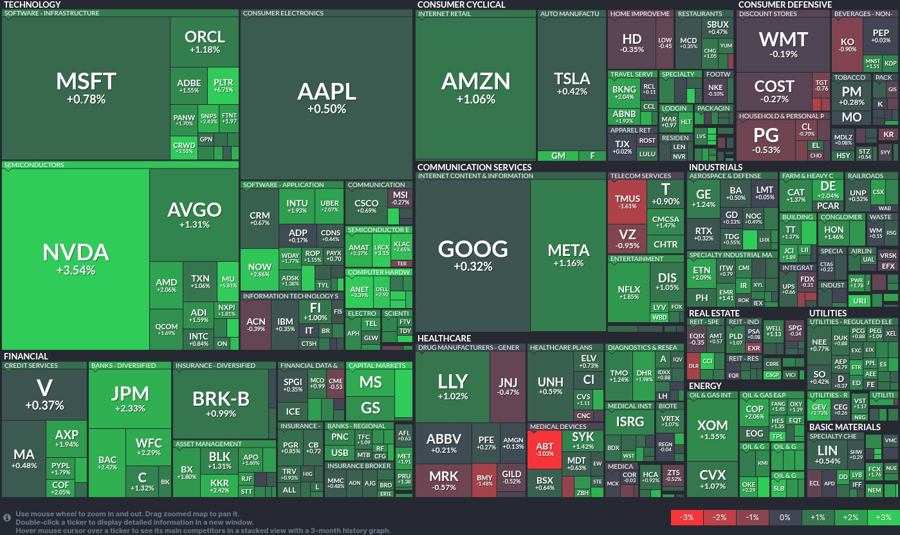
Individual tech stock performance provides further evidence of this trend, with NVIDIA leading at +41.17% year-to-date, Microsoft showing strong gains of +19.22%, and Apple delivering solid performance at +9.25% [0]. These gains have significantly contributed to the outperformance of large-cap growth funds, which have particularly benefited from the sustained tech rally throughout 2025.
Current sector performance data shows mixed leadership, with Healthcare (+1.55%) and Communication Services (+1.27%) joining tech in outperformance, while defensive sectors like Utilities (-1.55%), Real Estate (-0.52%), and Financial Services (-0.29%) are lagging [0]. This sector divergence suggests a market environment favoring growth-oriented investments over traditional defensive plays.
- Concentration Risk: Heavy reliance on technology stocks creates vulnerability to sector-specific corrections or earnings disappointments
- Valuation Concerns: Extended rally may have pushed tech valuations to elevated levels, increasing sensitivity to negative catalysts
- Interest Rate Sensitivity: Growth stocks remain particularly vulnerable to Federal Reserve policy changes and interest rate movements
- Market Fatigue: Prolonged gains increase the potential for investor exhaustion and profit-taking episodes
- Tech Momentum Continuation: Strong fundamentals and innovation cycles could support further tech sector outperformance
- Sector Rotation Potential: Underperforming defensive sectors may present value opportunities if market dynamics shift
- Fund Selection Advantage: Large-cap growth funds continue to benefit from structural trends in technology adoption
The U.S. stock fund performance reaching 12% year-to-date gains represents a significant achievement in 2025, primarily driven by technology sector strength and large-cap growth fund outperformance. The market data shows clear leadership from major tech companies, with NVIDIA, Microsoft, and Apple delivering substantial returns that have lifted overall fund performance [0, 1].
Current market conditions feature strong momentum in growth-oriented investments, with the NASDAQ Composite outperforming other major indices (+9.97% over 60 days) [0]. However, this performance comes with elevated volatility levels and concentration risks that warrant careful consideration.
Sector performance remains mixed, with Healthcare and Communication Services joining technology in outperformance, while traditional defensive sectors lag [0]. This divergence suggests selective investment opportunities rather than broad-based market strength.
The extended nature of the tech rally, combined with current valuation levels, creates a complex environment where strong coexisting performance potential and significant risk factors require balanced assessment and continuous monitoring of market dynamics and economic indicators.
Insights are generated using AI models and historical data for informational purposes only. They do not constitute investment advice or recommendations. Past performance is not indicative of future results.
About us: Ginlix AI is the AI Investment Copilot powered by real data, bridging advanced AI with professional financial databases to provide verifiable, truth-based answers. Please use the chat box below to ask any financial question.