In-depth Investment Analysis of South Korea's Biopharmaceutical Industry and Celltrion
Unlock More Features
Login to access AI-powered analysis, deep research reports and more advanced features
About us: Ginlix AI is the AI Investment Copilot powered by real data, bridging advanced AI with professional financial databases to provide verifiable, truth-based answers. Please use the chat box below to ask any financial question.
The growth of South Korea’s biopharmaceutical industry is fueled by multiple structural factors:
- The global biopharmaceutical market size reached 422.5 billion USDin 2024 and is expected to grow to921.5 billion USDby 2034, with a compound annual growth rate (CAGR) of8.2%[1]
- The biosimilar CDMO (Contract Development and Manufacturing Organization) market is growing even more rapidly, with a market size of 30 billion USD in 2025 and an expected 109.07 billion USDby 2035, a CAGR of13.1%[0]
- The global biosimilar sales totaled approximately 10.285 billion USDin 2024, with market penetration continuing to increase[2]
- New technologies such as monoclonal antibodies, recombinant proteins, cell and gene therapies are revolutionizing fields like oncology, immunology, and neurology[1]
- The application of AI technology in drug discovery, bioprocess optimization, and personalized medicine is improving R&D efficiency[1]
- Over 60%of outsourcing demand growth and45%of biologic production growth are driving the expansion of global CDMO partnerships[0]
- South Korea accounts for approximately 30%of the global biopharmaceutical manufacturing market share, second only to North America (40%) and Europe (25%)[0]
- It is known for its cost-effectivenessandmanufacturing capabilities, especially in monoclonal antibody and cell therapy production
- South Korea’s biopharmaceutical market is expected to grow from 22.1 billion RMB in 2024 to 30.2 billion RMB by 2035[1]
- Samsung Biologics: Announced the expansion of its fourth factory in 2025, increasing total capacity by30%, with contract projects growing by22%year-on-year[0]
- Celltrion: A global leader in biosimilars, with 12 marketed biosimilar products[2]
Based on brokerage API data and industry reports[4][5]:
| Indicator | 2024 | 2025 Forecast | Growth Rate |
|---|---|---|---|
Sales |
3.56 trillion KRW | 4.11 trillion KRW | +15.4% |
Operating Profit |
492 billion KRW | 1.16 trillion KRW | +135.8% |
Operating Margin |
13.8% | 28.2% | +14.4 percentage points |
This marks Celltrion’s

Chart shows: From 2021 to 2025, Celltrion’s sales grew from 928.5 billion KRW to 4.11 trillion KRW, operating profit from 152.8 billion KRW to 1.16 trillion KRW, and operating margin from 16.46% to 28.22%[0]
- Sales reached 1.404 billion USDin 2024, up96.36%year-on-year[2]
- It is a key product for treating autoimmune diseases such as rheumatoid arthritis
- Approved for marketing by the U.S. FDA and EU EMA[2][3]
- Currently has 12marketed biosimilar products[2]
- As many as 28biosimilar projects in R&D, providing momentum for future revenue growth[2]
- Plans to include blockbuster products such as Ocrevus®, Cosentyx®, Keytruda®, and Darzalex® in its biosimilar development options[2]
Based on brokerage API financial analysis[0]:
| Indicator | Value | Evaluation |
|---|---|---|
Market Capitalization |
39.60 trillion KRW | Leading global biopharmaceutical enterprise |
ROE (Return on Equity) |
4.35% | Low, but in the expansion phase |
Net Profit Margin |
18.94% | Excellent level |
Operating Margin |
22.84% | Strong profitability |
Current Ratio |
1.38 | Good liquidity |
Quick Ratio |
0.70 | Need to pay attention to short-term liquidity |
- Financial Attitude Classification: Conservative, showing a high depreciation/capital expenditure ratio, with room for profitability improvement as investments mature[0]
- Debt Risk: Low-risk classification, sound financial structure[0]
- Free Cash Flow: Reached 568.3 billion KRW in the latest period, good cash generation capacity[0]
- High-end biosimilarscontinue to gain traction: Key products like Remsima® grew by 96.36% in 2024, indicating strong market demand[2]
- Diversified product line: 12 marketed products cover multiple therapeutic areas, reducing the risk of reliance on a single product[2]
- Rich R&D pipeline: 28 projects in R&D provide continuous momentum for long-term growth[2]
- Regulatory approval advantages: Products have been approved by the U.S. FDA and EU EMA, with high market access barriers[2][3]
- Strategic cooperation network: Established long-term partnerships with global distribution partners such as iQone Healthcare[3]
- Acquisitions and capacity expansion: Recently acquired a biopharmaceutical production facility from Eli Lilly in the U.S. and plans to追加投资 to expand capacity[5]
- The global biosimilar market reached 10.285 billion USD in 2024 and is expected to continue growing rapidly[2]
- Over 50%of new biopharmaceutical drugs rely on CDMO services, with huge room for market penetration improvement[0]
- The monoclonal antibody market size continues to expand, dominating the biopharmaceutical market[1]
- Determined a cash dividend of 750 KRWper common share in 2025, with total dividends of approximately 164 billion KRW[5]
- Invested over 1 trillion KRWin shareholder returns (including share repurchases and dividends) in 2024[5]
- Committed to achieving a 3-year average 40%shareholder return target by 2027[5]
- P/E Ratio: 53.79x, higher than the industry average[0]
- P/B Ratio: 2.38x[0]
- P/S Ratio: 10.16x[0]
- Current valuation has fully reflected high growth expectations, requiring continuous outperformance to support
- Currently in a downtrend, to be confirmed[0]
- Support level at 178,200 KRW, resistance level at 192,100 KRW[0]
- Beta value only 0.12, low correlation with the broader market, obvious independent trend[0]
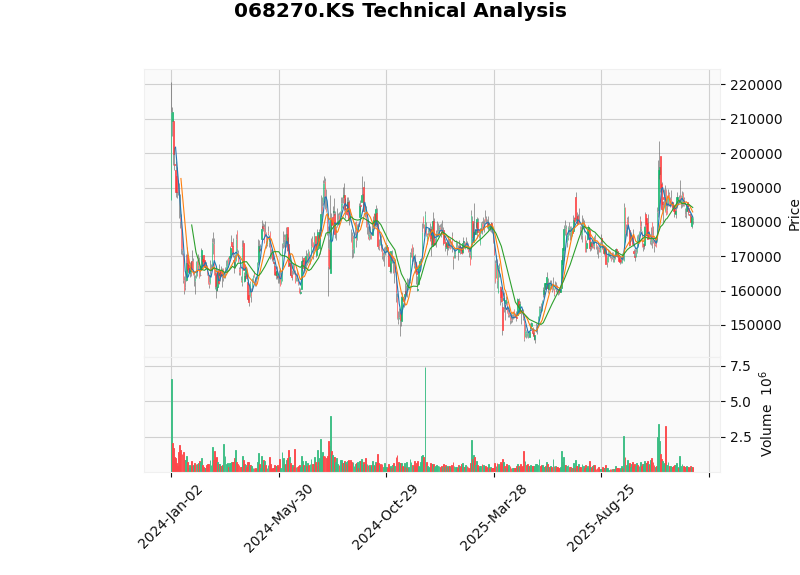
Chart shows: Celltrion’s stock price fluctuated significantly from 2023 to 2025, currently in a technical adjustment phase[0]
- Samsung Biologics: Capacity expansion by 30%, contract projects growth by 22%, fierce competition[0]
- International giants: More than 100 companies including Sandoz, Amgen, Pfizer are investing in biosimilar development[2]
- Price pressure: As more generics enter the market, price competition may intensify
- Regulatory approval for biosimilars is complex, with different standards across countries
- Original drug manufacturers may delay generic drug launches through patent litigation
- Changes in U.S. and European regulatory policies may affect market access
- ✅ Rich product pipeline: 28 R&D projects provide long-term growth engines[2]
- ✅ Strong key products: Remsima®'s 96.36% growth shows market leadership[2]
- ✅ Continuous capacity expansion: Acquired U.S. factory and plans to追加投资[5]
- ✅ High industry prosperity: Biosimilar market CAGR of 13.1%[0]
- ✅ Sound financial structure: Low debt risk, sufficient free cash flow[0]
- ⚠️ High base effect: 2025 operating margin of 28.2% is at a historical high, with limited room for further significant improvement
- ⚠️ Valuation pressure: P/E ratio of 53.79x requires sustained high growth[0]
- ⚠️ Intensified competition: Competitors like Samsung Biologics are expanding rapidly[0]
- ⚠️ Technical adjustment: Stock price is in a downtrend, short-term pressure[0]
- Sales growth rate: Expected to remain at12-18%(slightly slower than 2025’s 15.4%)
- Operating profit growth rate: Expected to drop to25-35%(2025’s 135.8% is unsustainable)
- Operating margin: Expected to stabilize in the25-28%range
- South Korea’s biopharmaceutical market is expected to grow from 22.1 billion RMB in 2024 to 30.2 billion RMB by 2035, with a CAGR of approximately 3.0%[1]
- CDMO market opportunities are huge, with a CAGR of 13.1%from 2025 to 2035[0]
- South Korean enterprises will continue to benefit from manufacturing cost advantagesandtechnological innovation capabilities
- 2025-2027: Consolidate global biosimilar leadership and expand market share
- 2028-2030: Expand into innovative biopharmaceuticals to upgrade product portfolio
- Post-2030: Develop into an integrated biopharmaceutical group covering generics, innovative drugs, and CDMO
- Valuation Risk: Current P/E ratio of 53.79x is at a high level; if performance falls short of expectations, there may be valuation correction pressure[0]
- Competition Risk: Competitors like Samsung Biologics are expanding rapidly, which may squeeze market share and profit margins[0]
- Regulatory Risk: Changes in regulatory policies of U.S. FDA, EU EMA, etc., may affect product approval and market access
- Exchange Rate Risk: Fluctuations in the KRW/USD exchange rate may affect the performance of overseas businesses
- Technical Risk: New drug R&D has uncertainties, and projects in R&D may face failure or delay
[0] Gilin API Data (including Celltrion company profile, financial analysis, technical analysis, stock price data, etc.)
[1] Global Market Insights - “Biopharmaceutical Market 2025-2034” (https://www.gminsights.com/zh/industry-analysis/biopharmaceutical-market)
[2] Global Growth Insights - “Biopharmaceutical CDMO Market Growth and Trends 2026-2035” (https://www.globalgrowthinsights.com/zh/market-reports/biopharmaceutical-cdmo-market-121135)
[3] Celltrion Official Website - Company Profile and Product Information (https://www.celltrion.com/en-us/company/media-center/press-release/3521)
[4] Sina Finance - “South Korean Biopharmaceutical Giant Celltrion’s Operating Profit Exceeds 1 Trillion KRW for the First Time This Year” (https://finance.sina.com.cn/stock/usstock/c/2025-12-31/doc-inheshqn6691139.shtml)
[5] Daily Economic News - “Celltrion Group Acquires Eli Lilly’s Biopharmaceutical Production Facility in the U.S.” (https://www.mk.co.kr/cn/it/11489993)
[6] Taiwan Biotech Medical Industry Policy Promotion Center - “2025 Biotechnology Industry Development Overview” (https://ccd.nat.gov.tw/biopharm/images/2025/2-2025 Biotechnology Industry in TaiwanV1001.pdf)
[7] 36Kr - Celltrion 2025 Performance Forecast Report (https://www.36kr.com/newsflashes/3619006643668232)
Note: Some data is sourced from South Korean and international public information, and there may be differences in statistical calibers. Investment decisions should take multiple factors into account; investors are advised to conduct independent research and consult professional investment advisors.
Insights are generated using AI models and historical data for informational purposes only. They do not constitute investment advice or recommendations. Past performance is not indicative of future results.
About us: Ginlix AI is the AI Investment Copilot powered by real data, bridging advanced AI with professional financial databases to provide verifiable, truth-based answers. Please use the chat box below to ask any financial question.