Analysis of the Impact of Unitree Technology's Offline Stores on C-end Sales Proportion
Unlock More Features
Login to access AI-powered analysis, deep research reports and more advanced features
About us: Ginlix AI is the AI Investment Copilot powered by real data, bridging advanced AI with professional financial databases to provide verifiable, truth-based answers. Please use the chat box below to ask any financial question.
Based on the latest search data, I now provide you with a more detailed and accurate
According to the latest public data, Unitree Technology’s 2024 annual revenue exceeded 1 billion yuan, making it one of the few profitable robot companies in the industry [1]. The company’s sales structure shows the following characteristics:
- Quadruped robots (Go1/Go2 series):Account for approximately 65% of revenue, with cumulative shipments exceeding 50,000 units, occupying more than 60% of the global consumer-grade legged robot market share [1][2]
- Humanoid robots (G1/H1 series):Account for approximately 30% of revenue, with a global market share of 37%, leading the humanoid robot market [3]
- Parts and accessories:Account for approximately 5% of revenue
Unitree Technology’s main buyers can be divided into three categories:
- Universities and AI laboratories:Use Unitree’s open platform as a carrier to verify embodied intelligence algorithms
- Tech bloggers and content creators:Gain traffic by reviewing and showcasing robots
- Rental arbitrageurs:During periods of tight supply, the daily rental price of robots can reach 15,000 to 25,000 yuan [2]
From the above data, it can be seen that Unitree Technology’s B-end business (universities, research institutions) still dominates, while the proportion of C-end individual consumers is relatively low.
On December 31, 2024, Unitree Technology’s first physical store in cooperation with JD.com officially opened at JD MALL Shuangjing Store in Beijing, which is the first “JD MALL X Unitree Technology” brand store in mainland China [4][5]. The store:
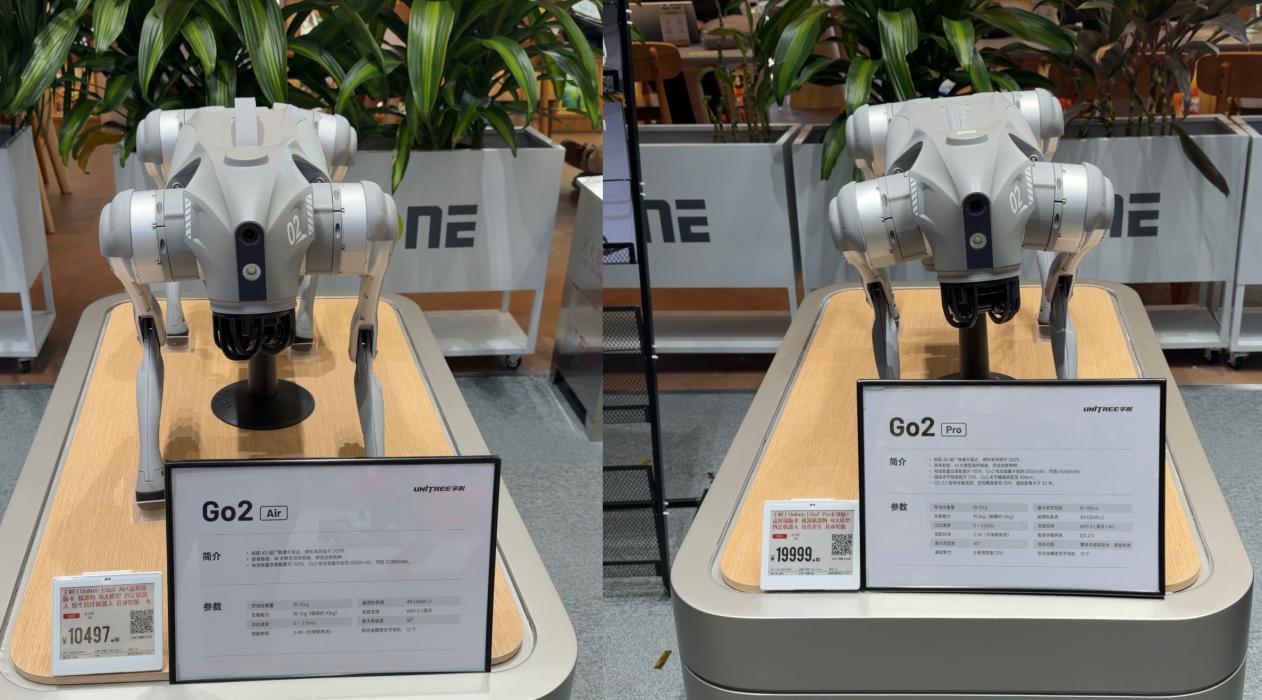
- Concentrates on displaying multiple products such as the Go2 quadruped robot dog and G1 humanoid robot
- Has an immersive interactive experience area where consumers can actually operate and experience under the guidance of engineers
- Supports on-site direct purchase (quadruped robots can be taken away directly, humanoid robots need to be reserved) [2]
Unitree Technology has previously opened an official online flagship store on JD.com, and set a record of sales exceeding 1 million yuan within 1 minute in the “Make Friends” live broadcast room in March 2024 [6].
- Significant increase in brand exposure:As a large commercial complex, JD MALL has a large daily passenger flow, which can effectively reach potential consumers
- Experiential marketing promotes conversion:High-priced robot products require personal experience to promote purchase decisions, and offline stores provide “visible and tangible” experiences
- Continuation of Spring Festival Gala effect:After the “Yang BOT” performance at the 2025 Year of the Snake Spring Festival Gala, the sales demand for humanoid robots soared [6], and offline stores can capture this traffic dividend
- Production capacity bottleneck:The G1 humanoid robot was in a “out of stock” state for most of 2025, with a delivery cycle of 1-3 months [2]
- Price threshold:The minimum price of consumer-grade robots is 39,900 yuan (R1), which is still a high-priced product for ordinary consumers [2]
| Time Node | C-end Sales Proportion | Main Driving Factors |
|---|---|---|
| Current | Approximately 20-25% | Online channel dominance |
| +6 months | Approximately 28-35% | Flagship store opening effect |
| +12 months | Approximately 35-42% | Store network expansion |
| +18 months | Approximately 40-48% | Mature large-scale operation |
- Rich product line:Launched the more cost-effective R1 humanoid robot (starting from 39,900 yuan) in 2025 [2], lowering the consumption threshold
- Production capacity ramp-up:With supply chain optimization, delivery cycles are shortened and spot supply capacity is improved
- Channel synergy:Online and offline form a closed loop, with offline experience → online purchase or offline direct purchase
- Store network scale:If it can cover 10-20 major cities, an effective retail network will be formed
- Product price reduction:With the increase in localization rate and scale effect, the overall machine cost is expected to continue to decrease
- Application scenario expansion:Consumer scenarios such as housework, education, and companionship are implemented
- First phase:Consolidate the Beijing flagship store, optimize the experience process and service standards
- Second phase:Expand to first-tier cities such as Shanghai, Shenzhen, and Hangzhou
- Third phase:Cover new first-tier cities and key second-tier cities
- Launch more affordable products (e.g., 20,000-30,000 yuan price range)
- Develop dedicated applications and accessories for home scenarios
- Provide flexible purchase plans such as installment payments and trade-in
- Establish a localized after-sales service network
- Provide on-site installation and debugging services
- Carry out regular product training and upgrade services
-
Short-term (1-6 months):The opening of the flagship store will increase brand awareness and conversion rate, but due to production capacity and price constraints, the increase in C-end proportion is limited (approximately 5-10 percentage points)
-
Mid-term (6-18 months):If the store network expands smoothly (reaching 10-20 stores), combined with product price reduction and production capacity improvement, the C-end sales proportion is expected to increase to 35-45%
-
Long-term (18-36 months):With a mature store network, complete product matrix, and sound service system, the C-end sales proportion is expected to reach 45-55%, achieving balanced development of B-end and C-end businesses
- Production capacity bottlenecks may continue to restrict short-term sales
- High-priced products have limited appeal to ordinary consumers
- Store operation costs are high, requiring sufficient sales to support profitability
[1] 21 Finance - “Unitree Technology Has Another Big Move” (December 29, 2025)
https://www.21jingji.com/article/20251229/herald/5fc4451d0de13ea00433bfb1090a0cbc.html
[2] Literature City - “Robot Retail in 2026: Like Selling Phones?” (December 31, 2025)
https://www.wenxuecity.com/news/2025/12/31/126469310.html
[3] The Paper - “How Do Humanoid Robots ‘Come Alive’?” (2025)
https://m.thepaper.cn/newsDetail_forward_32274868
[4] Economic Daily - “Unitree and JD.com Jointly Open Robot Store” (December 2024)
https://money.udn.com/money/story/5603/9233406
[5] Futu Information - “Robot Year-end Review ①: Unitree Technology Announces IPO, Sparkling Industry Capital Wave” (2025)
https://news.futunn.com/post/66163323/year-end-review-of-robotics-unitree-technology-announces-ipo-sparking
[6] Juejin - “The Year of ‘Unitrees’: Showing Off on Stage While Going Public for Funding” (2025)
https://juejin.cn/post/7588022226739920946
Insights are generated using AI models and historical data for informational purposes only. They do not constitute investment advice or recommendations. Past performance is not indicative of future results.
About us: Ginlix AI is the AI Investment Copilot powered by real data, bridging advanced AI with professional financial databases to provide verifiable, truth-based answers. Please use the chat box below to ask any financial question.