
Strategic Analysis of Zhipu AI's Return to Foundation Model Research
Unlock More Features
Login to access AI-powered analysis, deep research reports and more advanced features
About us: Ginlix AI is the AI Investment Copilot powered by real data, bridging advanced AI with professional financial databases to provide verifiable, truth-based answers. Please use the chat box below to ask any financial question.
Related Stocks
Based on the collected information, I will prepare a detailed strategic analysis report for Zhipu AI.
On January 8, 2026, Zhipu AI (Stock Code: 02513.HK) was officially listed on the Hong Kong Stock Exchange, becoming the world’s first listed company with foundation large models as its core business [1]. This IPO issued 37.4195 million shares at HK$116.20 per share, raising HK$4.35 billion, with an estimated post-listing market capitalization exceeding HK$51.8 billion [2]. Notably, the company brought in 11 cornerstone investors with subscription amount totaling HK$2.98 billion, accounting for nearly 70% of the issuance scale, including well-known institutions such as Highflyer Asset Management and Taikang Life Insurance [3].
At this critical juncture, Tang Jie, the company’s founding initiator, issued an internal letter, clearly announcing the launch of the next-generation model GLM-5, and focusing its 2026 strategy on three core technical directions:
Zhipu AI chose to announce its return to foundation model research upon listing, a strategic decision with profound industry background and competitive considerations. From a timeline perspective, 2023 was the wild outbreak period of the “Hundred Models War” in China’s large model market, 2024 entered the period of technical route differentiation, and 2025 has already entered the most brutal “capital realization period” [5]. Against this competitive landscape, pure application-layer innovation can no longer build a sustainable competitive advantage, and differentiation in underlying model capabilities has become the key battlefield.
Currently, China’s general-purpose large model market has formed a
| Competitor | Representative Model | Core Advantages | Business Model Characteristics |
|---|---|---|---|
| Alibaba | Tongyi Qianwen | Well-developed open-source ecosystem, cumulative downloads exceeding 600 million | Bundled sales of “model + cloud services” |
| ByteDance | Doubao | Traffic aggregation and distribution capabilities | Low-price strategy, daily call volume exceeding 50 trillion Tokens |
| Baidu | ERNIE Bot | Synergy with search ecosystem | In-depth integration of AI-native applications |
| Tencent | Hunyuan | Connection with social and content ecosystems | Ecosystem synergy to build user stickiness |
| Zhipu AI | GLM | Independent architecture innovation, advantages in Chinese context | MaaS platform + localized deployment |
In May 2025, ByteDance launched the Doubao large model, priced in “li” (0.01 yuan) units, which instantly ignited the market [5]. Zhipu quickly responded by cutting the price of GLM-4.5 Lite to US$0.11 per million tokens. This price war has exerted enormous pressure on independent vendors: giants can sell models at a loss and profit from cloud services; while for startups, selling models at a loss is equivalent to “blood loss” [5].
The prospectus shows that Zhipu’s cloud business’s main customers include 9 of China’s top 10 internet companies, but these customers access multiple model services simultaneously with low loyalty, further exacerbating the difficulty of profitability [3]. This structural dilemma makes pure price competition unsustainable, and a differentiated technical route has become an inevitable choice.
Zhipu AI’s technical route has distinct independent innovation characteristics. Unlike the global trend of following OpenAI’s GPT architecture, Zhipu’s team chose to develop its own
The core innovation of the GLM architecture lies in its
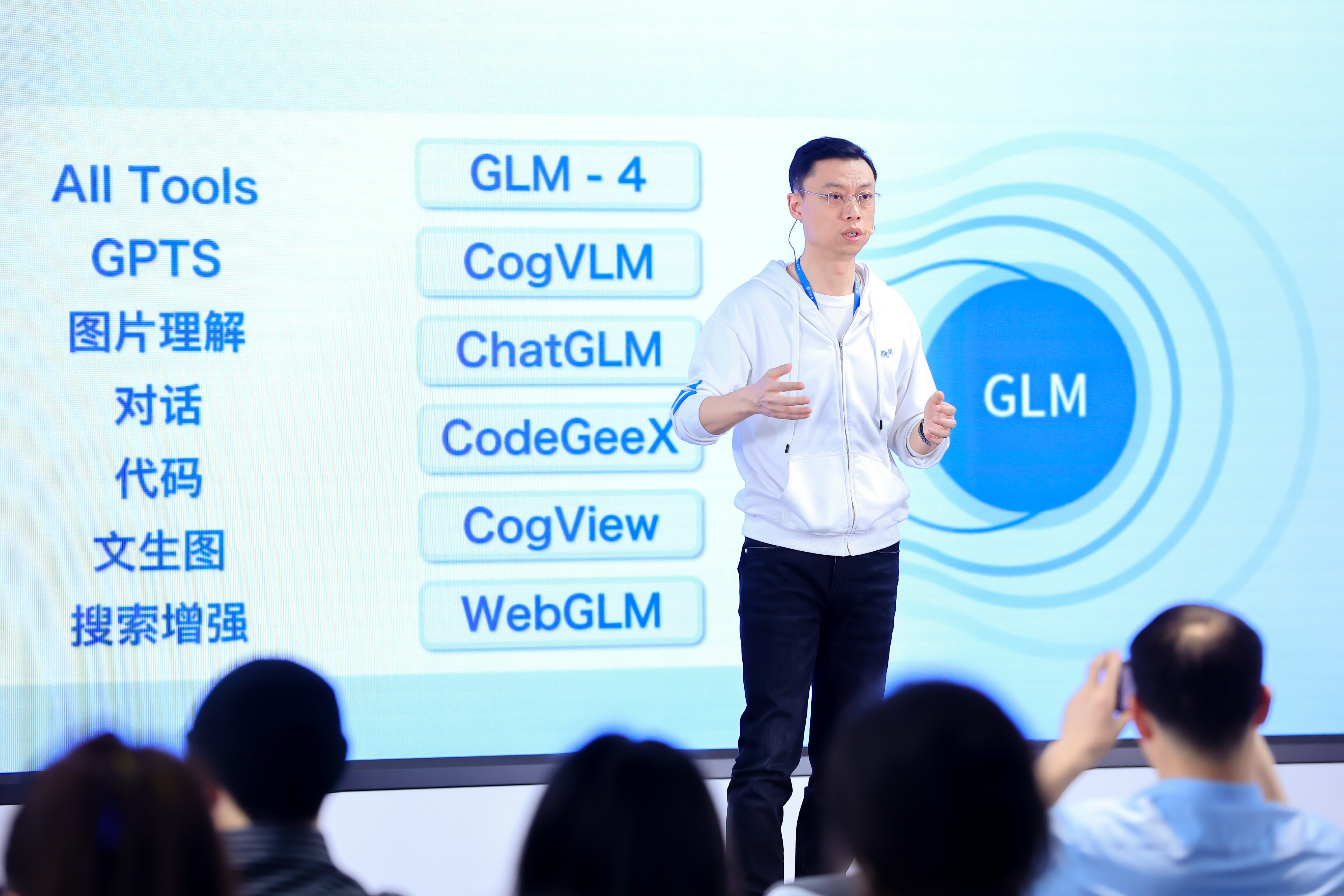
From the perspective of technological evolution, Zhipu has achieved continuous iteration from GLM-130B (the open-source 100-billion-parameter model launched in 2022) to GLM-4 (released in 2024) and the upcoming GLM-5, with overall performance gradually approaching that of GPT-4 [2]. In the Code Arena programming evaluation, Zhipu’s GLM series models have tied for first place globally with OpenAI and Anthropic [3].
Zhipu AI has a distinct “Tsinghua School” identity, with its founding team including CEO Zhang Peng and Professor Tang Jie from the Department of Computer Science at Tsinghua University [4]. The company’s prospectus discloses that Professor Zhang Bo, a 90-year-old Tsinghua University professor and academician of the Chinese Academy of Sciences, has succeeded Tang Jie as Zhipu’s Chief Scientist [4]. This pure “Tsinghua heritage” and profound academic background laid the foundation for its early development, forming a unique corporate ethos:
Zhipu’s business model features “dual-drive”: on one hand, it operates a
More importantly, Zhipu’s “independent third-party” positioning becomes a competitive advantage in specific scenarios. Since Zhipu does not belong to any internet giant, it has strong neutrality, so customers have no concerns about “taking sides” when choosing it, and it is more like an underlying infrastructure provider for the entire industry [1].
The financial pressure faced by Zhipu AI cannot be ignored. According to prospectus data, the company’s gross profit margin has declined from 76.1% in 2022, even turning negative [3]. As of June 30, 2025, Zhipu’s book cash was only RMB 2.55 billion, while its net loss in the first half of the year reached RMB 1.75 billion; based on this calculation, it can only maintain operations for about 9 months [3].
| Financial Indicator | 2022 | 2023 | 2024 | H1 2025 |
|---|---|---|---|---|
| Revenue (RMB 100 million) | 0.57 | 1.25 | 3.12 | 1.91 |
| Revenue Growth Rate | - | 119% | 150% | 325% |
| Gross Profit Margin | 76.1% | Declined | Declined | Negative |
This “high growth, continuous loss” model is not uncommon among startups, but for large model enterprises that require continuous high-intensity R&D investment, cash flow management is crucial. IPO financing has become a “life-or-death line” for it to continue R&D investment [3].
Since 2025, Zhipu has experienced relatively frequent personnel adjustments. Zhang Kuo, Chief Strategy Officer, and Qu Teng, Vice President, left successively in January 2025; Peng Jianbiao, CFO, resigned in May 2025; and Zhang Fan, COO, also left in July of the same year [6]. In the short term, the loss of core talents can easily trigger team instability, and technological R&D and commercialization processes may experience periodic stagnation.
In the underlying model market, Zhipu faces fierce competition from internet giants. Giants such as Alibaba and Tencent use the “model + cloud services” bundled sales strategy, which turns Zhipu’s independent third-party label into a disadvantage in the price war [3]. Giants can withstand long-term losses, while startups must find a breakthrough path within limited resources.
Zhipu AI’s choice of “returning to the improvement of foundation model capabilities” as its core strategy for 2026 has the following strategic values:
By focusing on three major directions: new model architecture design, more universal RL reinforcement learning paradigm, and model continuous learning and autonomous evolution exploration, Zhipu is expected to form differentiated competitiveness at the underlying technical level. Breakthroughs in foundation model capabilities will provide solid support for upper-layer applications, forming a positive cycle of “technology - products - ecosystem”.
When price wars become the industry norm, technological differentiation is the key to breaking through. By improving the intelligence density and inference efficiency per token of the model, it can provide more competitive prices without sacrificing gross profit margin.
Zhipu’s strategic positioning is not only a commercial company, but also an explorer of AGI (Artificial General Intelligence). The exploration of model continuous learning and autonomous evolution represents long-term technological reserves for advancing towards AGI.
According to a report by Frost & Sullivan, based on 2024 revenue, the size of China’s large language model market is approximately RMB 5.3 billion, of which institutional customers contribute RMB 4.7 billion. The market is expected to grow to RMB 101.1 billion by 2030, with a compound annual growth rate of 63.5% [1]. The enterprise-level large model market is expected to reach RMB 90.4 billion, which means the ToB market is still the main battlefield.
Against this backdrop, Zhipu’s “technology + products + talents” strategic framework is forward-looking: at the technical level, it continues to invest in the iteration of the GLM series; at the product level, it enriches the MaaS platform and standardizes industry solutions; at the talent level, it maintains the stability of the core R&D team.
Based on the above analysis, the following recommendations are put forward for Zhipu AI’s strategic adjustment:
Zhipu AI’s strategic adjustment to return to foundation model research is an inevitable choice to seek differentiated breakthroughs in the fierce large model competition. Facing price squeeze from internet giants and profitability pressure from the capital market, the company needs to build irreplicable competitive advantages at the technical level.
From a long-term perspective, Zhipu’s original GLM architecture, Tsinghua academic background, and independent third-party positioning constitute unique competitive endowments. If substantial breakthroughs can be achieved in the three technical directions focused on in 2026—new model architecture design, more universal RL reinforcement learning paradigm, and model continuous learning and autonomous evolution exploration—it will be expected to seize the initiative in AGI competition and convert it into sustainable commercial value.
However, the implementation of the strategy faces multiple challenges: financial pressure needs to be alleviated through IPO financing; talent stability needs to be guaranteed through incentive mechanisms; the business model needs to be optimized from “heavy delivery” to “light service”. Only by making coordinated efforts in three dimensions—technology, business, and organization—can Zhipu AI stand out in this “life-or-death” competition and truly establish a differentiated competitive barrier.
[1] Sina Finance - Zhipu AI Officially Lists Today: 6 Key Things You Need to Know (https://finance.sina.com.cn/cj/2026-01-08/doc-inhfpwvc1548570.shtml)
[2] Securities Times - “World’s First Large Model Stock” Lists on Hong Kong Stock Exchange (https://www.stcn.com/article/detail/3578099.html)
[3] RCCaijing - Gross Profit Margin Plummeted from 76.1% to Negative in 3.5 Years: Zhipu’s “Life-or-Death Race” to List in Hong Kong (https://m.rccaijing.com/news-7414275934394185518.html)
[4] CYZone - Zhipu and MiniMax List “Back-to-Back”: Global Large Model Companies Have Entered Different Game Tables (https://view.inews.qq.com/a/20260101A0582G00)
[5] 36Kr - Frenzy: Who Will Be the First Large Model Stock? (https://m.36kr.com/p/3596965010292992)
[6] 21st Century Business Herald - A Look at the 2025 of the Six Large Model “Little Tigers”: Personnel Turmoil, Financing Race, Shuffle and Differentiation (https://www.21jingji.com/article/20260107/herald/60ab618efcf373c981aeef2e544f1ab6.html)
Insights are generated using AI models and historical data for informational purposes only. They do not constitute investment advice or recommendations. Past performance is not indicative of future results.
About us: Ginlix AI is the AI Investment Copilot powered by real data, bridging advanced AI with professional financial databases to provide verifiable, truth-based answers. Please use the chat box below to ask any financial question.