
Investment Value Analysis of Overseas Market Expansion for China's Embodied Intelligent Robot Manufacturers
Unlock More Features
Login to access AI-powered analysis, deep research reports and more advanced features
About us: Ginlix AI is the AI Investment Copilot powered by real data, bridging advanced AI with professional financial databases to provide verifiable, truth-based answers. Please use the chat box below to ask any financial question.
According to the report Analysis and Typical Application Practices of China’s Embodied Intelligent Robot Application Market, 2025 released by International Data Corporation (IDC), driven by three forces: policy support, active capital, and accelerated industrial chain collaboration, China is rapidly forming a complete embodied intelligent robot industrial chain [1]. IDC forecasts that China’s user expenditure on embodied intelligent robots will exceed $1.4 billion in 2025, and will surge to $77 billion by 2030, with a staggering compound annual growth rate (CAGR) of 94% [2]. This growth rate far outpaces that of traditional manufacturing and most emerging industries, highlighting the huge growth potential of the embodied intelligent robot industry.
From a global perspective, Morgan Stanley maintained its strong long-term market outlook for the industry in its December 2025 special report Humanoid Horizons: What to Watch for 2026. The report predicts that the annual revenue of the global humanoid robot market could reach $7.5 trillion by 2050; assuming a replacement cycle of 6 years and average selling prices declining as the supply chain matures, it is estimated that approximately 24.4 million humanoid robots will be adopted globally by 2036, and this number will reach 1 billion by 2050 [3]. Since the launch of the Humanoid 100 Index in February 2025, it has risen by 25%, outperforming the S&P 500 Index as well as the MSCI Europe and MSCI China Indexes, indicating high recognition from the capital market for this track [3].
The 2026 International Consumer Electronics Show (CES 2026) was held in Las Vegas, USA, from January 6 to 9. Approximately 20 Chinese robot companies made a collective appearance, with the number of participating companies exceeding the total of the United States, Japan, South Korea, Germany, and the United Kingdom [4]. This large-scale appearance marks an important transformation of China’s embodied intelligent robot industry from a “technology follower” to a “global competitor”.
The participating Chinese companies include representative players across all segments of the industrial chain:
| Company Name | Core Product/Technology | Application Scenario |
|---|---|---|
| Unitree Robotics | G1 Mass-Produced Humanoid Robot | Industrial Manufacturing, Commercial Services |
| UBTECH | Walker S2 Industrial Humanoid Robot | Automobile Manufacturing, 3C Electronics |
| Galaxy General Robotics | General Humanoid Robot Platform | Multi-Scenario Applications |
| ORBBEC | 3D Camera Perception System | Robot Visual Navigation |
| Zhao Wei Machinery & Electronics | Dexterous Hand and Joint Modules | Precision Operations |
| Fourier Intelligence | GR-3 Full-Size Humanoid Robot | Commercial Services |
| DeepRobotics | Jueying Series Quadruped/Wheeled-Legged Robots | Patrol, Field Operations |
Notably, CES 2026 is regarded as the “year of advancement” for the practical execution capabilities of humanoid robots. Huatai Securities pointed out in its research report that Chinese manufacturers are expected to showcase mass-produced versions of products such as G1 and X2, as well as core components like dexterous hands at the show, and demonstrate practical operational capabilities in unstructured scenarios such as factory assembly lines. This marks the transition of robots from the laboratory prototype stage to the practical verification stage in the logistics and manufacturing sectors [4].
The most prominent competitive advantage of China’s embodied intelligent robot manufacturers lies in their supply chain cost advantage. According to calculations in Morgan Stanley’s October 2025 special report Global Humanoid Robot Supply Chain Cost Analysis, the current bill of materials (BOM) cost of humanoid robots using Chinese supply chains is approximately $46,000, while the cost using non-Chinese supply chains is as high as $131,000, a nearly threefold gap [5].
This cost advantage stems from multiple aspects:
-
Large-Scale Manufacturing Capability: China has the most complete robot industrial chain in the world, with large-scale production capabilities covering everything from servo motors and reducers to sensors and chips. Taking Agibot (Zhiyuan Robotics) as an example, its 5,000th universal embodied intelligent robot Lingxi X2 has officially rolled off the production line; UBTECH’s Walker S2 started mass production and delivery in November 2025, with a planned annual production capacity of 5,000 units in 2026 [6].
-
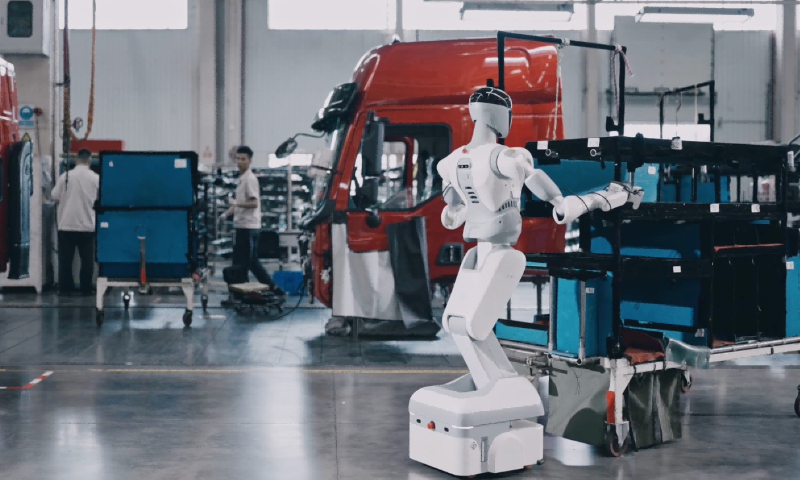
Supply Chain Synergy Effect: China’s robot industry has formed a three-pole collaborative pattern where “Beijing is responsible for the ‘brain’ (software/AI), Shanghai for the ‘body’ (hardware manufacturing), and Zhejiang for application scenarios”. The “Embodied Tiangong 2.0” developed by the Beijing Humanoid Robot Innovation Center has been deployed at the Foton Cummins Engine Factory; the “Meiluo” humanoid-like robot developed by Midea Group has been “on duty” at the Jingzhou Washing Machine Factory for over half a year [5].
-
Continuous Cost Optimization: In 2025, through software-hardware decoupling and supply chain restructuring, the BOM cost of domestic robots was reduced by approximately 40%, while the task execution success rate increased from 75% to 99.9% [5]. This two-way optimization of “cost reduction + performance improvement” gives Chinese products an overwhelming advantage in cost performance.
There are significant differences in the development paths of the robot industries in China and the United States: China focuses more on commercialization and practical applications, while the United States emphasizes top-level technology R&D and concept verification. This difference gives Chinese manufacturers unique advantages in overseas market expansion:
-
Order Scale Verification: According to incomplete statistics from public data, in 2025, UBTECH accumulated nearly RMB 1.4 billion in orders for industrial humanoid robots; Unitree Robotics accumulated nearly RMB 1.2 billion; Dobot Robotics (Yuejiang Robotics) approximately RMB 1.1 billion; and Agibot over RMB 1 billion [6]. Several leading companies such as Star Dynamics (Xingdong Jiyuan), Leju Robotics, and Zhipingfang have annual cumulative orders exceeding or close to RMB 500 million.
-
Accelerated Scenario Penetration: Humanoid robots have achieved large-scale application verification in fields such as automobile manufacturing, 3C electronics, and material handling. Founder Securities analyzed that assuming the penetration rate of humanoid robots in the automobile manufacturing, 3C manufacturing, and material handling sectors reaches 20%, 0.8%, and 20% respectively by 2028, and a single robot can replace 1.5 workers, the total demand for humanoid robots in these three sectors is expected to reach 840,000 units [4].
-
Increasing Proportion of Overseas Orders: The overseas orders of many Chinese robot companies account for a significant proportion of their total orders. Accel Robotics (Jiasu Jinhua) stated that its overseas market share has exceeded 40% [7]; Magic Atom (Mofa Yuanzi) revealed that its overseas orders account for more than 60% of total orders, with strong demand from the European, North American, and Southeast Asian markets [7].
The secondary market’s attention to the embodied intelligent robot track continues to rise. The Wind Humanoid Robot Concept Index has risen by 12.92% cumulatively since December 17, 2025 [4]. Leading enterprises have launched IPO processes one after another: domestic leaders such as Unitree Robotics and Leju Robotics are preparing for listing, and high-quality assets are gradually entering the investment horizon [4].
At the same time, investment opportunities across the industrial chain have also received widespread attention. Morgan Stanley’s report pointed out that as global robot companies move from the laboratory to the real world, the differentiation between winners and laggards will become increasingly obvious, and capital and talents will concentrate on enterprises that demonstrate the strongest internal AI capabilities and manufacturing expertise [3]. Rare earth materials, sensors, and industrial automation enterprises are listed as key areas of focus [3].
The primary challenge of going overseas is the construction of after-sales systems under the DTC (Direct-to-Consumer) model. Compared with the domestic market, building a service network in overseas markets is more difficult:
-
Service Network Layout: Overseas markets require the establishment of localized after-sales service centers, spare parts inventories, and technical support teams. Taking X-Motors as an example, it quickly expanded into the Indonesian market by leveraging Bosch’s intelligent mobility after-sales system, emphasizing the systematic migration of domestically verified organizational and supply chain capabilities, and combining localized insights to build a complete operating system from online customer acquisition, supply chain support to offline service network [8].
-
Supply Chain Localization: Transportation costs account for 1/4 of exhibition participation costs, and booth fees are 4-5 times those of the World Robot Conference (WRC) [9]. This reflects the logistics cost pressure of overseas operations. In the long run, it is necessary to establish regional warehousing and assembly capabilities in key target markets.
-
Compliance Certification System: From the CE certification in Europe, FDA and OSHA standards in the United States, to METI certification in Japan and KCs certification in South Korea, each compliance certificate is backed by strict technical tests, complex document preparation, and lengthy approval processes [10]. Many Chinese enterprises underestimated the importance and complexity of compliance work in the early stages of going overseas, resulting in significant delays in product launch, and even huge fines due to compliance issues.
In overseas markets, Chinese logistics robot brands generally face the practical dilemma of low recognition and lack of trust endorsement. Although “Made in China” has established an image of cost and quality advantages globally, there is still a clear gap in brand recognition in the high-end automation equipment sector, especially for logistics robot systems that require deep integration [10].
-
Brand Building Investment: Participation fees for international exhibitions such as CES are high, but they are crucial for brand exposure. Enterprises need to continuously invest in international exhibitions, industry media, benchmark cases, etc., to gradually build brand recognition.
-
Obtaining Trust Endorsements: Overseas customers are more concerned about whether enterprises can truly understand their business scenarios and core pain points. The questions customers first raise are often business-level concerns: Can you help reduce labor costs? Can the investment be recovered within the expected time? Can the system be seamlessly integrated into the existing IT architecture? [10]
-
Profit Pressure: Even UBTECH, which is listed on the Hong Kong Stock Exchange, reported a loss of over RMB 400 million in the first half of 2025 [6]. Many leading embodied intelligent enterprises sprinting for IPOs are prepared for “bleeding listings”. The “starting gun” of the mass production year is both a starting signal and the prelude to an elimination round, which tests enterprises’ delivery capabilities and self-sustaining capabilities even more.
-
Technology Iteration Risk: Embodied intelligence technology is still in a period of rapid iteration, and there is uncertainty in technical routes. There is still a significant gap between “dancing robots” and “practical robots” [3].
-
Industry “Bubble” Risk: Morgan Stanley’s report warns of the risk of an industry “bubble” [3]. Investors need to pay attention to the possibility of valuation bubbles.
Based on the above analysis, the impact of overseas market expansion by China’s embodied intelligent robot manufacturers on investment value can be evaluated from the following dimensions:
| Investment Dimension | Positive Factors | Risk Factors | Investment Recommendation |
|---|---|---|---|
Whole Machine Manufacturing |
Significant cost advantage, growing overseas orders, improved mass production capability | Weak profitability, intensifying competition | Focus on leading enterprises, prioritize those with scale effects |
Core Components |
Independent and controllable supply chain, accelerated domestic substitution | Relatively low technical barriers, price war pressure | Focus on enterprises with differentiated technologies |
Software and AI |
Industrial chain value shifting to software, China and the US are on the same starting line | Rapid technology iteration, fierce talent competition | Focus on enterprises with AI algorithm capabilities |
System Integration |
Strong scenario implementation capability, high customer stickiness | Long project cycle, payment recovery risk | Focus on enterprises with benchmark cases |
-
Dexterous Hands and Precision Transmission: Zhao Wei Machinery & Electronics will showcase products such as the B20 dexterous hand with 20 degrees of freedom and the A17 with 17 active degrees of freedom [11]. Dexterous hands are key components for humanoid robots to perform precise operations, with high technical barriers and added value.
-
3D Vision and Perception Systems: ORBBEC has launched a number of new 3D camera products, focusing on typical application scenarios such as humanoid robots and outdoor autonomous mobile robots [11]. Visual perception is a fundamental capability for robots to interact with the environment.
-
AI Algorithms and System Integration: As the application scenarios of humanoid robots expand, the value of the industrial chain will shift to the software and AI segments. Chinese enterprises are expected to achieve breakthroughs in AI algorithms and system integration [3].
-
Industrial and Logistics Applications: Humanoid robots have broad development prospects in the manufacturing and logistics sectors, and are expected to take the lead in achieving large-scale applications in manufacturing sectors such as automobiles and 3C electronics [4].
-
Short-Term (2026): Focus on the order expectations and brand exposure effects brought by the CES exhibition, and prioritize enterprises that already have mass production capabilities and a high proportion of overseas orders.
-
Mid-Term (2027-2028): Focus on technological iteration progress, and prioritize layout in enterprises with technical advantages in the “brain” segment of embodied intelligence.
-
Long-Term (2030 and Beyond): Focus on industry integration trends, and anticipate platform-type enterprises with full-stack capabilities (hardware + software + services).
-
Risk Hedging: It is recommended that investors pay attention to upstream segments such as rare earth materials and sensors to hedge against the operational volatility risks of whole machine enterprises.
The overseas market expansion of China’s embodied intelligent robot manufacturers has a dual impact on investment value:
[1] IDC Report Analysis and Typical Application Practices of China’s Embodied Intelligent Robot Application Market, 2025 (Doc# CHC53183625), November 2025
[2] Sina Finance - “China’s Embodied Intelligent Robot Market Size to Reach $77 Billion by 2030”, December 9, 2025
[3] Morgan Stanley Report Humanoid Horizons: What to Watch for 2026, December 2025
[4] China Securities Journal - “Multiple Domestic and Overseas Manufacturers Showcase at CES 2026, Investment Opportunities in Humanoid Robot Segment Highlighted”, January 7, 2026
[5] 36Kr - “Beijing vs. Shanghai: The Robot Price War Drives Costs Down to RMB 3,000”, December 30, 2025
[6] 36Kr - “2026: Embodied Robots Compete for “Working Hours””, 2026
[7] National Business Daily - “Direct Coverage of CES 2026 | Robots Are the “Trendiest” Item! Overseas Orders Account for About Half of Total Orders for Multiple Chinese Robot Companies”, January 7, 2026
[8] Boyuan Capital 2025 Industry Conference - “Empowering “Made in China” to Go Global with Ecological Strength”, December 9, 2025
[9] Background information provided by the user
[10] NetEase - “Evolution and Implementation Path of China’s Logistics Robot Globalization Strategy”, 2025
[11] Electronic Engineering Times - “CES 2026 | Which Chinese Robot Companies Are Participating This Year?”, January 2026
Insights are generated using AI models and historical data for informational purposes only. They do not constitute investment advice or recommendations. Past performance is not indicative of future results.
About us: Ginlix AI is the AI Investment Copilot powered by real data, bridging advanced AI with professional financial databases to provide verifiable, truth-based answers. Please use the chat box below to ask any financial question.