
Analysis of Hanwha Group's U.S. Shipbuilding Strategic Layout and Global Competitive Landscape
Unlock More Features
Login to access AI-powered analysis, deep research reports and more advanced features
About us: Ginlix AI is the AI Investment Copilot powered by real data, bridging advanced AI with professional financial databases to provide verifiable, truth-based answers. Please use the chat box below to ask any financial question.
Related Stocks
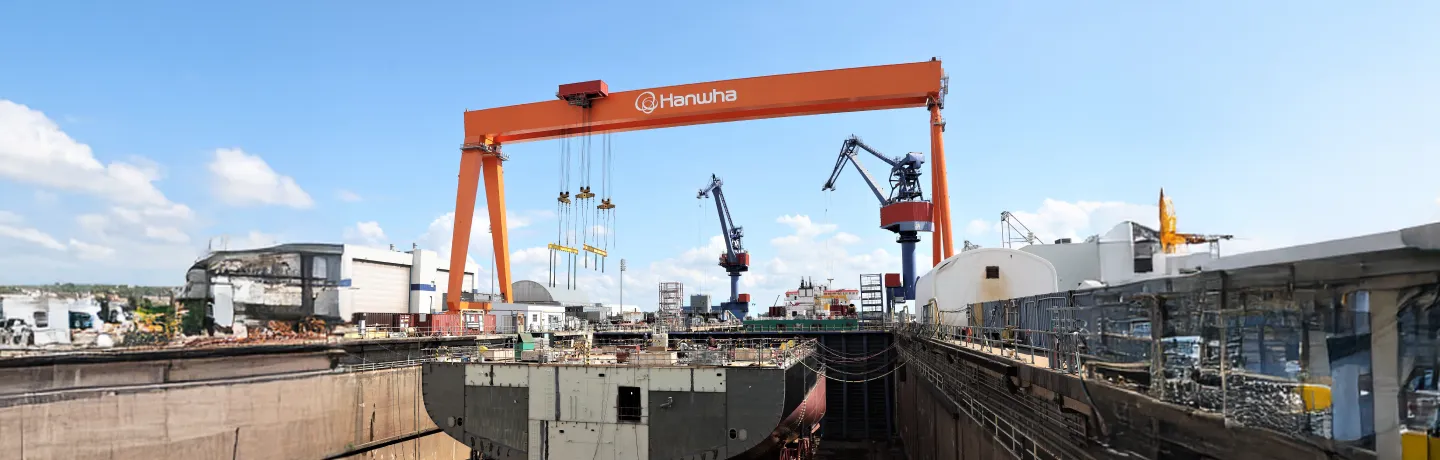
Based on the latest market data and strategic dynamics analysis, I will systematically elaborate on Hanwha Group’s strategic layout for expanding U.S. shipbuilding capacity and its implications.
Hanwha Ocean announced a strategic investment in the U.S. Philly Shipyard in 2024, with an initial investment of over
According to the latest plan, the annual shipbuilding capacity of Philly Shipyard will be significantly expanded from the current 1-1.5 ships to
Hanwha Group’s layout in the U.S. market is characterized by diversification:
| Cooperation Field | Partner | Project Content | Strategic Significance |
|---|---|---|---|
| MRO Services | Vigor Marine Group (August 2025) | Vessel Maintenance, Repair, and Operations | Gain access to the U.S. Navy’s logistics support system |
| Design and Supply | NASSCO Shipyard (December 2025) | Vessel design and component supply | Integrate upstream industrial chain resources |
| Maintenance Contract | U.S. Navy Military Sealift Command | Mid-term maintenance of USNS Amelia Earhart | First Korean mid-sized shipyard to enter the U.S. Navy’s MRO market |
| Tanker Project | U.S. Navy Fleet | USNS Wally Schirra, USNS Yukon | Gain experience in military vessel construction |
Hanwha Ocean (Stock Code: 042660.KS) achieved remarkable valuation growth between 2024 and 2025:
- Stock Price Performance: Surged from 45,000 Korean won in early 2024 to 141,000 Korean won in October 2025, representing an increase of over200%[3]
- Market Capitalization: Grew from approximately $8.5 billion to$26.6 billion, a more than three-fold increase [3]
- Enterprise Value (EV): Rose from $2.96 billion in 2022 to $27.59 billion in 2025, an over nine-fold increase [3]

Based on the latest data as of September 2025 [3]:
| Financial Indicator | TTM (September 2025) | 2024 Fiscal Year | 2023 Fiscal Year | Year-over-Year Change |
|---|---|---|---|---|
| Revenue | $9.02 billion | $7.89 billion | $5.67 billion | +59% |
| EBITDA | $870 million | $340 million | $50 million | +1500% |
| Net Profit | $860 million | $390 million | $120 million | +600% |
| Total Assets | $13.23 billion | $12.11 billion | $10.82 billion | +22% |
| Total Orders | $9.8 billion | - | - | Exceeded target |
The global shipbuilding industry is undergoing profound structural reshaping. According to data from Clarkson Research [5][6]:

| Year | China | South Korea | Japan | Others |
|---|---|---|---|---|
| 2020 | 43% | 27% | 15% | 15% |
| 2022 | 52% | 24% | 12% | 12% |
| 2024 | 60% | 22% | 10% | 8% |
| 2025 | 63% | 21% | 8% | 8% |
According to the latest data [5][6]:
- China: 74.49% (secured 71 vessels, totaling 2.13 million CGT)
- South Korea: 15.22% (secured 11 vessels, totaling 440,000 CGT)
- Japan: 4.00% (secured 6 vessels, totaling 110,000 CGT)
- China: 60.38% (3,993 vessels, 99.5 million CGT)
- South Korea: 20.92% (672 vessels, 34.48 million CGT)
- Japan: 8.10% (746 vessels, 1.33 million CGT)
South Korea’s shipbuilding industry faces the following major pressures:
- Declining Order Share: Dropped from 27% in 2020 to 21% in 2025, a nearly 6 percentage point loss
- Intensified Competition from China: Lags far behind in bulk carriers (China’s share exceeds 80%) and container ships (China’s share 68%)
- Laggard Capacity Expansion: South Korea has been relatively conservative among the 191 global capacity expansion projects from 2021 to 2025
- Policy Pressure: U.S. Section 301 investigation and tariff policies have impacted order flows
In August 2025, during South Korean President Lee Jae Myung’s visit to the U.S., he reached a
- Investment Scale: South Korea committed to investing$150 billionin the future to support the reconstruction of the U.S. shipbuilding industry
- Tariff Exchange: South Korea secured a 15% tariff on exports to the U.S. (lower than the initially threatened 25%)
- Core Content: Technology transfer, joint shipbuilding ventures, and military vessel maintenance, repair, and operations (MRO) cooperation
The U.S. government is promoting the revival of its shipbuilding industry through multi-level policies:
| Policy/Act | Time | Objective |
|---|---|---|
| Ship and Port Infrastructure Prosperity and Security Act (SHIPS Act) | Reintroduced in April 2025 | Inject federal funding and incentives into shipyards and ports |
| U.S. Maritime Sustainability Restoration Framework | March 2025 | Revitalize commercial and military shipbuilding |
| Jones Act Amendment Discussions | Ongoing | Allow partial foreign investment in domestic vessel operations |
The MASGA initiative faces multiple obstacles [7]:
- Legal Restrictions: The Burns-Tollefsen Amendment prohibits the construction of U.S. Navy vessels in foreign shipyards
- Jones Act Restrictions: Prohibit the use of non-domestically built vessels for cargo transportation between U.S. ports
- Skilled Labor Shortage: The U.S. domestic shipbuilding workforce lacks sufficient skills, requiring large-scale training
- Policy Uncertainty: Policy fluctuations under the Trump administration may affect long-term investment returns
- Market Diversification: Reduce dependence on the Chinese market and mitigate geopolitical risks
- Endorsement of Technology: Gain endorsement from U.S. Navy orders and enhance global brand influence
- Valuation Re-rating: Access to the U.S. market brings a valuation premium, with the stock price rising 200% in 2025
- Industrial Chain Integration: Full-chain layout from design to MRO creates synergistic effects
- Investment Return Cycle: The $5 billion investment will take 5-10 years to generate stable returns
- Policy Dependence: Highly reliant on U.S. government policy support, posing policy risks
- Profit Margin Pressure: Profit margins for military vessel construction are typically lower than those for civilian merchant ships
Hanwha Group’s U.S. layout is reshaping the competitive strategy of South Korea’s shipbuilding industry:
- Differentiated Competition: Avoid direct competition with China in the merchant ship sector and shift to high-value-added military vessels
- Technology Export: Expand international influence through technology transfer and joint venture models
- Supply Chain Restructuring: Transfer some low-value-added segments to the U.S. while retaining high-value-added segments domestically
| Impact Dimension | Short-term (1-2 Years) | Mid-to-Long-term (3-5 Years) |
|---|---|---|
| Market Share | South Korea maintains a 20-22% share | May rebound to 25% |
| Competition Focus | Competition for merchant ship orders | Competition in military vessels and technical services |
| Industrial Chain | East Asia-dominated landscape continues | Accelerated integration of U.S.-South Korea industrial chains |
| Policy Variables | U.S. tariffs affect demand | Trade policy risks are gradually digested |
According to PitchBook and public market data [3][4]:
| Valuation Indicator | Value | Industry Comparison |
|---|---|---|
| Price-to-Earnings (P/E) | Approximately 42x | Average of South Korean manufacturing industry is approximately 15x |
| EV/EBITDA | Approximately 31.7x | Average of the shipbuilding industry is approximately 10x |
| Price-to-Book (P/B) | Approximately 2.8x | Average of the South Korean stock market is approximately 1.2x |
| Dividend Yield | Approximately 0.8% | Lower than the market average |
- Growth expectations brought by U.S. market expansion
- High-profit margin premium from military vessel orders
- Geopolitical dividend from increasing global defense spending
- “National Team” effect supported by the South Korean government
- Uncertainty in order conversion (whether the $9.8 billion in orders can be converted into revenue)
- Potential investment losses caused by changes in U.S. policies
- Cyclical downward risk in the global shipbuilding industry
- Price competition pressure from China’s shipbuilding industry
| Dimension | Assessment | Explanation |
|---|---|---|
| Growth | High |
U.S. expansion brings significant incremental market |
| Profitability | Medium-High |
Profit margins for military vessels are higher than those for merchant ships |
| Valuation Rationality | Neutral to Overvalued |
Current price already reflects most optimistic expectations |
| Risk Level | Medium-High |
High degree of policy dependence |
| Investment Rating | Hold |
It is recommended to wait for order fulfillment signals before increasing positions |
-
Hanwha Group’s U.S. shipbuilding layout is a strategic market expansion: Through the acquisition and expansion of Philly Shipyard and diversified cooperation models, it has successfully entered the U.S., the world’s largest military vessel market.
-
Valuation growth reflects market recognition of strategic transformation: The 200% stock price increase in 2025 indicates investors’ optimistic expectations for Hanwha’s transformation from traditional merchant ships to high-value-added military vessels.
-
The global shipbuilding competitive landscape is being reshaped: China’s market share has risen from 43% to 63%, and South Korea faces continued pressure of declining order shares; exploring the U.S. market is a key strategy for South Korea’s shipbuilding industry to cope with competition from China.
-
The MASGA initiative faces policy uncertainty: Although South Korea has committed to a $150 billion investment, U.S. protectionist laws (Jones Act, Burns-Tollefsen Amendment) may limit the depth of actual cooperation.
[1] Eworldship - “South Korean Shipyards Accelerate U.S. Shipbuilding Market Layout; Hanwha to Collaborate with U.S. Navy on New Frigate Construction” (December 25, 2025) https://www.eworldship.com/html/2025/ShipbuildingAbroad_1225/217421.html
[2] Taiwan Institute of National Defense and Security Research - “Analysis of Recent South Korean Investments in the U.S. Shipbuilding Industry” (September 12, 2025) https://indsr.org.tw/respublicationcon?uid=12&resid=3024&pid=5613
[3] PitchBook - “Hanwha Ocean 2026 Company Profile: Stock Performance & Earnings” https://pitchbook.com/profiles/company/124352-38
[4] Investing.com - “Hanwha Ocean Co Ltd Stock Price Today” https://www.investing.com/equities/daewoo-shipbuilding
[5] China Ship Trading Network - “97 Vessels! Orders Plunge! Latest Monthly Report on the Global Shipbuilding Industry Released” (August 25, 2025) https://www.cn-eship.com/news/newsinfo.jsp?id=225396
[6] iMarine - “Clarkson Research | Annual Summary: Newbuilding Market – A Year of Stress Testing” (January 4, 2026) https://www.imarine.cn/212626.html
[7] BISI - “Make American Shipbuilding Great Again: The US-South Korea Deal” (September 12, 2025) https://bisi.org.uk/reports/make-american-shipbuilding-great-again-the-us-south-korea-deal
[8] RAND - “Collaborating Toward a Shipbuilding Renaissance” (October 2025) https://www.rand.org/pubs/commentary/2025/10/collaborating-toward-a-shipbuilding-renaissance.html
Insights are generated using AI models and historical data for informational purposes only. They do not constitute investment advice or recommendations. Past performance is not indicative of future results.
About us: Ginlix AI is the AI Investment Copilot powered by real data, bridging advanced AI with professional financial databases to provide verifiable, truth-based answers. Please use the chat box below to ask any financial question.