
Profit Analysis of 37 Interactive Entertainment's Investment in Zhipu AI: Research on AI's Restructuring of Game Development Cost Structure
Unlock More Features
Login to access AI-powered analysis, deep research reports and more advanced features
About us: Ginlix AI is the AI Investment Copilot powered by real data, bridging advanced AI with professional financial databases to provide verifiable, truth-based answers. Please use the chat box below to ask any financial question.
Based on the searched information, I have prepared a detailed professional analysis report for you.
As a leading enterprise in China’s game industry, 37 Interactive Entertainment’s strategic investment in Zhipu AI reflects its forward-looking layout for future technological changes [1]. In 2023, when ChatGPT attracted global attention, 37 Interactive Entertainment acutely captured the potential disruptive impact of large model technology on the game industry. The management of the company deeply recognizes that the game industry has long faced the pain point of “high cost, low efficiency” — taking 3A games as an example, the development cost of Cyberpunk 2077 reached 173 million USD, with overall R&D and marketing expenses of approximately 316 million USD, and the development cycle lasted 8-10 years [2]. This traditional development model, which is labor-intensive, lengthy, and high-cost, is in urgent need of technological breakthroughs.
37 Interactive Entertainment’s investment in Zhipu AI is not a simple financial game, but a strategic choice based on business synergy [1]. As one of the “Four Little Dragons” of domestic large models with a Tsinghua University background, Zhipu AI’s GLM large model can effectively optimize industrial production processes such as copywriting, original art, and video, reducing the cost of single materials by more than 60% and shortening the production cycle from weekly to hourly. This technical capability highly matches 37 Interactive Entertainment’s actual needs in game R&D, operation, distribution and other links, providing the company with the optimal solution for cost reduction and efficiency improvement.
On January 8, 2026, Zhipu AI officially listed on the Hong Kong Stock Exchange under the aura of “the world’s first large model stock”, with a closing market value exceeding HK$57.8 billion [1]. As an early shareholder of Zhipu AI, 37 Interactive Entertainment has achieved significant investment returns from this investment. According to market estimates, the book floating profit of 37 Interactive Entertainment’s investment in Zhipu AI reaches RMB 5.7 billion, which fully verifies the company’s precise industrial investment vision [1].
37 Interactive Entertainment’s investment portfolio goes far beyond this. Through systematic industrial layout, the company has successively invested in large model enterprises such as Baichuan Intelligence and Moonshot AI, as well as hardware and computing power companies such as E-Chips and Quantum Brilliance, and also laid out interactive technology enterprises such as Morningstar Robotics and Star River Visual Effects [1]. This complete closed-loop layout of “computing power infrastructure - large model algorithms - AI applications” not only brings considerable investment returns to 37 Interactive Entertainment, but also lays a solid technical moat for the company’s long-term development in AI, XR and other fields.
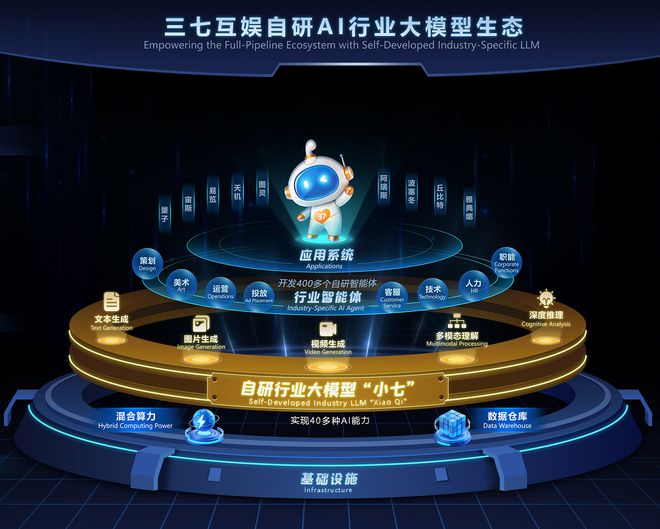
The application of AI technology in art production is the most mature and effective. According to research data, “Turing”, the art AI platform independently developed by 37 Interactive Entertainment, can save 60%-80% of working hours in character original art, while improving efficiency by more than 20% in the production of distribution material videos and audio [2]. The company has now achieved that AI-assisted advertising material generation accounts for more than 70%, AI-assisted 2D art accounts for more than 80%, and AI-generated 3D assets account for more than 30% [1].
As evidenced by specific cases, after NetEase’s Justice Online mobile game introduced the AI face customization system, the character customization time was shortened from traditional hours to seconds, the scene design efficiency was increased by 70%, and the comprehensive animation production efficiency was improved by 30%-300% [2]. NetDragon’s Art Production Center increased its AI utilization rate from 14% to 58%, saving more than RMB 3 million in labor hour costs. These data fully demonstrate that AI technology is fundamentally restructuring the cost structure of art production.
In the field of program development, the application of AI technology has also brought revolutionary changes. The 2024 Unity Gaming Report shows that 37% of game developers use AI to accelerate code writing, and 36% of developers use AI to generate artworks, game levels and test game loops [2]. NetEase Fuxi’s AI code generation tool improves development efficiency by 50% in some scenarios, and its logical quality can reach expert level.
The AI “Juewu” system of Tencent’s Honor of Kings is a classic case. The system uses reinforcement learning training, and through generalized model training, it has successfully reduced the large-scale training cost of 400 characters significantly [2]. For the version update materials of a medium-sized SLG game, the traditional mode requires 20 people to spend 2 weeks, while after AI intervention, it is reduced to 5 people in 3 days, with labor costs reduced by about 87.5%.
The application of AI technology in game testing has significantly improved quality assurance efficiency. The Wuji framework developed by NetEase Fuxi combines evolutionary strategies and reinforcement learning, which can explore game space and discover hidden bugs. Official data shows that the AI automated testing system improves efficiency by 50%, greatly reducing manual testing time [2].
At the operation level, 37 Interactive Entertainment uses the multi-modal understanding ability of large models to realize refined operations such as player behavior prediction, churn warning, and personalized recommendation. By feeding player chat records and battle data to AI, the system can automatically generate customized activity plans, which can increase the activity lifetime value by 15%-20% [1]. In the first three quarters of 2025, the company’s sales expenses decreased by 19.5% year-on-year, and this achievement is closely related to the application of AI in marketing material generation and precise delivery.
Based on the above data, the restructuring of game development cost structure by AI technology is reflected in the following aspects:
| Cost Item | Proportion in Traditional Mode | Proportion in AI-assisted Mode | Change Range |
|---|---|---|---|
| Art Cost | 35% | 20% | -42.9% |
| Program Development | 25% | 20% | -20.0% |
| Testing & Quality Assurance | 15% | 8% | -46.7% |
| Operation & Promotion | 20% | 17% | -15.0% |
From the perspective of cost structure evolution, the application of AI technology has significantly reduced the proportion of costs in art and testing links, releasing more resources for content innovation and user experience improvement. This optimization of cost structure enables game companies to significantly reduce overall development costs while maintaining or even improving product quality.
According to estimates from market.us, the global market size of generative AI in the game field was 1.43 billion USD in 2024, and it is expected to grow to 11.11 billion USD by 2033, with a compound annual growth rate of up to 25.6% during the period [2]. On the Steam platform, the number of games using generative AI technology has surged by 800%, and the proportion of AI applications in newly launched games in 2025 is expected to reach 20%.
37 Interactive Entertainment has already explored the field of AI-native games. The company is internally trying to use AI to generate personalized dialogues for non-player characters (NPCs), allowing every passerby in the game to have a unique thinking pattern like a real person [1]. Companies such as Giant Network and Anuttacon under miHoYo have also begun to test AI-native gameplay in puzzle and adventure games, attempting to build new interaction logic through in-depth dialogue and situational judgment.
Cai Haoyu, founder of miHoYo, once put forward the view: “It’s only a matter of time before AIGC completely changes game R&D.” [2] This judgment is gradually becoming a reality. Based on a non-preset framework, AI-native games can realize real-time response to player input and intent, dynamically generate plots, NPC minds and scene rules. Although current AI-native games are not yet perfect, they have broken the content boundaries of traditional games and represent the future development direction of the game industry.
The case of 37 Interactive Entertainment’s RMB 5.7 billion floating profit from investing in Zhipu AI profoundly reveals the investment opportunities and value restructuring logic of the game industry under AI technological changes. From a financial perspective, this investment has brought substantial book returns; from a strategic perspective, it has built a future-oriented technical moat for 37 Interactive Entertainment.
AI technology is fundamentally restructuring the cost structure of game development. In all links such as art production, program development, testing and quality assurance, operation and promotion, the application of AI tools has brought significant efficiency improvement and cost reduction. According to estimates, AI technology can reduce the overall game development cost by 30%-50% and shorten the development cycle by 40%-60%. This optimization of cost structure not only improves the profitability of game companies, but also provides solid support for the implementation of high-quality, diversified and globalization strategies.
Looking forward, with the continuous progress and in-depth application of generative AI technology, the game industry will accelerate its evolution from “Game + AI” to “AI-native Games”. For game enterprises and investors, actively embracing AI technology and building an AI capability base will be the key to seizing the initiative in the new round of industrial transformation.
[1] Phoenix Finance - 37 Interactive Entertainment Invests in 5 AI Leaders (https://finance.ifeng.com/c/8plkGcPnyag)
[2] 36Kr - How Can AI + Gaming Support a 10-Billion USD Market? (https://m.36kr.com/p/3504304060095369)
[3] Hubei Daily - AI Empowerment: Eight Trends of Game Industry Transformation in 2025 (https://news.hubeidaily.net/mobile/c_4305455.html)
[4] Enjoy Going Global - 37 Interactive Entertainment, with Overseas Annual Revenue Exceeding RMB 5.7 Billion, Has 70% of Its Video Materials Generated by AI (https://enjoy.link/detail/news/ans1912)
[5] CNfol.com - 37 Interactive Entertainment’s Moat is Being Redefined by AI (http://mp.cnfol.com/49438/article/1761970092-142094556)
Insights are generated using AI models and historical data for informational purposes only. They do not constitute investment advice or recommendations. Past performance is not indicative of future results.
About us: Ginlix AI is the AI Investment Copilot powered by real data, bridging advanced AI with professional financial databases to provide verifiable, truth-based answers. Please use the chat box below to ask any financial question.