
OpenAI's SB Energy Investment: Strategic Analysis
Unlock More Features
Login to access AI-powered analysis, deep research reports and more advanced features
About us: Ginlix AI is the AI Investment Copilot powered by real data, bridging advanced AI with professional financial databases to provide verifiable, truth-based answers. Please use the chat box below to ask any financial question.
Related Stocks
Based on my research, I can provide you with a comprehensive analysis of OpenAI’s strategic investment in SB Energy and what it reveals about AI companies’ energy infrastructure needs.
On January 9, 2026, OpenAI and SoftBank Group jointly invested
Additionally, SB Energy secured
The investment reflects the unprecedented energy demands of next-generation AI infrastructure. Key facts:
| Metric | Scale |
|---|---|
Initial data center lease |
1.2 GW (Milam County, Texas) |
Stargate total commitment |
$500 billion / 10 GW capacity |
Single data center equivalent |
Equivalent to annual consumption of 1.8 million people |
Energy consumption growth |
Data center electricity use could triple by 2028 |
A single gigawatt-level data center campus consumes as much electricity as a major American city, underscoring why AI companies must secure dedicated power infrastructure [1][3].
The partnership represents a new model that
- Purpose-built AI infrastructureoptimized for high-density compute
- Coordinated energy generationto support site needs without burdening local grids
- Faster deployment timelinesthrough unified planning and execution
The investment builds on the
- ~7 GW of planned capacityacross multiple U.S. sites
- $400+ billion committedover three years
- Five new sitesannounced (Texas, Arizona, Wisconsin, Louisiana, and another Midwest location)
- International expansion to Norway(230 MW initial, hydropower-powered) andUAE(up to 1 GW)
By October 2025, Stargate was ahead of schedule to meet its full 10 GW commitment by year-end [1][4].
The OpenAI-SB Energy deal exemplifies a
| Traditional Approach | New Strategic Approach |
|---|---|
| Purchase energy from utilities | Invest directly in energy infrastructure |
| Optimize existing grid connections | Build dedicated power generation |
| Focus on efficiency within constraints | Secure capacity before building capacity |
| Treat energy as a commodity | Treat energy access as competitive advantage |
Microsoft’s 2025 strategy illustrates this broader industry trend—shifting from passively procuring energy to
AI companies are no longer willing to rely on potentially strained public utilities. The Stargate Texas site in Milam County exemplifies this approach:
- Plans to build new energy generationto support the site’s needs
- Designed to minimize water usageand protect Texas ratepayers
- Grid modernizationinvestments as part of community commitments
This reflects the reality that data center operators are transitioning from
The energy infrastructure play requires massive capital commitments:
- Microsoft: Planned $80 billion in FY2025 CAPEX for AI-enabled data centers, with significant allocation to power and cooling infrastructure
- Microsoft & Google: Over $16 billion combined committed to UK data centers
- Microsoft: $30 billion investment over four years in the UK, with £2.5 billion initially for data centers and GPUs
Data center power demand is projected to grow from
Securing reliable, scalable energy supply has become a
The industry is shifting from sustainability metrics toward
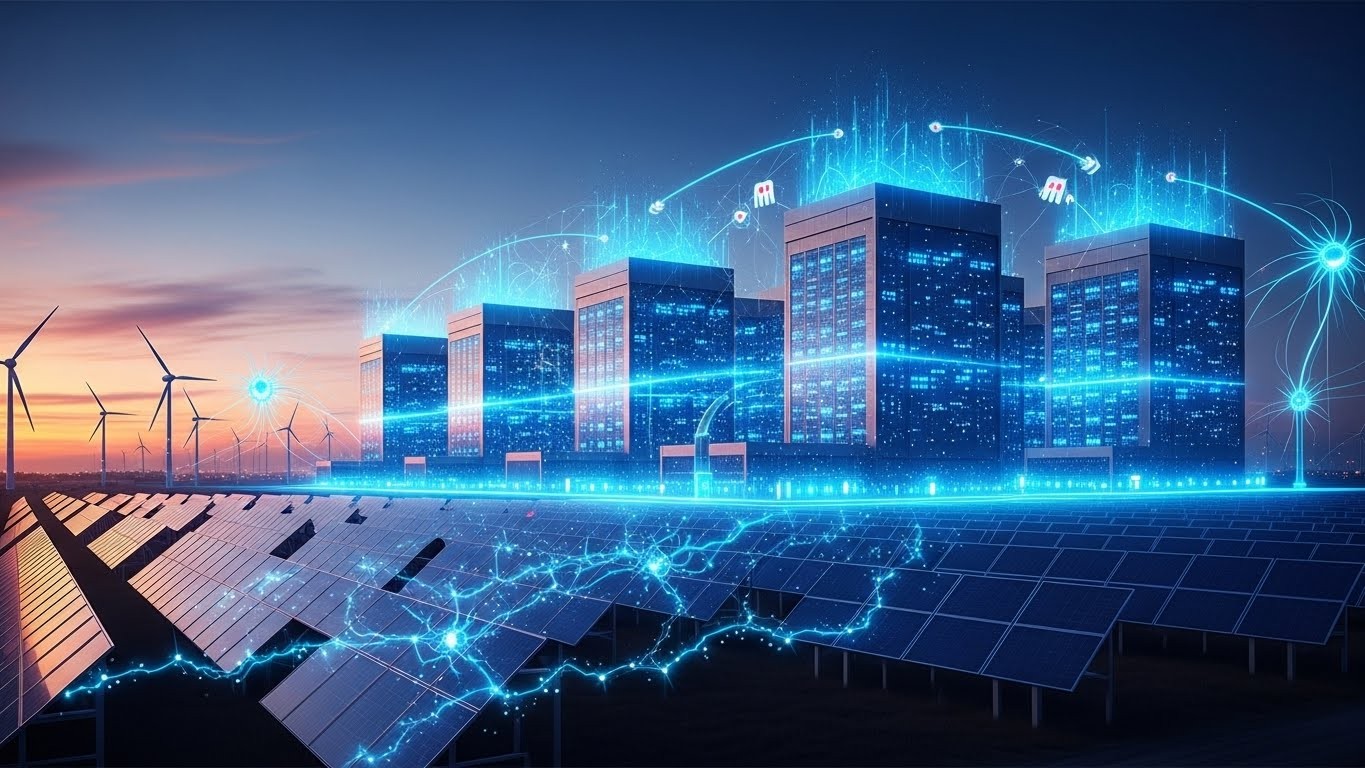
AI companies are blending multiple energy sources to balance performance and sustainability:
- Renewables(wind, solar, hydropower)
- Natural gasfor base load and backup
- Nuclear(Microsoft’s agreement to restart Three Mile Island Unit 1)
- Battery storagefor grid stability
- On-site generationfor reliability
The OpenAI-SB Energy partnership includes commitments to:
- Well-paying jobsand workforce development
- Grid modernizationin host communities
- Durable economic growthfor partner communities
This reflects growing regulatory and public scrutiny over data center energy consumption and its impact on local utility rates and grid reliability [1][3].
OpenAI’s $1 billion investment in SB Energy signals that AI companies have recognized a fundamental truth:
The Stargate initiative represents one of the largest infrastructure projects ever undertaken in the tech sector, with implications extending far beyond OpenAI. As Microsoft, Google, Amazon, and other AI giants make similar investments, the industry is witnessing a
For AI companies, the message is clear:
[1] OpenAI. “OpenAI and SoftBank Group Partner with SB Energy.” January 9, 2026. https://openai.com/index/stargate-sb-energy-partnership/
[2] Bloomberg. “OpenAI, SoftBank Invest $1 Billion in Stargate Partner SB Energy.” January 9, 2026. https://www.bloomberg.com/news/articles/2026-01-09/openai-softbank-invest-1-billion-in-stargate-partner-sb-energy
[3] MediaJustice. “Stargate Project SW Fact Sheet.” December 2025. https://mediajustice.org/wp-content/uploads/2025/12/Stargate-Project-SW-Fact-Sheet-FINAL.pdf
[4] OpenAI. “OpenAI, Oracle, and SoftBank expand Stargate with five new AI data center sites.” September 23, 2025. https://openai.com/index/five-new-stargate-sites/
[5] EnkiAI. “Microsoft AI Energy Strategy 2025: Powering Dominance.” November 2025. https://enkiai.com/ai-market-intelligence/microsoft-ai-energy-strategy-2025-powering-dominance
[6] Data Center Knowledge. “2026 Predictions: AI Sparks Data Center Power Revolution.” December 2025. https://www.datacenterknowledge.com/operations-and-management/2026-predictions-ai-sparks-data-center-power-revolution
[7] IntuitionLabs. “OpenAI’s Stargate Project: A Guide to the AI Infrastructure.” 2025. https://intuitionlabs.ai/articles/openai-stargate-datacenter-details
Insights are generated using AI models and historical data for informational purposes only. They do not constitute investment advice or recommendations. Past performance is not indicative of future results.
About us: Ginlix AI is the AI Investment Copilot powered by real data, bridging advanced AI with professional financial databases to provide verifiable, truth-based answers. Please use the chat box below to ask any financial question.