
Analysis of the Impact of Stellantis' Cancellation of Plug-In Hybrid Sales in the U.S.
Unlock More Features
Login to access AI-powered analysis, deep research reports and more advanced features
About us: Ginlix AI is the AI Investment Copilot powered by real data, bridging advanced AI with professional financial databases to provide verifiable, truth-based answers. Please use the chat box below to ask any financial question.
Related Stocks
Based on the latest data and market information, I will provide you with an in-depth analysis.
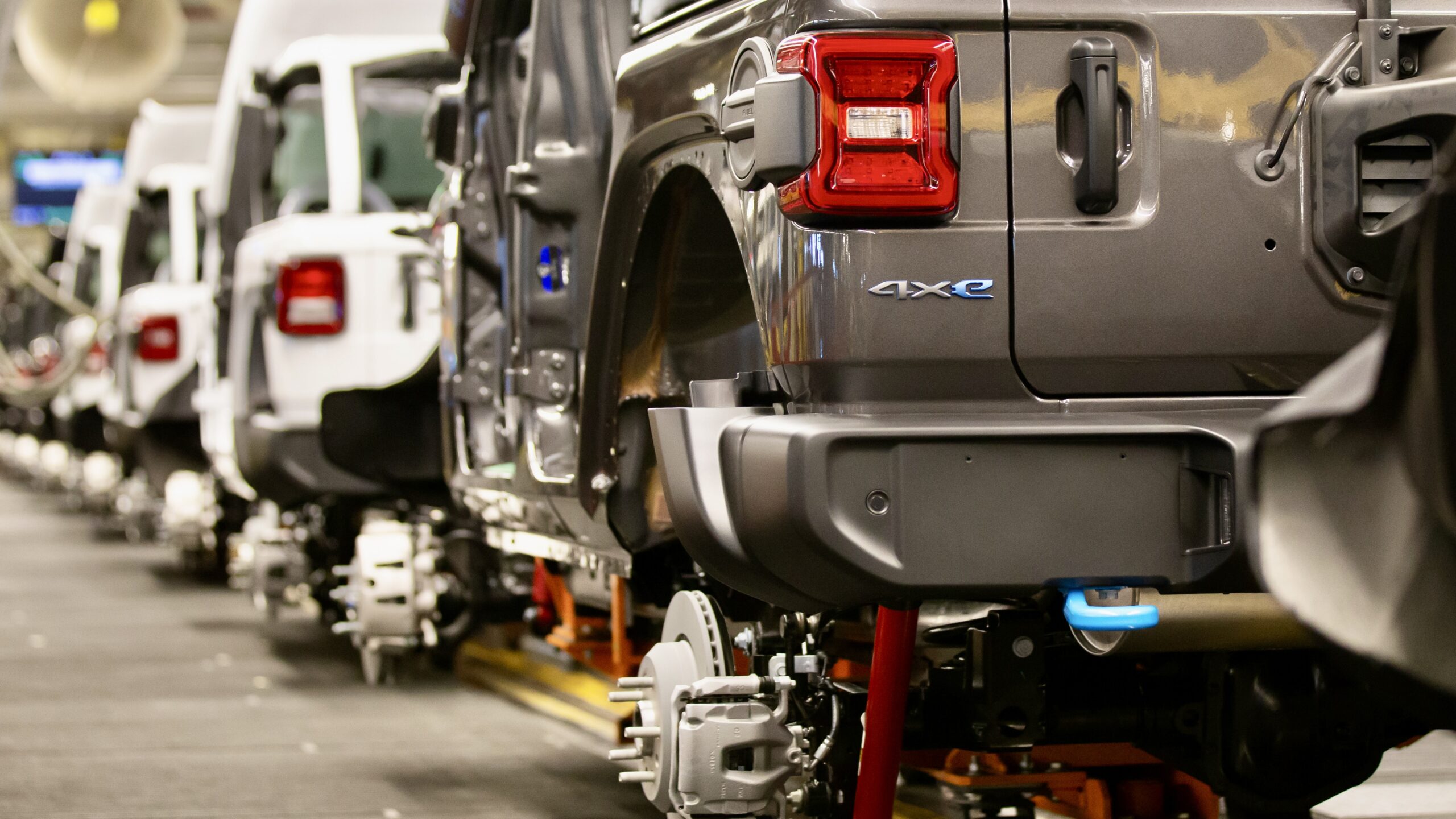
According to the latest reports, Stellantis has officially announced that it will
Stellantis’ decision is not an isolated case. Legacy automakers are facing
| Automaker | Loss Amount | Main Reason |
|---|---|---|
General Motors (GM) |
$7.1 Billion |
$6 billion of which is related to EV investment cuts [4][5] |
Ford (Ford) |
$19.5 Billion |
Canceled the second-generation EV platform plan [5] |
Stellantis |
Amount Not Disclosed | Full termination of plug-in hybrid projects |
These losses reflect a
Legacy automakers’
- GM: Suspended production at two joint venture battery plants for 6 months, reduced production capacity at its Detroit EV plant, and converted the Michigan facility originally planned for an EV plant to produce internal combustion engine (ICE) vehicles (Cadillac Escalade and full-size pickup trucks) [5]
- Ford: Canceled the entire second-generation EV platform plan, and CEO Jim Farley admitted that “market changes are the real driver behind this decision” [5]
- Stellantis: Redirecting resources to “more pragmatic” hybrid and extended-range electric vehicle technical routes
The Trump administration has taken multiple measures to
- Revoked emission regulations
- Canceled federal tax credits
- Challenged the authority of states such as California to set independent emission standards
- Threatened to withdraw from global climate agreements
In stark contrast to legacy automakers’ cuts to BEV investments,
- BMW’s U.S. plug-in hybrid sales bucked the trend with a 30.7% increase, reaching 25,351 units, while its pure electric vehicle sales declined by 16.7% [7]
- Hyundai Palisade Hybrid became the fastest-selling vehicle in the U.S. in 2025, with an average inventory turnover period of less than 14 days [6]
- S&P Global Mobility pointed out that hybrid vehicles “offer a little bit of everything”, and their “practical characteristics may be more appealing to consumers in rural areas and red states” [6]
| Metric | BEV | Hybrid (HEV) |
|---|---|---|
| 2025 U.S. Sales Growth Rate | +1.2% (Omdia data) [5] | Significant Growth |
| Projected 2026 Market Share | Approximately 6% (Edmunds forecast) [5] | Continued Growth |
| Consumer Acceptance | Limited by charging infrastructure and range anxiety | No range anxiety, with access to partial electrification benefits |
Legacy automakers are reallocating capital,
- Stellantis: Retains conventional hybrid technology, with a focus on developing extended-range electric vehicles (EREVs)
- Industry Trend: The number of extended-range electric vehicle models increased by 40% in 2024 (from 31 to 43 models) [8]
- R&D Shift: Reducing costs and optimizing existing platforms instead of developing all-new BEV architectures
- Europe: BEV market share reached 16.9% (January-November 2025), hybrids accounted for 34.6%, and ICE vehicles dropped to 36.1% [9]
- U.S.: Policy uncertainty leads to automakers’ strategic wavering, with hybrids becoming a “practical choice”
- China: The ratio of BEVs to PHEVs is approximately 2:1, with local brands dominating [8]
Studies show that
Billions of dollars invested by automakers are difficult to recover:
- GM needs to pay $4.2 billion in cashfor supplier settlements, contract cancellations, and other expenses [5]
- Once built, battery plants are difficult to repurpose or shut down
- Supply chains (lithium mines, battery manufacturing) are facing shrinking demand
The automotive industry is going through a transition period from “early adopters” to “mainstream consumers”. Early adopters are willing to tolerate the limitations of EVs, but
- Conventional hybrid (HEV) sales will continue to grow
- Plug-in hybrid (PHEV) sales in the U.S. market may shrink further
- Extended-range electric vehicles (EREVs) are gaining attention as a compromise solution
- After the policy environment stabilizes, BEVs may regain momentum
- Declining battery costs and improved range will enhance BEV competitiveness
- Coexistence of multiple technical routes will become the norm
- The EU’s 2035 “zero-emission” policy may be relaxed (allowing 10% non-zero-emission sales) [9]
- The direction of U.S. federal policy remains uncertain
- China will consolidate its dominant position in the EV industrial chain
| Impact Area | Specific Performance |
|---|---|
Legacy Automakers |
Valuations are under pressure, but the market has already priced in negative news (GM’s stock price still rose 50% year-to-date) [4] |
Battery Suppliers |
Risk of overcapacity increases, demand growth slows |
Charging Infrastructure |
Investment payback period lengthens, industry integration accelerates |
Component Suppliers |
Demand for hybrid-related components rises, BEV supply chains are under pressure |
Investor Sentiment |
Capital shifts from concept-based EV companies to profitable legacy automakers |
Stellantis’ cancellation of plug-in hybrid sales in the U.S. is a
- Ebb of the “Aggressive BEV Route”: Without strong government subsidies and regulatory pressure, pure electrification cannot be driven spontaneously by the market
- “Revival” of Hybrid Technology: As a transitional solution, hybrids have greater advantages in practicality and are becoming a “safe haven” for legacy automakers
- Restructuring of Investment Landscape: Capital is flowing back from “money-losing” EV projects to more profitable hybrid and ICE vehicle businesses
- Highlighted Policy Sensitivity: The automotive industry is highly dependent on government policies, and drastic changes in the regulatory environment directly alter corporate strategies
This shift does not mean the end of electrification, but rather a
[1] Automotive News - “Stellantis, No. 1 in plug-in hybrids, kills entire lineup of them” (https://www.autonews.com/stellantis/an-stellantis-phev-discontinuations-0109/)
[2] The Truth About Cars - “Report: Stellantis To Kill Current Plug-In Hybrids” (https://www.thetruthaboutcars.com/cars/news-blog/report-stellantis-to-kill-current-plug-in-hybrids-45133183)
[3] Yahoo Autos - “Stellantis Is Canceling All Of Its Plug-In Hybrids For The 2026 Model Year” (https://autos.yahoo.com/ev-and-future-tech/articles/stellantis-canceling-plug-hybrids-2026-230919756.html)
[4] LinkedIn News - “GM takes $7.1B hit amid EV strategy shift” (https://www.linkedin.com/news/story/gm-takes-71b-hit-amid-ev-strategy-shift-7414801/)
[5] Reuters - “GM to take $6 billion writedown on EV pullback” (https://www.reuters.com/business/autos-transportation/gm-take-6-billion-writedown-ev-pullback-2026-01-08/)
[6] Bloomberg - “Hybrid Vehicle Sales in US Auto Market Rise, Helping Keep EV Plans Alive” (https://www.bloomberg.com/news/articles/2025-12-29/hybrid-vehicle-sales-in-us-auto-market-rise-helping-keep-ev-plans-alive)
[7] InsideEVs - “BMW Buyers Turned To Plug-In Hybrids As EV Demand Softened In 2025” (https://insideevs.com/news/783502/bmw-ev-phev-sales-2025-us/)
[8] IEA - “Global EV Outlook 2025: Trends in the electric car industry” (https://www.iea.org/reports/global-ev-outlook-2025/trends-in-the-electric-car-industry-3)
[9] WINSSolutions - “How did the EV-market evolve (EU/US) in 2025 + what to expect in 2026” (https://www.winssolutions.org/ev-market-evolution-eu-us-2025-2026/)
Insights are generated using AI models and historical data for informational purposes only. They do not constitute investment advice or recommendations. Past performance is not indicative of future results.
About us: Ginlix AI is the AI Investment Copilot powered by real data, bridging advanced AI with professional financial databases to provide verifiable, truth-based answers. Please use the chat box below to ask any financial question.