
Major Regulation Targets Food Delivery Wars: Industry Turning Point After the Billion-Yuan Subsidy Battle
Unlock More Features
Login to access AI-powered analysis, deep research reports and more advanced features
About us: Ginlix AI is the AI Investment Copilot powered by real data, bridging advanced AI with professional financial databases to provide verifiable, truth-based answers. Please use the chat box below to ask any financial question.
Related Stocks
Based on the latest search results, I provide a systematic analysis of this hot topic.
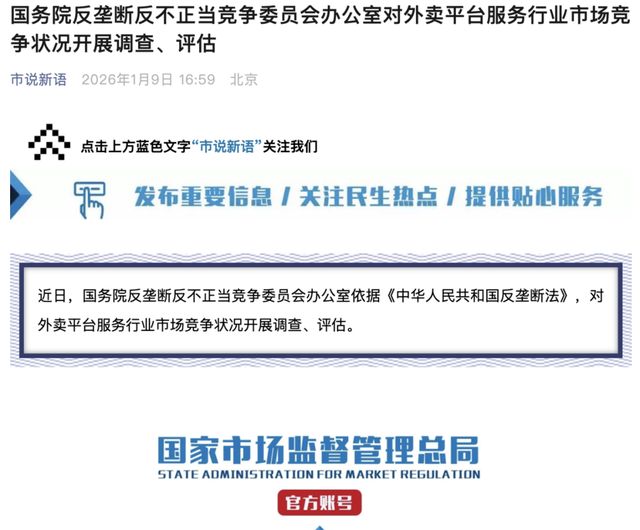
On January 9, 2026, the State Administration for Market Regulation (SAMR) released a major announcement. The Office of the Anti-Monopoly and Anti-Unfair Competition Committee of the State Council, in accordance with the Anti-Monopoly Law of the People’s Republic of China, officially launched an investigation and assessment of market competition in the food delivery platform service industry [1][2].
Regulators clearly pointed out that in recent times, the food delivery platform service industry has seen prominent issues such as
In 2025, three platforms—Taobao Flash Sale, JD.com, and Meituan—launched an over billion-yuan subsidy battle that lasted nearly half a year centered on the food delivery market [1][2]. The drivers of this competition are as follows:
- Market Share Competition: Rapidly acquire user traffic through low prices
- Ecological Synergy Construction: Implement the “high-frequency driving low-frequency” strategy (using high-frequency food delivery scenarios to drive other low-frequency consumption)
- Increasing Importance of Instant Retail Strategy: Taobao Flash Sale has set its primary goal for 2026 as market share growth, with a long-term goal of achieving absolute market leadership [1]
| Platform | Core Data Performance |
|---|---|
Meituan |
In Q3 2025, revenue from core local business decreased 2.8% year-over-year to RMB 67.4 billion, swung from profit to loss , with an operating loss of RMB 14.1 billion and an operating loss rate of 20.9% [1][2] |
Alibaba |
Revenue from instant retail business reached RMB 22.9 billion, up 60% year-over-year, but adjusted EBITA dropped 78% year-over-year to RMB 9.073 billion, mainly due to huge investments in instant retail [1][2] |
| Food delivery GMV and order volume grew steadily, overall investment narrowed quarter-over-quarter, and operational efficiency improved [2] |
Merchants generally oppose the subsidy battle:
- Low Prices Fail to Retain Users: Hit products are completely ignored once subsidies are reduced
- Higher Profits Without Subsidies: Profit margins for subsidized hit products are meager
- Severe Resource Waste: A large number of food delivery orders are discarded due to time lags after sudden order surges
- Distorted Consumption Habits: Low prices reduce food delivery quality, leading to a decline in in-store dining [1][2]
Hong Yong, Associate Research Fellow at the Chinese Academy of International Trade and Economic Cooperation (CAITEC), analyzed that the core of this investigation and assessment is
| Platform | Key Response Points |
|---|---|
Meituan |
Firmly supports and fully cooperates; takes the investigation as an opportunity to jointly fulfill the responsibilities of market entities and participate in fair market competition [2][3] |
Taobao Flash Sale |
Welcomes and actively cooperates; strictly fulfills compliance entity responsibilities and provides diversified, high-quality services [1][2] |
| Firmly supports; highly approves of measures to curb involution and maintain fair market competition order [1][2][3] |
Hong Yong from CAITEC pointed out that systematic investigation and assessment to clarify competition boundaries and behavioral bottom lines will help promote platforms to shift from purely competing on prices to
Reporters have noticed that “average order value (AOV)” has become the hidden main line of competition disclosed in the financial reports of Taobao and Meituan:
- Meituan: Holds over 2/3 of orders with actual payment exceeding RMB 15, and over 70% of orders with actual payment exceeding RMB 30; the high-AOV segment is a more valuable focus for Meituan [1]
- Taobao Flash Sale: The proportion of high-AOV orders increased from September to October 2025, with average order value growing by double digits month-over-month compared to August [1]
In 2025, regulators held two interviews with food delivery platforms, and released the Basic Requirements for Food Delivery Platform Service Management at the end of the year, setting bottom lines in aspects such as
Chen Liteng, Analyst of Life Service E-Commerce at the e-commerce research center of 100EC, predicts that
The “billion-yuan subsidy” battle in the food delivery industry reflects a typical dilemma of the platform economy in stock competition: the prisoner’s dilemma of
The intervention of regulation is not to suppress the development of platforms, but to “set rules” for industry competition:
- Short-term: Curb vicious low-price competition and restore market order
- Medium-term: Promote platforms to shift from traffic games to efficiency competition
- Long-term: Establish a sustainable development model to achieve a win-win situation for platforms, merchants, consumers, and riders
In 2026, the focus of competition in the food delivery industry is shifting from “low-price involution” to
[1] Sina Finance - “Unwilling to Fight, Unable to Stop”: Major Regulation Enters Food Delivery Wars, What Will 2026 Bring? (https://news.sina.com.cn/o/2026-01-09/doc-inhftipp0424278.shtml)
[2] Jiemian News - “Unwilling to Fight, Unable to Stop”: Major Regulation Enters Food Delivery Wars, What Will 2026 Bring? (https://www.jwview.com/jingwei/html/m/01-10/653548.shtml)
[3] Jimu News - Major Regulation Targets Food Delivery Wars! Responses from All Parties (https://www.ctdsb.net/c1476_202601/2635571.html)
Insights are generated using AI models and historical data for informational purposes only. They do not constitute investment advice or recommendations. Past performance is not indicative of future results.
About us: Ginlix AI is the AI Investment Copilot powered by real data, bridging advanced AI with professional financial databases to provide verifiable, truth-based answers. Please use the chat box below to ask any financial question.