
In-Depth Analysis of the Competitive Landscape Between Three Squirrels' Offline Lifestyle Store Model and Bulk Snack Stores
Unlock More Features
Login to access AI-powered analysis, deep research reports and more advanced features
About us: Ginlix AI is the AI Investment Copilot powered by real data, bridging advanced AI with professional financial databases to provide verifiable, truth-based answers. Please use the chat box below to ask any financial question.
Related Stocks
Based on the collected materials, I will conduct an in-depth analysis of the competitive predicament between Three Squirrels’ offline lifestyle store model and bulk snack stores from multiple dimensions.
In recent years, China’s snack retail market has been undergoing profound channel restructuring. From the end of 2020 to 2024, the total number of domestic bulk snack stores has rapidly grown from approximately 1,800 to over 38,000, and is expected to reach 45,000 in 2025[1]. Behind this explosive growth is the subversion of traditional retail models by the logic of channel efficiency:
- Change in Channel Share: The GMV share of the bulk snack specialty store channel increased from 7.6% in 2019 to 14% in 2024, with the GMV scale growing from RMB 218.4 billion to RMB 419 billion[1]
- Increased Market Concentration: The two giants, Mingming Mangmang and Wanchen Group, together account for 75% of the market share, forming a “duopoly” pattern[2]
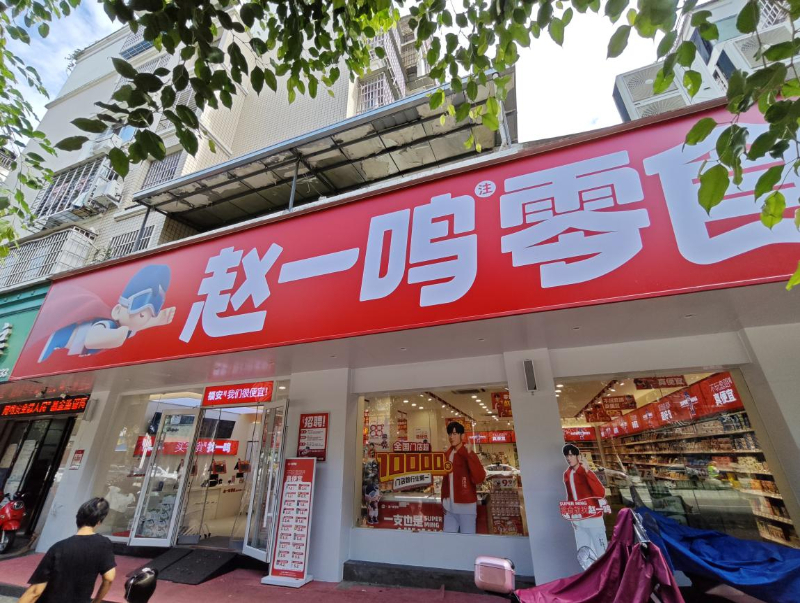
- Data of Leading Enterprises: The total number of operating stores nationwide of Snack Busy and Zhao Yiming Snacks, under Mingming Mangmang, reached 19,517, with revenue of RMB 46.371 billion in the first nine months of 2025, a year-on-year increase of 75.2%[3]
However, the dividend period of scale expansion is fading. In 2025, the industry has begun to show obvious growth bottlenecks:
| Indicator | Data Performance | Industry Impact |
|---|---|---|
| Average Monthly Revenue per Store | Approximately RMB 300,700 | Significant decline from the peak |
| Average Monthly Profit per Store | Only RMB 5,500 | Profit margin severely compressed |
| Gross Profit Margin | Approximately 18% | Lower than traditional retail formats |
| Payback Period | Extended to 1.5-2 years | Franchisee confidence shaken |
-
Homogeneous Product Structure: The supply chains of various brands are highly overlapping, with star products such as cola, potato chips, and mineral water accounting for a relatively high proportion, while private labels and exclusive products account for a low proportion, making it difficult to form differentiated brand awareness[1]
-
Single Consumption Scenario: The positioning still focuses on instant and impulsive snack consumption, with weak relevance to the scenario of daily planned household procurement, resulting in obvious ceilings for customer unit price and repurchase frequency[1]
-
Scarcity of High-Quality Locations: Store density has reached a critical value, and densification and competition with rivals have become the main strategies. The industry has officially entered the “red sea knockout stage” from the “blue sea expansion stage”[1]
Three Squirrels’ offline exploration journey has been full of setbacks, and its strategic adjustment trajectory clearly reflects the company’s evolving understanding of the offline market:
| Phase | Time | Strategy | Result |
|---|---|---|---|
| First Attempt | 2018-2021 | Liberalized franchising and implemented the “Squirrel Alliance Stores” | Reached 1,065 stores by the end of 2021 |
| Large-Scale Store Closures | 2022 | Strategic contraction | Closed over 300 stores |
| Community Snack Stores | Second Half of 2023 | Launched “community snack stores” focusing on white-label low prices | Opened approximately 150 stores that year |
| Lowered Franchise Thresholds | May 2024 | Reduced store area to 40 ㎡ and initial investment to RMB 250,000 | Only 353 stores as of the first half of 2025 |
From the data perspective, the contribution of Three Squirrels’ offline stores has continued to shrink: in 2022, 2023, 2024, and the first half of 2025, offline stores contributed RMB 940 million, RMB 360 million, RMB 400 million, and RMB 187 million respectively, accounting for 12.9%, 5%, 3.8%, and 3.41% of total revenue[4].
Three Squirrels once attempted to quickly enter the offline market through capital means: in October 2024, the company announced that it would acquire control of the bulk snack brand Ai Snack and the hard discount supermarket brand Ai Discount for no more than RMB 200 million and RMB 60 million respectively[4]. However, in June 2025, Three Squirrels issued an announcement to terminate the acquisition of Ai Snack, citing “failure to reach an agreement on some core terms of this transaction between the two parties”.
This failure reveals several key issues:
- Brand Positioning Conflict: There is a fundamental contradiction between the brand tone of Three Squirrels and the white-label low-price model of bulk snacks
- Channel Discourse Power Game: The bulk snack channel has transformed from a “traffic ally” of traditional brands to a “direct competitor”, and the integration difficulty after acquisition far exceeds expectations[5]
- Accelerated Capitalization Process: Mingming Mangmang has launched its Hong Kong stock listing, and Haoxianglai is also preparing for an IPO. The capitalization window period for the bulk snack track is closing
Facing competitive pressure from bulk snacks, Three Squirrels launched the
- Category Expansion: Extended from nut snacks to rice, flour, grain, oil, fresh produce, daily chemical care products, prepared dishes, and even the sanitary napkin brand “Tazhimei”
- Store Format: 1,000-square-meter large store model, with the first store’s revenue exceeding RMB 1 million in three days[5]
- Strategic Positioning: Attempting to build an “ecological economic platform with full categories, full channels, and cross-domain synergy”
| Dimension | Lifestyle Store Model | Bulk Snack Store | Advantage Analysis |
|---|---|---|---|
| Category Coverage | Full categories (thousands of SKUs) | Snacks-focused (limited SKUs) | Covers broader consumer demands |
| Customer Unit Price | High (household procurement scenario) | Low (instant consumption scenario) | Increases single customer value |
| Differentiation | Private labels + exclusive products | Dominated by white labels | Strengthens brand perception |
| Consumption Frequency | High (daily procurement) | Low (impulsive consumption) | Enhances user stickiness |
However, the core challenges faced by this model cannot be ignored:
-
Increased Operational Complexity: Expanding from vertical snack categories to full categories puts forward higher requirements for supply chain management, inventory turnover, and category combination optimization
-
Questionable Input-Output Ratio: The 1,000-square-meter large store means higher rent and labor costs, and the replicability of the first store’s “RMB 1 million in three days” performance remains to be verified
-
Conflict with Brand Image: The Three Squirrels brand is highly associated with “nuts”, and consumers’ cognitive inertia may hinder the expansion of new categories[4]
-
Capital Pressure: The heavy asset model of full-category lifestyle stores is contrary to Three Squirrels’ consistent light asset operation logic
| Capability Dimension | Three Squirrels | Leading Bulk Snack Brands |
|---|---|---|
| Brand Momentum | Strong (first echelon in nut category) | Weak (channel brands-focused) |
| Supply Chain | OEM-focused, with quality control challenges | Own supply chain system |
| Store Network | 353 stores | 19,517 stores under Mingming Mangmang |
| Capital Support | Advancing A+H dual listing | Undergoing Hong Kong IPO |
| Offline Operation Experience | Weak | Rich |
Based on the above analysis, if Three Squirrels’ offline lifestyle stores are to break through the competitive predicament of bulk snack stores, they need to focus on the following directions:
- Form misplaced competition with the “low-price high-volume” model of bulk snacks
- Reference the strategy of high-end nut gift boxes co-developed by Qiaqia and Sam (sales exceeded RMB 100 million during the Mid-Autumn Festival period)[5]
- Strengthen the cognitive positioning of “Three Squirrels = high-end nuts” instead of blindly expanding categories
- Transform stores from “commodity sales venues” to “community lifestyle service nodes”
- Integrate elements such as light meals, coffee, and social interaction to increase customer stay time and consumption experience
- Reference the model innovation of Laiyifen’s “warehouse membership store”
- Transform from a pure OEM model to a mixed model of “self-construction + OEM”
- Invest in building own production capacity for core products to strengthen quality control
- Reference the case of Wangxiaolu solving flavor instability through customized production line design[5]
- Avoid direct price wars with bulk snacks
- Leverage brand momentum to establish in-depth cooperation with high-quality supermarkets and premium supermarkets
- Reference Yanjin Puzi’s “return to supermarkets” strategy to become a “growth partner” for supermarket channels[5]
Based on the above analysis, I believe that
-
Huge Scale Gap: Compared with the nearly 20,000-store network of bulk snacks, 353 stores do not have channel coverage advantages
-
Shortcomings in Operational Capabilities: Three Squirrels has long relied on the online light asset model, with insufficient experience in operating offline large stores, and the replicability of the lifestyle store model is questionable
-
Scattered Strategic Resources: The company is simultaneously advancing multiple initiatives such as multi-category sub-brand incubation, Hong Kong stock listing, and full-category lifestyle stores, making it difficult to concentrate resources to break through a single strategic direction
-
Closing Time Window: The bulk snack track has entered the capitalization sprint stage, and the first-mover advantages of Mingming Mangmang and Haoxianglai are being solidified
Although it is difficult to break through in the short term, Three Squirrels still has the opportunity to achieve a strategic breakthrough in offline business through the following methods:
- Precise Positioning: Focus on the high-end nut field, form misplaced competition with bulk snacks, and avoid direct confrontation with giants in the full-category battlefield
- Channel Synergy: Leverage brand momentum to establish in-depth cooperation with high-quality supermarkets and premium channels, instead of clinging to building its own store network
- Supply Chain Upgrade: Invest in building own production capacity for core products to fundamentally solve quality control and cost control problems
As industry analysts have pointed out, competition in the snack industry is shifting from “fighting for scale” to “fighting for efficiency, organization, and supply chains”[5]. If Three Squirrels can recognize its own advantages and focus on core capability building, it still has the opportunity to occupy a favorable position in the next stage of industry reshuffle.
[1] 36Kr - “2025 Retail Industry Review: Bulk Snack Stores from ‘Ten Thousand Stores Sprint’ to ‘Dividend Inflection Point’” (https://www.36kr.com/p/3630753491076104)
[2] Sina Finance - “Snack Industry 2025: Breakthrough Transformation and Long-Term Growth Path” (https://finance.sina.com.cn/tech/roll/2026-01-06/doc-inhfkfun5970805.shtml)
[3] 36Kr - “Mingming Mangmang Takes the Lead in Landing on the Hong Kong Stock Exchange, New Year’s Goods Festival Becomes the First Battle of the Second Half of Bulk Snacks” (https://m.36kr.com/p/3628833763492871)
[4] 36Kr - “Three Squirrels Trapped Online” (https://m.36kr.com/p/3625990921258249)
[5] Sohu Finance - “Snack Industry 2025: Breakthrough Transformation and Long-Term Growth Path” (https://m.sohu.com/a/973826517_250147)
[6] People’s Daily “China City News” - “Sprinting for A+H Dual Listing, Three Squirrels Launches Capital Breakthrough Battle” (https://paper.people.com.cn/zgcsb/pc/content/202505/19/content_30074048.html)
[7] CBNData - “Performance Recovery, Hong Kong Listing, Can Three Squirrels Achieve ‘Self-Rescue’?” (https://www.cbndata.com/information/293948)
[8] Xinhua Finance - “Three Hidden Worries Behind Three Squirrels’ Impressive Performance” (http://jjckb.xinhuanet.com/20250417/3eb8b8bc617b4694bb039c8cc6c8e54c/c.html)
Insights are generated using AI models and historical data for informational purposes only. They do not constitute investment advice or recommendations. Past performance is not indicative of future results.
About us: Ginlix AI is the AI Investment Copilot powered by real data, bridging advanced AI with professional financial databases to provide verifiable, truth-based answers. Please use the chat box below to ask any financial question.