
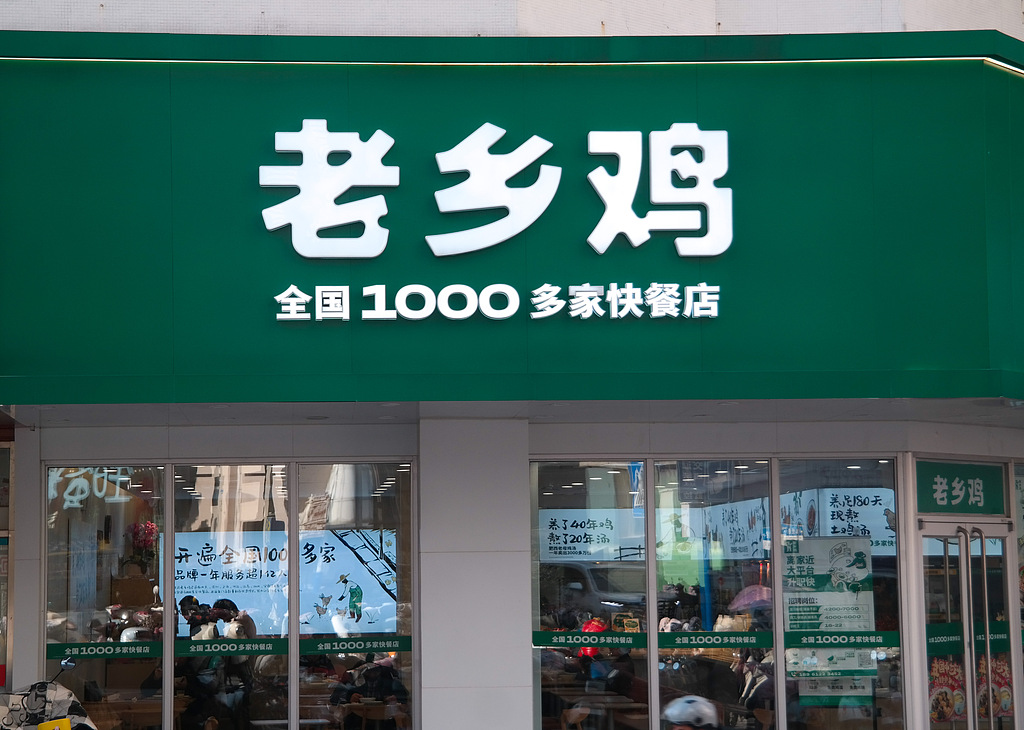
Lao Xiang Ji Franchise Expansion Speed Analysis: Risks and Concerns Behind 6x Growth in 3 Years
Unlock More Features
Login to access AI-powered analysis, deep research reports and more advanced features
About us: Ginlix AI is the AI Investment Copilot powered by real data, bridging advanced AI with professional financial databases to provide verifiable, truth-based answers. Please use the chat box below to ask any financial question.
Based on the searched information, I will analyze the store expansion speed issue of Lao Xiang Ji after it launched its franchise program from multiple dimensions.
| Time Node | Total Stores | Direct-Operated Stores | Franchise Stores | Franchise Store Proportion |
|---|---|---|---|---|
| End of 2022 | 1,125 | 1,007 | 118 | 10.5% |
| April 2025 | 1,564 | 911 | 653 | 41.8% |
| August 2025 | 1,658 | 925 | 733 | 44.2% |
- The number of franchise stores grew from 118 at the end of 2022 to 653 in April 2025, a nearly 6-fold increase[1]
- Revenue from franchise stores soared from RMB 174 million to RMB 717 million, with an annual compound growth rate of 102.9%[1]
| Year | Revenue | Year-over-Year Growth Rate |
|---|---|---|
| 2022 | RMB 4.528 billion | - |
| 2023 | RMB 5.651 billion | 24.8% |
| 2024 | RMB 6.288 billion | 11.27% |
| Metric | Direct-Operated Stores | Franchise Stores | Gap |
|---|---|---|---|
| Daily Sales per Store | RMB 16,000 | RMB 12,400 | -22.5% |
| Table Turnover Rate | 4.8 times/day | 3.6 times/day | -25% |
| Revenue per Square Meter per Day | RMB 82.2/㎡/day | RMB 72.6/㎡/day | -11.7% |
- Dropped from 28.9% in 2022 to 20.1% in 2024 [1]
- Risks of a “volume growth with weak profitability” model
- Reduced from 1,007 in 2022 to 911 in 2025 [2]
- The large-scale conversion of direct-operated stores to franchise stores in 2024 attracted market attention
- The chain rate of Chinese fast casual dining is only 32.5%, far lower than the 67.9% of Western fast food [3]
- The industry has great integration potential, with leading brands successively proposing the “10,000-store target”
- Ranked first in the 2024 Chinese fast casual dining market with a 0.9% market share [1]
- Holds a 2.2% market share in East China, 2.5 times that of the second-place brand [3]
- Has 3 standardized chicken farms, 2 central kitchens, and 8 distribution centers [1]
- Constructing a new central kitchen project in Hefei to support expansion [1]
As of August 2025:
- Stores in East China account for 86.5%[3]
- 784 stores in Anhui Province, accounting for 47.3%[3]
- The number of stores in Anhui Province is 5 times that of the second-largest Chinese fast casual dining brand
This “home base dependence” model brings three major risks:
- Visible market ceiling: Limited penetration space in Anhui Province
- Cross-regional operational challenges: Need to adapt to taste preferences in different regions
- Increased supply chain costs: Difficulties in cold chain logistics coverage
- Early stage: Franchisees converted from internal employees (conservative and stable)
- Current stage: Increasing proportion of external franchisees (rapid expansion)
- Shift from “internal incubation” to “socialized expansion”
- Higher requirements for brand standardized management and supply chain capabilities
Behind Lao Xiang Ji’s three IPO attempts are capital market concerns about its expansion model:
- Growth doubts: Standardized replication capability has not been fully verified
- Insufficient replicability: The model is not “lightweight enough”, with great cross-regional operational challenges
- Declining profit quality: Gross profit margin continues to decline, and franchise store efficiency is lower than that of direct-operated stores
| Dimension | Assessment | Explanation |
|---|---|---|
| Expansion Speed | ⚠️ Relatively Fast | The 6-fold growth in franchise stores in 3 years far exceeds the industry average |
| Profit Quality | ❌ Declining | Gross profit margin and store efficiency are both on a downward trend |
| Management Capability | ⚠️ Under Pressure | Independent franchisees account for over 50%, posing great standardized management challenges |
| National Expansion Progress | ⚠️ Lagging | East China still accounts for over 85% of stores |
- Lengthened franchisee profit cycle: Referring to the industry average investment payback period of 24-30 months, if it cannot be shortened to within 18 months, it may affect franchise willingness
- Brand consistency risk: Rapid expansion may dilute brand standards and customer experience
- Supply chain stress test: Expanding from East China to the whole country will test cold chain logistics capabilities
- Intensified competition: Emerging brands like Fish You Together (2,400+ stores) and Micun Bibimbap (1,800+ stores) are rising rapidly with small-store models
[0] Sina Finance - “Lao Xiang Ji’s Four IPO Attempts in Three Years: Sustained Revenue Growth, Hidden Concerns Behind 6-Fold Store Expansion in Three Years” (https://finance.sina.com.cn/stock/hkstock/ggipo/2025-07-21/doc-infheytw3222731.shtml)
[1] Forbes China - “Lao Xiang Ji’s Third IPO Attempt: 6-Fold Surge in Franchise Stores in 3 Years, Founding Family Controls 92% of Equity” (https://www.forbeschina.com/delicacies/70101)
[2] Catering Industry News - “Lao Xiang Ji’s Prospectus ‘Changes Face’: Independent Franchisees Account for Over Half, Capital Landscape of Chinese Fast Food Shifts?” (https://canyinj.com/news/23387.html)
[3] 36Kr - “Lao Xiang Ji Continues to Chase ‘First Chinese Fast Food Stock’, Store Count Reaches 1,658” (https://m.36kr.com/p/3631493377311749)
[4] CBNData - “Capital Can No Longer ‘Appetize’ for Lao Xiang Ji” (https://www.cbndata.com/information/293546)
Insights are generated using AI models and historical data for informational purposes only. They do not constitute investment advice or recommendations. Past performance is not indicative of future results.
About us: Ginlix AI is the AI Investment Copilot powered by real data, bridging advanced AI with professional financial databases to provide verifiable, truth-based answers. Please use the chat box below to ask any financial question.