
Customer Concentration Risk Assessment Report for Zhipu AI
Unlock More Features
Login to access AI-powered analysis, deep research reports and more advanced features
About us: Ginlix AI is the AI Investment Copilot powered by real data, bridging advanced AI with professional financial databases to provide verifiable, truth-based answers. Please use the chat box below to ask any financial question.
Based on the prospectus and market data, I will conduct a systematic customer concentration risk assessment for you.
Based on data disclosed in Zhipu AI’s post-hearing materials for Hong Kong Stock Exchange listing[1], customer concentration exhibits the following characteristics:
| Indicator | 2024 Data | H1 2025 Data | Risk Rating |
|---|---|---|---|
Revenue Share of Largest Customer |
19% | Over 10% | ⚠️ Medium-High Risk |
Revenue Share of Top 5 Customers |
45.5% | Consistently Over 40% | 🔴 High Risk |
Total Number of Institutional Customers |
- | 3,156 (65x growth from 2022) | 📈 Improving |
Customer Concentration Ratio (CR5) |
45.5% | >40% | Above Industry Average |
Customer Type          2022    2023    2024    H1 2025
─────────────────────────────────────────────────────────
Internet & Technology      55.2%     67.6%     49.6%     38.3%
Public Services          Declining Trend  Continuous Growth  ~30%   ~30%
Telecom Industry          Stable      Stable      Stable      13.6%
Others              -         -         -         -
-
Key Customer Dependency Risk: The top 5 customers contribute 45.5% of revenue, meaningthe loss of any major customer could cause severe revenue volatility[1]
-
High Customer Turnover: The prospectus shows thatthere is almost no overlap in the list of top 5 customers, reflecting the issue with one-time delivery models - revenue is unsustainable, requiring constant acquisition of new customers[1]
-
Customer Structure Transformation Pressure: The revenue share of internet and technology customers has continued to decline (from 67.6% to 38.3%), and these customers have the strongest willingness and most mature technical capabilities to develop their own models[2]
Zhipu AI adopts the
| Delivery Model | Revenue Share (H1 2025) | Customer Characteristics | Impact on Concentration |
|---|---|---|---|
On-Premises Deployment |
~85% | Large Enterprises, Government Agencies | High Customer Value, High Customization |
Cloud Deployment |
15.2% | SMEs, Developers | Low Customer Value, High Frequency |
- On-premises deployment has a long expansion cycle and high degree of customization
- Difficult to achieve explosive growth in the short term[1]
- Gross margin of cloud deployment business has turned from positive to negative (-0.4%), with ongoing price war pressure[3]
Comparison with major players in the large AI model industry:
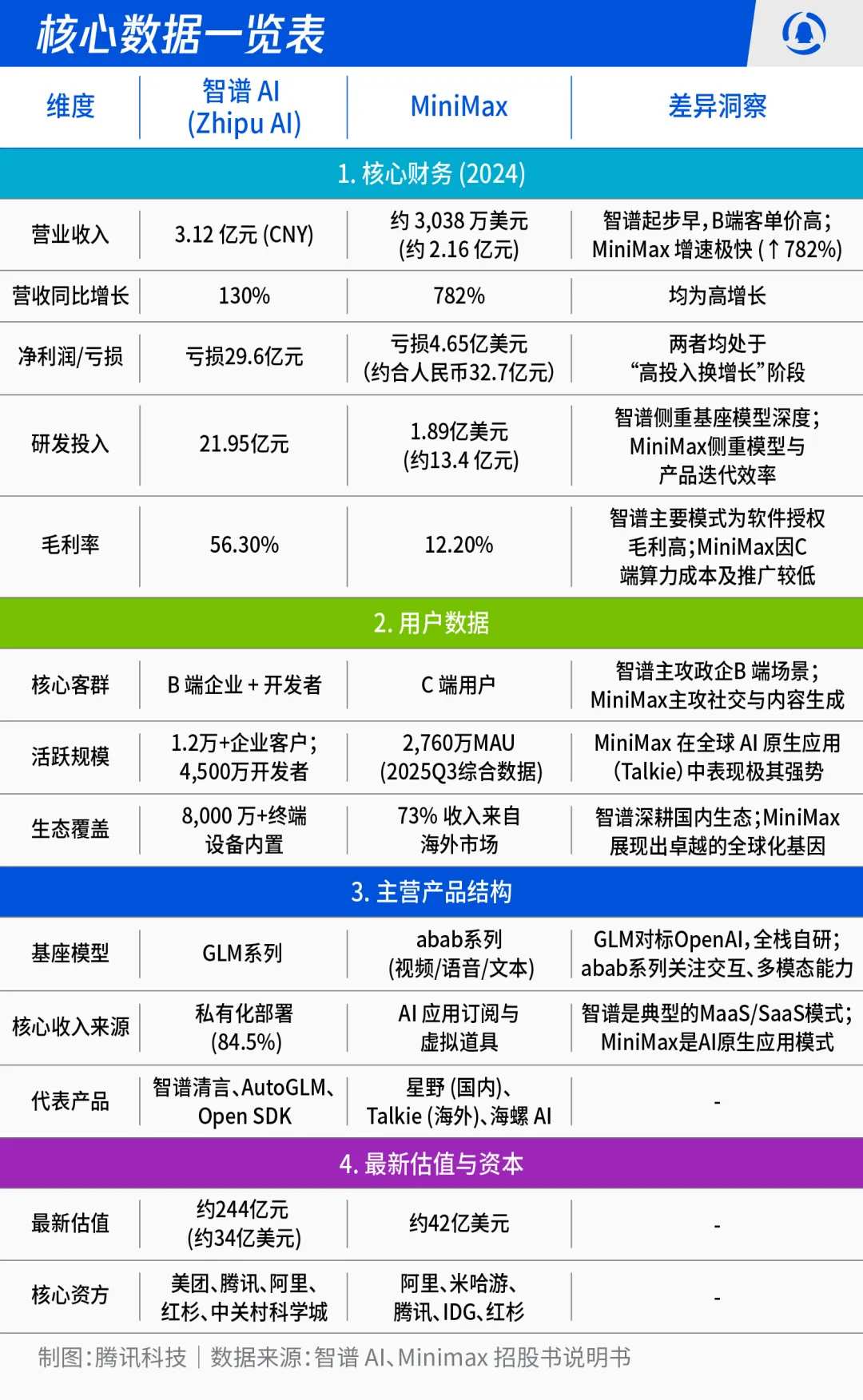
| Company | Customer Concentration Characteristics | Business Model | Risk Differences |
|---|---|---|---|
Zhipu AI |
Top 5 Customers: 45%+ | B2B Focused (MaaS) | High Concentration |
MiniMax |
Relatively Dispersed | C2C Focused (Subscription) | Dispersed |
Baidu/Aliyun |
Relatively Dispersed | Platform-Based | Low |
| Positive Factors | Analysis |
|---|---|
| Rapid Growth in Customer Base | Number of institutional customers increased from 48 in 2022 to 3,156[2], with concentration dispersion improving |
| Optimization of Customer Structure | Increased revenue share from public services and telecom customers, diversifying customer sources |
| Overseas Business Expansion | Overseas revenue accounted for 11.6% in H1 2025[1], reducing reliance on a single market |
| MaaS Platform Advantages | API platform has over 2.9 million developer users, forming a long-tail effect[3] |
| Risk Dimension | Rating | Explanation |
|---|---|---|
Concentration Risk |
🔴 High | Top 5 Customers: >40%, single dependency on largest customer |
Customer Churn Risk |
🔴 High | High annual customer turnover rate, one-time delivery model |
Bargaining Power Risk |
🟡 Medium | Major customers have strong bargaining power |
Decentralization Progress |
🟢 Improving | Rapid growth in customer base, ongoing structure optimization |
Zhipu AI’s customer concentration risk requires continuous attention. Although the number of customers is growing rapidly (65x growth in the previous two years), revenue remains highly concentrated among a small number of major customers. If key customers churn or reduce their budgets, it will have a significant impact on the company’s revenue.
- Key Monitoring Indicators: Changes in top 5 customers, number of new/churned customers and their revenue contributions, customer retention rate
- Focus on Inflection Points: When CR5 drops below 30% and annual customer overlap rate increases, the risk will decrease significantly
- Risk Hedging: Pay attention to the company’s cloud business expansion and overseas market growth to reduce reliance on B2B concentration
[1] Yicai Global - “Going Overseas, Going Public: China’s First Batch of Large Models Finally Break Through” (https://m.cbndata.com/information/294851)
[2] 36Kr - “At the IPO Door, China’s Large Models Finally Settle the Books” (https://m.36kr.com/p/3617797772461057)
[3] QbitAI - “Urgent Analysis of Zhipu AI’s Prospectus: Annual Revenue of RMB 300 Million with 130% Growth Rate” (https://www.qbitai.com/2025/12/362256.html)
[4] Caixin - “Zhipu AI Switches to Hong Kong Stock Exchange Listing and Passes Hearing; H1 Revenue RMB 191 Million, Net Loss RMB 2.3 Billion” (https://companies.caixin.com/2025-12-20/102395298.html)
Insights are generated using AI models and historical data for informational purposes only. They do not constitute investment advice or recommendations. Past performance is not indicative of future results.
About us: Ginlix AI is the AI Investment Copilot powered by real data, bridging advanced AI with professional financial databases to provide verifiable, truth-based answers. Please use the chat box below to ask any financial question.