
President Trump's Detroit Economic Club Speech: Economic Claims and Market Response Analysis
Unlock More Features
Login to access AI-powered analysis, deep research reports and more advanced features
About us: Ginlix AI is the AI Investment Copilot powered by real data, bridging advanced AI with professional financial databases to provide verifiable, truth-based answers. Please use the chat box below to ask any financial question.
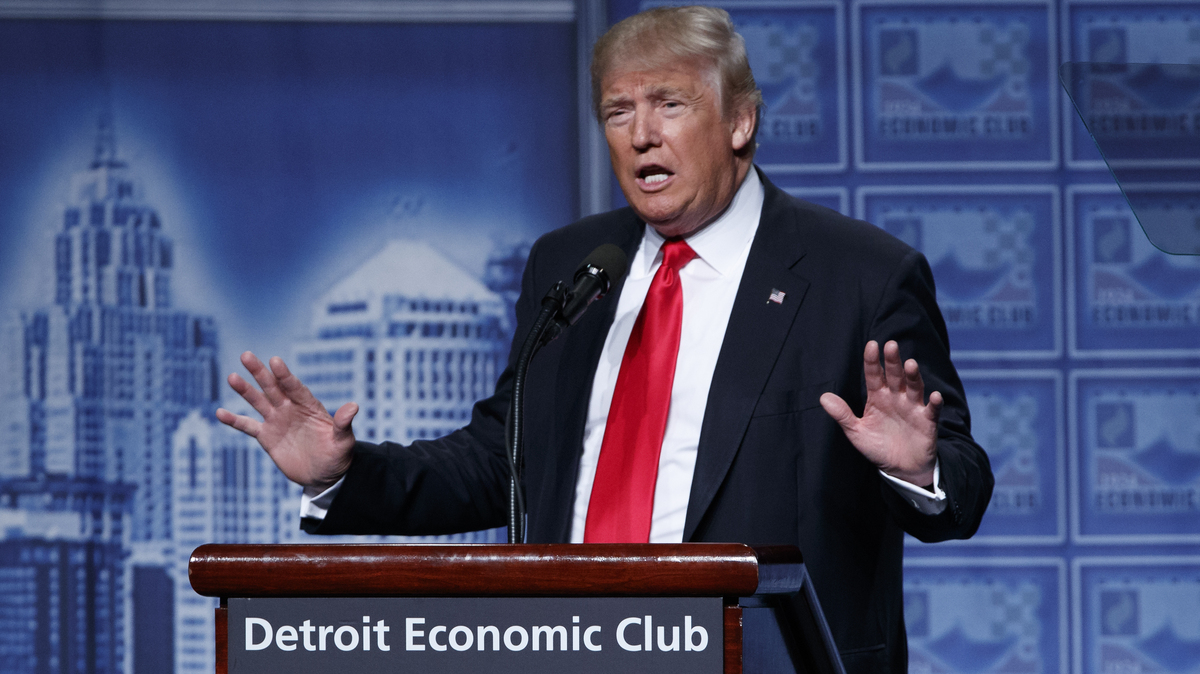
President Trump’s January 13, 2026 address to the Detroit Economic Club represents a significant moment in the administration’s economic messaging strategy, occurring at a time when polling indicates voter concern about cost of living remains elevated despite White House claims of economic success. The speech contained several testable economic assertions that can be verified against available data, along with concrete policy announcements that may face implementation challenges. The concurrent DOJ investigation into Federal Reserve Chair Jerome Powell, combined with Trump’s direct criticism of the Fed chairman, introduces unprecedented tensions regarding central bank independence that warrant careful monitoring [2].
The Detroit Economic Club appearance marked Trump’s third speaking engagement at this influential business forum, suggesting a deliberate strategy to connect economic messaging directly with the business community in a battleground state context. The speech followed a tour of a Ford plant, providing visual reinforcement of manufacturing strength claims while delivering policy announcements targeting both consumer financial products and residential real estate investment [1][3].
The rapid analysis reveals a mixed record regarding the administration’s economic claims, with some metrics supporting growth narratives while others contradict sweeping statements about inflation victory. Trump’s assertion that “inflation is defeated” requires careful examination against available data, while the claim that “growth is exploding” finds partial support in recent GDP figures, though certain timing inconsistencies merit attention [2].
The December 2025 Consumer Price Index data provides the most immediate test of the “inflation defeated” claim, showing year-over-year inflation at 2.7%—notably above the Federal Reserve’s 2% target rate [2]. While this represents improvement from the peaks experienced during 2022 and 2023, the 2.7% figure does not constitute definitive victory over inflation, particularly given persistent pressures in specific categories. Grocery prices, for instance, showed a 2.4% increase year-over-year, directly affecting household budgets in ways that may not align with the triumphant rhetoric [2]. The Quinnipiac poll finding that 64% of voters view the cost of living as a “very serious problem” suggests a significant gap between administration messaging and public perception on this issue [2].
The administration’s claim of 4.3% annual growth rate in November 2025 finds support in GDP data, though analysts note a timing question regarding whether this figure properly reflects Q4 2025 performance or represents a different measurement period [2]. Regardless of the timing nuance, stronger-than-expected economic growth provides legitimate support for positive economic messaging. However, the characterization of growth potential as “unlimited” represents a subjective claim that cannot be verified against specific economic metrics and should be understood as political rhetoric rather than data-driven analysis [2].
The announcement of a one-year, 10% cap on credit card interest rates represents the most immediate and consequential policy proposal from the speech, directly affecting consumers and financial institutions alike [1][2]. This interventionist approach to credit pricing faces significant implementation challenges and industry resistance. Financial institutions have expressed concern about compliance costs, potential profit margin compression, and the broader implications for credit availability. Historical precedents for interest rate caps suggest they can reduce credit access for higher-risk borrowers while potentially pushing some borrowing activity into less regulated channels. The one-year duration of the proposed cap creates additional uncertainty about longer-term market implications and whether the policy represents a temporary intervention or precursor to more permanent restrictions.
The proposed ban on large institutional investors purchasing additional single-family homes targets a phenomenon that has attracted increasing scrutiny from both political parties—namely, the growing role of private equity and institutional capital in residential real estate markets [2]. Proponents argue that such purchases inflate housing prices and reduce inventory available to individual homebuyers, while critics question the practical implementation of such restrictions and their likely effectiveness. Analyst skepticism regarding this announcement reflects uncertainty about enforcement mechanisms, potential legal challenges, and the complex ownership structures that institutional investors employ. The policy announcement may serve political purposes in appealing to housing affordability concerns while the practical implementation timeline and effectiveness remain uncertain.
The administration highlighted its $200 billion mortgage bond purchase program, which the White House claims contributed to pushing 30-year mortgage rates below 6% [2]. This initiative represents a more traditional form of housing market intervention through Federal Reserve-style open market operations, though executed through alternative mechanisms. The success of this program in reducing mortgage rates provides a concrete policy achievement that can be measured against stated objectives, though the broader impact on housing affordability remains dependent on multiple factors including inventory levels, wage growth, and regional market dynamics.
The rhetorical escalation regarding Federal Reserve Chair Jerome Powell represents one of the most significant aspects of the speech from a institutional and market stability perspective. Trump’s characterization of Powell as “too-late Powell” and “crooked or incompetent” extends beyond standard policy disagreement into personal attack territory [2]. The concurrent DOJ criminal investigation into Powell’s conduct—reportedly examining aspects of Fed decision-making and potential regulatory violations—creates an unprecedented situation for American monetary policy governance [2].
The combination of public criticism and criminal investigation raises fundamental questions about Federal Reserve independence, a cornerstone of modern central banking that has historically enjoyed bipartisan support. Markets historically value Fed independence because it insulates monetary policy from short-term political pressures, enabling decisions based on long-term economic considerations rather than electoral cycles. Any perception that monetary policy decisions are being influenced by political pressure or investigation threats could affect Treasury yields, dollar confidence, and longer-term investment decisions.
The Quinnipiac poll finding that 57% of voters disapprove of Trump’s handling of the economy provides important context for understanding the political dynamics underlying this speech [2]. Despite positive economic indicators including strong GDP growth and moderating inflation, a majority of voters do not perceive economic conditions as improved under the current administration. This disconnect between statistical economic measures and lived experience—often termed the “vibecession” phenomenon—reflects ongoing challenges with grocery prices, housing costs, and wage growth that aggregate statistics may not fully capture.
The 64% of voters identifying cost of living as a “very serious problem” indicates that economic anxiety remains a potent political force regardless of headline economic growth figures [2]. This polling context helps explain the administration’s aggressive economic messaging and the timing of policy announcements targeting household financial concerns, particularly the credit card rate cap that directly addresses a visible expense category.
Michigan represents a critical battleground state where economic messaging carries significant electoral implications. The Detroit Economic Club address allowed Trump to deliver economic policy announcements in a state that will likely be contested in future elections while connecting with the business community directly. The choice to follow the speech with a Ford plant tour reinforced manufacturing credentials and provided visual evidence of industrial activity, though the specific plant’s production focus and workforce composition would require additional context for complete assessment [1][3].
The modest negative market reaction on January 13—with the Dow Jones declining 1.00%, the S&P 500 falling 0.40%, the NASDAQ dropping 0.30%, and the Russell 2000 decreasing 0.54%—suggests that investors processed the speech’s policy announcements with caution [0]. The Dow’s leadership of the decline may reflect the index’s composition of financial institutions potentially affected by credit card rate cap proposals, though the modest magnitude of moves indicates neither dramatic approval nor rejection of the administration’s economic narrative.
Market data from the trading session suggests that the speech’s announcements were neither positively transformative nor negatively destabilizing from an investor perspective [0]. However, the modest negative tilt may reflect concerns about policy implementation uncertainty, Fed independence implications, or simply routine market dynamics unrelated to the political event. Longer-term market reaction will depend substantially on implementation progress for announced policies, Federal Reserve response, and subsequent economic data releases.
The speech reveals a strategic tension between political messaging imperatives and economic data realities. While certain claims—particularly the 4.3% GDP growth figure—find support in available data, the sweeping declaration that “inflation is defeated” contradicts the basic fact that December 2025 inflation remained 35% above the Federal Reserve’s 2% target [2]. This pattern suggests that political rhetoric may be calibrated more toward voter sentiment than precise economic measurement, a common feature of political communication that nonetheless creates challenges for credibility assessment.
The simultaneous announcement of multiple significant economic policies—the credit card rate cap, institutional housing ban, and mortgage initiative—represents a concentrated delivery strategy designed to generate sustained media coverage and demonstrate administrative action on economic concerns [1][2]. However, the number and complexity of announcements may dilute focus and create implementation bottlenecks. The credit card rate cap in particular faces potential legal and practical challenges that could affect its effective start date and duration.
The escalating conflict between the White House and Federal Reserve leadership represents a structural shift in American economic governance with potentially significant implications. The combination of public criticism, nickname-based ridicule, and DOJ investigation creates conditions that could affect Fed decision-making dynamics regardless of formal independence protections [2]. Markets have historically responded negatively to perceptions of compromised central bank independence, though the full impact of this situation will depend on how events develop over coming weeks and months.
President Trump’s January 13, 2026 address to the Detroit Economic Club presented an aggressive economic narrative emphasizing growth and inflation victory while announcing concrete policy interventions targeting consumer credit and institutional housing investment [1][2]. The speech’s economic claims require contextual calibration: GDP growth figures provide legitimate support for positive messaging, while the 2.7% December inflation rate contradicts the “inflation defeated” framing [2]. Market reaction was modestly negative, suggesting investor caution regarding policy implementation uncertainty and Federal Reserve independence implications [0].
The policy announcements—the 10% credit card rate cap and institutional housing purchase ban—represent significant interventions into private markets that face implementation challenges and industry resistance [2]. The escalating conflict between the White House and Federal Reserve leadership introduces structural uncertainty into monetary policy governance with implications extending beyond immediate political considerations. Public polling indicating majority disapproval of the administration’s economic handling despite positive statistical indicators reveals a persistent gap between aggregate economic measures and household experience that neither political messaging nor policy intervention has fully addressed [2].
Insights are generated using AI models and historical data for informational purposes only. They do not constitute investment advice or recommendations. Past performance is not indicative of future results.
About us: Ginlix AI is the AI Investment Copilot powered by real data, bridging advanced AI with professional financial databases to provide verifiable, truth-based answers. Please use the chat box below to ask any financial question.