
Supreme Court Tariff Decision Analysis: No Ruling Issued January 14, 2026
Unlock More Features
Login to access AI-powered analysis, deep research reports and more advanced features
About us: Ginlix AI is the AI Investment Copilot powered by real data, bridging advanced AI with professional financial databases to provide verifiable, truth-based answers. Please use the chat box below to ask any financial question.
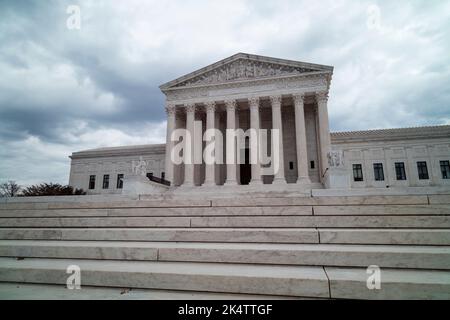
The U.S. Supreme Court declined to issue a decision on President Trump’s tariffs during its January 14, 2026 session, marking the second consecutive decision day without a ruling on the contested trade policy [1][2]. The case, Learning Resources, Inc. v. Trump, challenges the administration’s authority to impose sweeping tariffs under the 1977 International Emergency Economic Powers Act (IEEPA), with implications for approximately $4.5 trillion in annual trade [3]. Markets的反应 was muted, with the NASDAQ falling 0.96% and the S&P 500 declining 0.67% amid continued policy uncertainty [0]. The ruling is expected before the Court’s session concludes in June 2026, with the next scheduled opinion day set for February 20, 2026 [2].
The Supreme Court’s January 14, 2026 announcement confirms that the Learning Resources, Inc. v. Trump case remains under deliberation, with the Court instead releasing three unrelated opinions focused on matters including warrantless entries [1]. This represents the Court’s second consecutive decision window without ruling on the tariff matter, having also skipped the January 9, 2026 opinion day. Oral arguments in the case were previously held on November 5, 2025, establishing a deliberation period consistent with the Court’s typical handling of significant constitutional matters [1][2].
The legal framework at the center of this dispute centers on whether the IEEPA, enacted in 1977, authorizes the executive branch to impose broad tariff-setting authority, or whether this power constitutionally resides with Congress under the Commerce Clause [1]. This distinction carries profound implications for the balance of trade policy power between the executive and legislative branches, potentially reshaping how future administrations approach international trade measures.
The tariff policy under review affects an enormous scope of economic activity, with the average consumer tariff burden currently estimated at 16.8% [3]. This substantial impact explains why markets have shown sensitivity to each development in the case, as the ruling could either validate the current tariff structure or invalidate it entirely, requiring Congressional action to reinstate any suspended duties [1]. The uncertainty surrounding the outcome has created a risk premium in import-dependent sectors, with businesses struggle to plan long-term supply chain strategies without clarity on the regulatory environment.
Today’s market的反应—while modest in absolute terms—reflects the cumulative effect of extended uncertainty. The NASDAQ’s 0.96% decline and the S&P 500’s 0.67% drop indicate that investors are pricing in the possibility of adverse outcomes while maintaining exposure to potential favorable developments [0]. Trading volumes in tariff-sensitive sectors have shown elevated volatility as market participants adjust positions ahead of the anticipated ruling.
The IEEPA was originally designed to address national emergencies involving foreign threats, and its application to broad tariff authority represents a significant expansion of executive power in trade matters [1][3]. The Supreme Court’s eventual ruling will likely establish important precedents regarding the scope of emergency economic powers, potentially constraining or enabling future administrations’ ability to bypass traditional Congressional oversight in trade policy.
Should the Court rule that IEEPA does not authorize tariff-setting, the decision would represent a substantial constraint on executive authority in trade matters, requiring any future tariff regime to obtain explicit Congressional authorization [1]. Conversely, a ruling upholding the administration’s position would embolden future presidents to invoke emergency economic powers for trade purposes, fundamentally altering the constitutional balance of trade policy authority.
The Supreme Court’s decision to skip two consecutive decision windows indicates that the justices are grappling with significant constitutional questions that lack clear precedent. The Court typically reserves such extended deliberation for cases involving fundamental questions of governmental authority, suggesting that Learning Resources, Inc. v. Trump may produce a landmark ruling with far-reaching implications beyond the immediate tariff dispute [1][2]. Legal scholars should anticipate a comprehensive opinion addressing the boundaries of executive emergency authority in economic matters.
The international business community faces ongoing challenges in strategic planning as the regulatory environment remains unclear. Trading partners have reportedly adjusted their negotiation approaches in anticipation of potential outcomes, while multinational corporations are reassessing supply chain configurations that were implemented in response to the tariff regime [1]. A ruling invalidating the tariffs could trigger rapid adjustments in these arrangements, while an upholding of the policy would provide a more stable—though potentially costly—regulatory environment.
Meanwhile, Congressional activity indicates that lawmakers are preparing legislative responses regardless of the Supreme Court’s ultimate ruling. A newly proposed bill suggesting tariffs up to 500% on countries purchasing Russian energy demonstrates that even if the Court upholds IEEPA-based tariffs, the legislative branch is positioning itself to exercise its own trade authority in specific areas [3]. This parallel legislative activity suggests that the ultimate structure of U.S. trade policy will involve ongoing executive-legislative negotiation regardless of the Court’s decision.
This analysis is based on the CNBC report [1] published on January 14, 2026, covering the Supreme Court’s announcement that it would not issue a decision on tariffs during that day’s session. The case at issue, Learning Resources, Inc. v. Trump, challenges President Trump’s tariff authority under IEEPA and remains under deliberation with the next scheduled opinion day set for February 20, 2026 [1][2]. The ruling is expected before the Court’s June 2026 session concludes.
Key data points include the tariff policy’s impact on approximately $4.5 trillion in annual trade, an average consumer tariff burden of 16.8%, and current market indicators showing modest declines in major indices [0][3]. The Court’s decision to skip two consecutive decision windows indicates the complexity of the constitutional questions involved, suggesting the eventual ruling will have significant precedential value for executive authority in trade matters.
Insights are generated using AI models and historical data for informational purposes only. They do not constitute investment advice or recommendations. Past performance is not indicative of future results.
About us: Ginlix AI is the AI Investment Copilot powered by real data, bridging advanced AI with professional financial databases to provide verifiable, truth-based answers. Please use the chat box below to ask any financial question.