
In-depth Analysis of Anker Innovations' Recall Crisis: Brand Restoration Challenges and Response Strategies
Unlock More Features
Login to access AI-powered analysis, deep research reports and more advanced features
About us: Ginlix AI is the AI Investment Copilot powered by real data, bridging advanced AI with professional financial databases to provide verifiable, truth-based answers. Please use the chat box below to ask any financial question.
Related Stocks
Based on the information retrieved, I will provide you with a systematic analysis of Anker Innovations’ recall crisis and its brand restoration challenges.
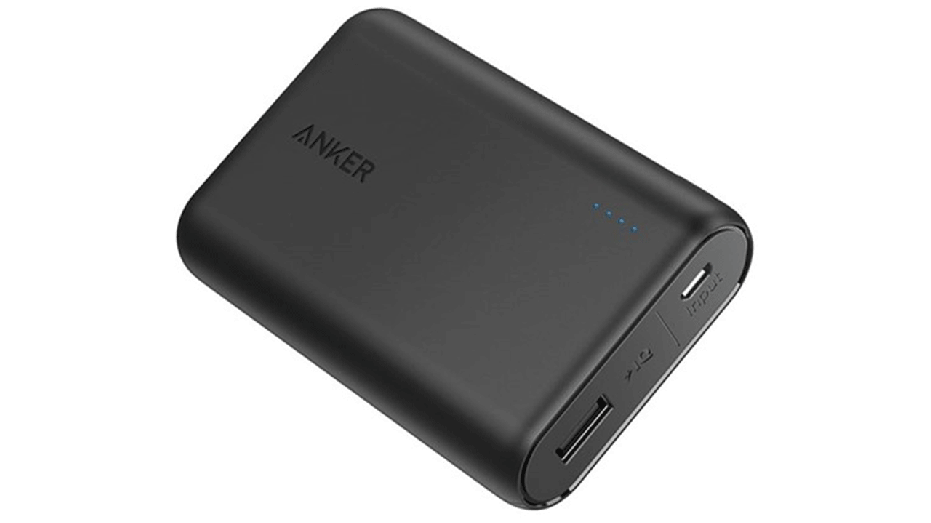
As a benchmark enterprise for China’s consumer electronics going global, Anker Innovations (300866.SZ) encountered its most severe brand crisis in history from June to September 2025.
Based on calculations using public information, if full refunds are adopted as the remedy for all recalled products, Anker Innovations’ direct economic losses will reach
| Recall Batch | Recall Quantity | Sales Amount (RMB) |
|---|---|---|
| U.S. Model A1263 | 1.158 million units | Approx. RMB 223 million |
| Domestic Recall | 713,000 units | RMB 106 million - RMB 163 million |
| New U.S. Batch | 481,000 units | RMB 103 million - RMB 171 million |
| Japanese Recall | 410,000 units + 100,000 speakers | Approx. RMB 110 million |
More notably, the company’s 2025 semi-annual report shows that
The root cause of this large-scale recall incident lies in
According to the company’s disclosure, the defective batteries in the recalled products come from a certain supplier, which
-
Inadequate Supplier Management: Anker Innovations adopts a light asset model focusing on the two ends of “design, R&D + sales, brand”, outsourcing production and manufacturing to suppliers, but there are obvious omissions in supplier management and on-site supervision[6][3].
-
Loopholes in Quality Supervision System: Although the company has passed ISO 9001 and ISO 14001 quality management system certifications, there is a significant gap between actual implementation and the standards[4].
-
Delayed Information Transmission: There is a serious delay in information transmission throughout the chain, from the supplier’s unauthorized material change, to the large-scale flow of products into the market, to consumer complaints and the final recall.
Compared with direct economic losses,
-
Changed Attitudes of Channel Partners:
- Yamada Denki, Japan’s largest electronics retailer, has removed all Anker power banks from its shelves[3]
- The negative review rate of the Anker brand on Amazon U.S. has increased significantly
- The recalled models can no longer be searched on the Amazon platform
-
Collapse of Consumer Trust:
- Negative reviews have surged on social media, with some consumers reporting “abnormal overheating in products not included in the recall”
- The number of complaints related to product quality on the Black Cat Complaint Platform has continued to rise
-
Absence of Response from the Founder: In a 3-hour media interview, founder Steven Yangdid not mention the power bank recall incident at all, triggering doubts from netizens. This silence was interpreted by the market as improper crisis response[1].
Brand restoration is a systematic project, and its time cycle depends on multiple factors. Based on the general laws of the consumer goods industry and Anker Innovations’ specific situation,
- Key Tasks: Complete all recall work, replace problematic suppliers, and establish a new quality control system
- Expected Outcomes: Stop the spread of negative public opinion and stabilize the existing customer base
- Main Challenges: Avoid new quality issues and prevent the secondary spread of negative public opinion
- Key Tasks: Reconstruct consumer trust through consistent product quality performance and restore channel partnership relations
- Expected Outcomes: Gradual recovery of market share and rebound of brand reputation indicators
- Main Challenges: Regain the preferred status among consumers in the highly competitive power bank market, and face continuous encroachment from brands such as Huawei, Xiaomi, Baseus, and Ugreen
- Key Tasks: Turn this crisis into an opportunity to improve organizational capabilities and establish an industry-leading quality management system
- Expected Outcomes: Brand value returns to pre-incident levels or higher
- Main Challenges: Completely reverse consumers’ negative perception of “Anker Quality”, which requires continuous output of high-quality products and transparent information disclosure
In the face of the crisis, Anker Innovations has taken a number of measures:
- Supply Chain Rectification: Replace problematic suppliers, and strengthen incoming material inspection and supplier audits[3]
- Management Adjustment: Jia Jingdong, former Vice President of vivo Brand, has taken up the position of CMO, and Peng Wenting, with an investment banking background, serves as the Board Secretary, in preparation for the Hong Kong IPO[1]
- Channel Diversification: Opened its first offline store in North America in September 2025 to reduce reliance on Amazon as a single channel[5]
- Capital Operations: Planning to issue H-shares on the Hong Kong Stock Exchange to raise funds “for supplementary capital”[2]
- Business Diversification: Continuously promote the “Shallow Sea Strategy”, and increase investment in non-charging businesses such as smart home and smart audio-visual products
However, from the perspective of brand restoration,
Although Anker Innovations delivered outstanding performance in H1 2025 (operating revenue of RMB 12.867 billion, a year-on-year increase of 33.36%; net profit of RMB 1.167 billion, a year-on-year increase of 33.8%), there are hidden concerns behind the financial data:
| Financial Indicators | H1 2025 | Year-on-Year Change |
|---|---|---|
| Net Cash Flow from Operating Activities | -RMB 1.132 billion | -234.58% |
| Inventory Balance | RMB 5.295 billion | +63.73% |
| Asset Impairment | RMB 290 million (Jan-Sept) | +73.1% |
The sharp deterioration of cash flow and the surge in inventory are likely related to inventory backlog caused by the recall incident. In addition, the company’s reliance on the Amazon channel (which contributes more than 50% of revenue) and policy risks in the U.S. market (an investigation was launched in September due to suspected tax evasion and product safety issues) have also added uncertainty to brand restoration[5].
Anker Innovations is facing a severe “major test”.
For investors, it is necessary to closely monitor the progress of follow-up handling of the recall incident, the recovery of channels, and the capital utilization efficiency after the Hong Kong IPO. Rebuilding brand trust cannot be achieved overnight, and whether Anker Innovations can take this opportunity to transform from a “benchmark for going global” to a “global brand” remains to be tested by time.
[1] Sina Tech - “Serial Recalls! Anker Recalls Another 480,000 Power Banks, Founder Doesn’t Mention It at All in 3-Hour Interview” (https://finance.sina.com.cn/tech/shenji/2025-09-25/doc-infrsfyv5851245.shtml)
[2] Phoenix Net Finance - “Recall Crisis Coupled with Cash Flow Pressure: Why Anker Innovations is Seeking a Hong Kong IPO” (https://finance.ifeng.com/c/8oo3m4W9uCg)
[3] 36Kr - “Anker is in Trouble Again” (https://m.36kr.com/p/3532643813317511)
[4] QQ News - “Anker’s Reputation is in Crisis: Why is the Star Brand Struggling to Defend its Quality Control Line?” (https://news.qq.com/rain/a/20250527A06QBE00)
[5] Fortune China - “Breaking Out of the ‘Shallow Sea Stranding Zone’: A Chinese Brand Endorsed by Trump” (https://www.fortunechina.com/shangye/c/2025-12/19/content_471021.htm)
[6] PingWest - “The Largest Recall by an Overseas Brand? Anker Innovations’ Global Governance Test” (https://www.pingwest.com/a/306141)
[7] Huxiu - “Anker’s Crisis is Not Just About Power Banks” (https://m.huxiu.com/article/4784755.html)
[8] Blue Ocean Yiguan Network - “Anker is in Trouble Again” (https://m.36kr.com/p/3532643813317511)
Insights are generated using AI models and historical data for informational purposes only. They do not constitute investment advice or recommendations. Past performance is not indicative of future results.
About us: Ginlix AI is the AI Investment Copilot powered by real data, bridging advanced AI with professional financial databases to provide verifiable, truth-based answers. Please use the chat box below to ask any financial question.