
In-Depth Analysis of Qian Dama's Losses: Pressures on the Daily Clearance Model and Strategic Dilemmas Amid Instant Retail Disruption
Unlock More Features
Login to access AI-powered analysis, deep research reports and more advanced features
About us: Ginlix AI is the AI Investment Copilot powered by real data, bridging advanced AI with professional financial databases to provide verifiable, truth-based answers. Please use the chat box below to ask any financial question.
According to the latest disclosed prospectus data, Qian Dama experienced a sharp reversal from profit to loss in the first three quarters of 2025 [1][2]. The company recorded operating revenue of RMB 8.359 billion, a 3.1% decrease from RMB 8.73 billion in the same period of 2024, marking the first year-on-year quarterly decline in recent years [1]. More critically, net profit plunged from a profit of RMB 227 million in the first three quarters of 2024 to a loss of RMB 288 million, which is equivalent to its full-year 2024 net profit, creating the awkward situation of “losing a year’s earnings in nine months” [1][2].
Excluding the RMB 481 million loss from fair value changes of convertible redeemable preferred shares, the company’s adjusted net profit was RMB 215 million, still down 27.6% year-on-year [1]. This data reveals that although the company’s gross profit margin has increased for three consecutive years to 11.3% (gradually improving from 9.8% in 2023), rising operating costs and intensified competition have significantly compressed profit margins [1][2].
In terms of revenue structure, 97% of Qian Dama’s revenue comes from product sales to franchisees. The number of franchise stores reached 2,898, accounting for 98.6% of total stores, with only 40 self-operated stores [3][4]. This heavy reliance on the franchise model triggers a chain reaction when the market environment deteriorates – terminal sales pressure is directly transmitted to the company’s overall performance.
As Qian Dama’s core market, South China contributed 65.9% of its revenue, but recorded a 6.8% year-on-year decline [1]. In stark contrast, the Hong Kong and Macau markets in China achieved a counter-trend growth of 7.6%, with revenue reaching RMB 692 million, accounting for an increased share of 8.3%, becoming the only growth highlight [1]. Regional gross profit margins also vary significantly: the gross profit margin in Hong Kong and Macau is as high as 18.5%, far exceeding 12.5% in South China (mainland) and 6.0% in other regions [1].
This regional differentiation reflects two key issues: first, intensified competition in the South China market has led to growth stagnation, and second, cross-regional expansion faces significant challenges in replicating its profit model. Although Qian Dama maintains the top position in community fresh grocery retail in South China (with GMV of approximately RMB 9.8 billion in 2024, 2.8 times that of the second-largest player), its national expansion has progressed slowly [4].
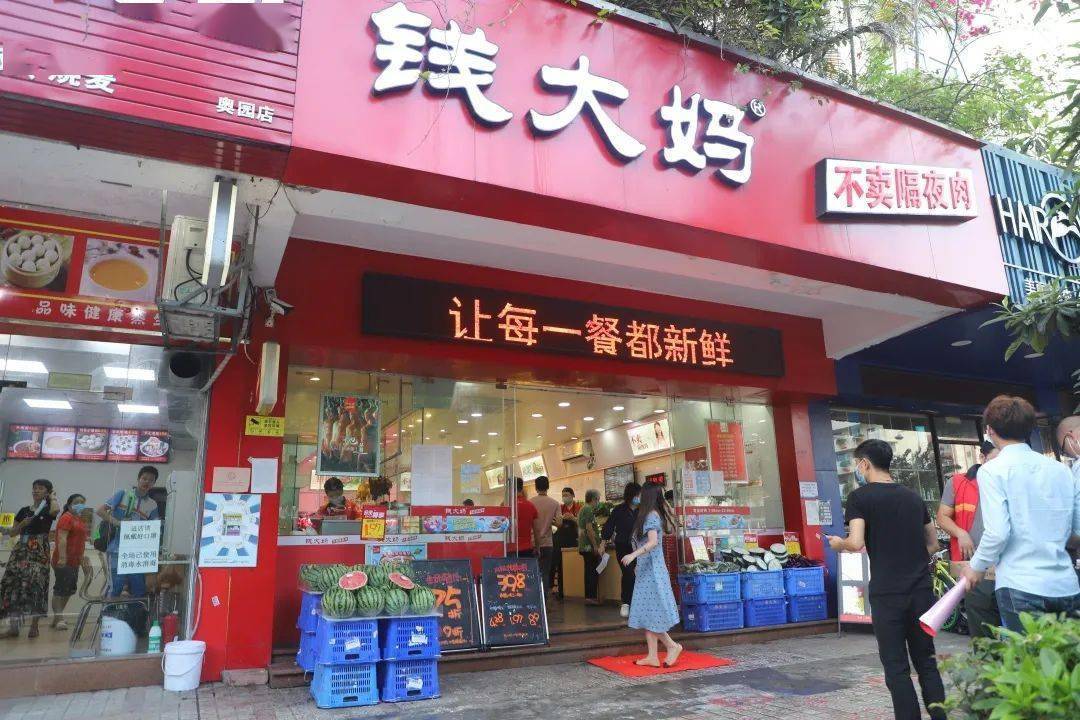
Qian Dama’s “discount daily clearance” model is its most distinctive brand identity, and also a key factor restricting its profitability [3][5]. The tiered discount implemented from 7 PM onwards (starting at 10% off, decreasing by 10% every half hour, and unsold items given away for free after 11:30 PM) ensures the promise of “no overnight meat”, but also brings persistent cost pressures [1].
On the positive side, this model has built a unique competitive barrier: consumers have formed the mental perception of “Qian Dama = fresh + affordable”, and many customers will wait for evening discounts at specific times, forming differentiated consumption habits [5]. Through the logic of “purchase based on sales”, the company has forced improvements in supply chain efficiency, building a three-level cold chain system of “central warehouse + regional warehouse + store”, with the turnover time of most fresh products controlled within 12 hours (the industry average is 2-4 days) [5].
However, the drawbacks of this model are equally clear. First, the fixed discount mechanism directly compresses the gross profit contribution of individual products, with some products sold at a 50% discount or even lower during evening discount periods [3]. Second, the product loss rate remains at 1.0%, which is higher than that of traditional retail enterprises [1]. Third, long-term fixed-time discounts have made store profits highly dependent on the full-price period from morning to afternoon. Consumers have developed the habit of deliberately waiting for discount times to shop, creating a paradox of “the more you sell, the more you lose” [4].
The biggest external challenge facing Qian Dama comes from the rise of instant retail platforms. China’s fresh grocery retail market is large in scale (expected to grow from RMB 65.7 trillion in 2024 to RMB 82.3 trillion in 2029), but the concentration of the community fresh grocery chain track is extremely low. In 2024, the combined market share of the top five industry players was only 7.2%, and Qian Dama, as a leading brand, accounted for only 2.2% [3].
More critically, the omni-channel, multi-format competitive landscape is diluting Qian Dama’s geographical convenience advantage of “500 meters from the community” [3]. Instant retail platforms such as Meituan Flash Buy and JD Daojia offer “30-minute delivery” services, making many consumers willing to pay a small delivery fee to save walking time. At the same time, front warehouse brands like Pupu often have thousands of SKUs, far exceeding Qian Dama’s 400-500 SKUs [3]. Warehouse club or premium supermarket brands such as Sam’s and Hema offer one-stop shopping experiences, further diverting customers.
The industry competition situation presents a “two extremes” characteristic [4]. On one hand, the once popular Missfresh withdrew from the market on the first anniversary of its listing; Dingdong Maicai’s stock price plummeted from the issue price of US$23.5 to below US$3, and there were even rumors that JD.com planned to acquire it [4]. On the other hand, Hema achieved profitability in fiscal year 2025, Meituan has opened Xiaoxiang Supermarkets in communities across the country, JD Seven Fresh’s order volume has doubled, and Pinduoduo is rumored to be testing a “10 Billion Yuan Supermarket” [4][6].
Qian Dama’s asset-liability structure is worrying. The asset-liability ratio is as high as 197%, with a net current liability of RMB 1.716 billion, resulting in severe insufficient short-term debt-servicing capacity [1]. The future conversion or redemption of convertible redeemable preferred shares may further exacerbate financial pressure, leading to liquidity risks.
Related party transaction risks also deserve attention. The proportion of purchases from related parties increased from 1.4% in 2023 to 2.4% in the first nine months of 2025, and is expected to reach 3.1% in 2026. The proportion of related party transactions continues to rise, raising questions about the fairness of pricing [1]. In addition, 82 leased properties of the company have not completed registration procedures, and 34 properties lack ownership certificates, posing potential legal dispute risks [1].
From the perspective of business model sustainability, Qian Dama’s daily clearance model essentially “sacrifices part of the gross profit margin in exchange for turnover and loss control, earning hard money from supply chain management and operational efficiency” [3]. However, this model limits profit margins – the company’s gross profit margin (11.3%) is significantly lower than that of peers focusing on premium fresh grocery and instant delivery (whose gross profit margins are generally in the 20%-30% range) [3]. When single-store growth is sluggish, the company’s overall growth can only rely on store expansion. However, the scarcity of high-quality locations and obstacles to regional expansion have challenged this growth logic.
Facing the impact of instant retail, Qian Dama has clearly defined three strategic directions in its prospectus [3][4]. First, continue to expand the store network, planning to add 1,300 franchise stores, but the core difficulty lies in solving the single-store profit model problem in non-South China markets. Second, upgrade the product portfolio, extending to higher gross profit margin categories such as chilled processed foods and private brands. However, this puts forward higher requirements for product research and development, brand reshaping, and supply chain adaptation capabilities, and may conflict with its inherent “affordable and fresh” brand perception. Third, strengthen digital and intelligent infrastructure, but the challenge is that the return on investment in digitalization must be extremely high under the low gross profit margin model, and at the same time, effectively enabling and having the over 98% of franchisees use digital tools is a huge management project.
From an industry perspective, retail competition is shifting from “traffic thinking” to “efficiency thinking” [6]. Platforms are not only pursuing scale, but also profits; merchants are not only pursuing orders, but also replicable profit models. The ability to turn efficiency into a systematic capability determines who will ultimately stay in the game. Qian Dama needs to tell a new story with more imagination than “no overnight meat” to grow from a regional leader to a national fresh grocery giant [3].
Based on comprehensive analysis, as a leading player in the community fresh grocery chain industry, Qian Dama has a mature franchise system and brand advantages, but its performance deteriorated significantly in 2025, with net losses expanding to RMB 288 million, and its asset-liability structure is worrying [1][2]. Risks such as the continuous increase in the proportion of related party transactions, high-debt operations, and intensified industry competition cannot be ignored. Investors need to carefully evaluate the sustainability of its business model and its ability to improve profitability, and be alert to stock price volatility risks.
[1] Sina Finance - Qian Dama Races for Hong Kong IPO: Net Loss of RMB 288 Million in First Nine Months of 2025, Net Profit Margin Plunged 6 Percentage Points (https://finance.sina.com.cn/stock/aigc/ggxg/zgs/2026-01-13/doc-inhhchmv7680471.shtml)
[2] Sohu Finance - Qian Dama Races for Hong Kong IPO: Net Loss of RMB 288 Million in First Nine Months of 2025, Net Profit Margin Plunged 6 Percentage Points (https://www.sohu.com/a/975401549_122014422)
[3] 36Kr - Qian Dama’s IPO Journey: Earning “Hard Money”, Lacking a New Story (https://m.36kr.com/p/3638692361899145)
[4] Investment Journal - Led by Her, 2,900 Qian Dama Stores Are Going for IPO (https://news.pedaily.cn/202601/559901.shtml)
[5] China Finance Online - Valued at RMB 13 Billion! Is Qian Dama’s “No Overnight Meat” Business Model Easy to Execute? (http://mp.cnfol.com/56497/article/1768376265-142213680.html)
[6] Sina Finance - Another Alibaba Platform Is Rising (https://t.cj.sina.cn/articles/view/1770735827/698b48d301901889i)
Insights are generated using AI models and historical data for informational purposes only. They do not constitute investment advice or recommendations. Past performance is not indicative of future results.
About us: Ginlix AI is the AI Investment Copilot powered by real data, bridging advanced AI with professional financial databases to provide verifiable, truth-based answers. Please use the chat box below to ask any financial question.