
Intuit Inc. (INTU) Investment Analysis Report: AI Strategy and Competitive Position Assessment
Unlock More Features
Login to access AI-powered analysis, deep research reports and more advanced features
About us: Ginlix AI is the AI Investment Copilot powered by real data, bridging advanced AI with professional financial databases to provide verifiable, truth-based answers. Please use the chat box below to ask any financial question.
Related Stocks
Based on collected data and news information, I now provide you with a comprehensive investment analysis report on Intuit.
As a leading global financial software provider, Intuit Inc. is in the critical execution phase of its AI transformation strategy. Despite its current share price having fallen over 30% from the 52-week high, the company is redefining the competitive landscape of the financial software industry through its $1 million strategic partnership with OpenAI, proprietary GenOS platform, and the launch of a new-generation AI agent system[1][2]. Major brokerage firms including Mizuho still maintain an “Outperform” rating, optimistic about the company consolidating its competitive advantages amid AI-driven industry transformation[3].
Intuit operates four core business segments, forming a complete product matrix covering individual consumers, small businesses, and the mid-market:
| Business Segment | FY2025 Revenue Contribution | Core Products | Strategic Positioning |
|---|---|---|---|
| Global Business Solutions | 78.6% | QuickBooks, Mailchimp | Primary Engine for Revenue Growth |
| Credit Karma | 16.9% | Credit Monitoring, Personal Finance | User Acquisition and Cross-Selling |
| Consumer Business | 3.6% | TurboTax | Seasonal High-Margin Business |
| Professional Tax | 0.8% | ProSeries, Lacerte | Tax Professionals Market |
In August 2025, the company completed a business restructuring, merging Consumer, Credit Karma, and ProTax into a unified Consumer Business segment to enable more efficient resource allocation and AI capability sharing[2].
According to the 10-K annual report filed on September 3, 2025, Intuit achieved strong financial growth in FY2025[4]:
- Revenue: $18.831 billion, YoY growth of 15.6%
- Net Income: $3.869 billion, YoY growth of 30.6%
- Gross Margin: Approximately 81.5% (high-margin structure driven by service revenue)
- Operating Margin: 26.7%
- Return on Equity (ROE): 21.4%
- Diluted Earnings Per Share (Diluted EPS): $13.67
The latest quarterly results (FY2026 Q1) show the company sustaining its growth momentum:
- Revenue: $3.88 billion (3.4% above expectations)
- EPS: $3.34 (8.1% above expectations)
- QuickBooks Online Ecosystem Growth: Approximately 20%[5]
The core of Intuit’s AI strategy is its self-developed
-
Financial Domain Specialization: Fine-tuned based on the company’s decades of accumulated financial data, with accuracy in vertical domains such as taxation, accounting, and payroll improved by 5% compared to general-purpose large language models
-
Inference Latency Optimization: Reduced response latency for specific accounting workflows by 50%, significantly enhancing user experience
-
Multi-Agent Collaborative Architecture: Supports collaborative work of Finance Agent, Accounting Agent, and Project Management Agent to enable end-to-end financial process automation
On November 18, 2025, Intuit announced a
- Access to Cutting-Edge Models: Priority access to GPT-4o and subsequent models
- Enterprise-Grade Capabilities: Ensures compliance, data security, and customization requirements
- R&D Collaboration: Jointly explore new frontiers of AI applications in the financial sector
As the company’s AI assistant product, Intuit Assist has been deeply integrated into core products such as QuickBooks, TurboTax, and Mailchimp[6].
- 78% of customers stated that Intuit’s AI features make business management more convenient
- 68% of users believe AI has freed up more time for business growth
- Processes 73 billion machine learning predictionsand73 million AI-driven customer interactionsannually[6]
In July 2025, Intuit’s launch of the Enterprise Suite marked a significant milestone in the company’s strategic expansion into the midsize business market[2].
| Agent Type | Functional Positioning | Value Proposition |
|---|---|---|
| Finance Agent | Financial Reporting and Scenario Planning | Delivers predictive business insights |
| Accounting Agent | Bookkeeping and Transaction Classification | Automates daily accounting workflows |
| Project Management Agent | Project Setup and Profit Targeting | Optimizes project resource allocation |
This product matrix directly addresses midsize businesses’ demand for an “integrated AI financial platform”, creating differentiated competition against rivals such as Salesforce and NetSuite.
The financial software market presents a “dominant player with strong peers” landscape, with Intuit maintaining a leading position in the core U.S. small business market:
| Competitor | Strong Regions | AI Capability Comparison |
|---|---|---|
Intuit (QuickBooks) |
U.S. Small Business | Leading GenOS platform, deepest AI integration |
| Xero | Australia, Europe, Emerging Markets | Actively catching up, JAX AI assistant launched |
| Sage | European Mid-Market | Undergoing traditional ERP transformation |
| FreshBooks | Small Professional Service Firms | Focused on user experience, limited AI capabilities |
-
Data Asset Barrier
- 30+ years of accumulated financial data
- Over 100 million user behavior data points
- Full-dimensional data coverage including tax filings, invoices, payroll, etc.
-
In-Depth Product Integration
- End-to-end integration of accounting, taxation, payroll, and marketing
- A single platform meets 80% of SMEs’ operational needs
- Cross-selling increases customer lifetime value (LTV)
-
Channels and Brand
- Strong accountant ecosystem (over 1 million certified professionals)
- Brand awareness exceeds 90% in the consumer tax software segment
- Dual-drive from direct sales and partner channels
-
First-Mover AI Advantage
- Proprietary financial large language model
- End-to-end AI agent architecture
- Continuously iterated machine learning infrastructure
AI technological transformation is redefining the competitive rules of the financial software industry. Traditional views hold that general-purpose AI (such as ChatGPT) may disrupt traditional software companies, but Intuit’s practice demonstrates that
- Accuracy Requirements: Tax filing has near-zero tolerance for errors, which general-purpose AI struggles to meet
- Compliance Requirements: Financial data processing requires strict privacy protection and audit trails
- Workflow Integration: AI needs to be deeply integrated with existing products, rather than being a standalone tool
This means companies with proprietary data and deep domain knowledge will benefit from AI transformation, rather than being disrupted.
Based on data from 34 analysts covering Intuit, the market holds a
| Rating | Percentage of Analysts |
|---|---|
| Buy/Strong Buy | 82% |
| Hold | 18% |
| Sell | 0% |
| Institution | Rating | Target Price | Core View |
|---|---|---|---|
| Mizuho Securities | Outperform | $875 | AI agents represent an “essential industry evolution” |
| Morgan Stanley | Overweight | $730 | Small business growth + AI-driven margin expansion |
| RBC Capital | Outperform | - | Maintains rating, optimistic about growth momentum |
| BMO Capital | Outperform | - | Affirms AI strategy execution capability |
| Evercore ISI | Outperform | - | Confirms growth sustainability |
| Metric | Value |
|---|---|
| Average Target Price | $805.00 |
| Highest Target Price | $880.00 |
| Lowest Target Price | $700.00 |
| Current Share Price | $566.60 |
| Potential Upside | +42.1% |
At the 2025 Mizuho Technology Conference, Mariana Tassel, Executive Vice President of Intuit’s Global Business Solutions Group, elaborated on the company’s AI strategy in detail[7]. Mizuho analyst Siti Panigrahi stated:
“Intuit’s AI agents represent an essential evolution for the entire industry. We expect the QuickBooks business to maintain strong growth, with AI-driven new functions serving as a core catalyst.”
Mizuho has listed Intuit as an “AI winner” target, believing that AI-related metrics will be the market’s focus in the upcoming FY2026 Q2 earnings report[8].
| Metric | Value | Signal Interpretation |
|---|---|---|
| Current Price | $566.60 | - |
| 20-Day Moving Average | $652.31 | 13.14% below MA20 |
| 50-Day Moving Average | $653.18 | 13.25% below MA50 |
| RSI (14-Day) | 16.17 | Extremely Oversold |
| MACD | -13.43 | Negative, weak territory |
| Beta (vs SPY) | 1.25 | Higher than market volatility |
| 52-Week Range | $532.65 - $813.70 | 30.4% below the 52-week high |
- Price Pattern: The share price has formed a clear descending channel, triggering a sell signal on January 12
- Moving Average System: The current price is significantly below all major moving averages, showing a bearish alignment
- Momentum Indicators:
- RSI is below 20 in the extremely oversold zone, which may trigger a technical rebound
- MACD histogram remains negative, but shows signs of narrowing
- Key Support Levels:
- Strong Support: $556.66 (current low)
- Key Support: $532.65 (52-week low)
- Key Resistance Levels:
- First Resistance: $657.81
- Strong Resistance: $700 (psychological level)
A significant
- Fundamentals: Strong revenue growth, expanding margins, leading AI strategy
- Technicals: Over 30% drop from the high, oversold condition, downward trend
Such divergence usually indicates that the market may be overpricing short-term risks, providing an entry opportunity for long-term investors.
| Metric | Expected Range |
|---|---|
| Revenue | $20.997B - $21.186B (+12-13%) |
| GAAP Operating Income | $5.782B - $5.859B (+17-19%) |
| Non-GAAP Operating Income | $8.611B - $8.688B (+14-15%) |
- QuickBooks Online Advanced: 28% growth in subscription users, continuous ARPU improvement
- Online Ecosystem: Expected growth of approximately 20%, AI features increase attach rates
- Mid-Market: AI agent features of the Enterprise Suite drive market share expansion
- International Business: Synergies between Mailchimp and QuickBooks are emerging
The AI strategy is expected to improve margins through the following channels:
- Operating Leverage: AI automation reduces service delivery costs
- Customer Acquisition Efficiency: AI-driven marketing personalization improves conversion rates
- Customer Retention: AI features enhance product stickiness and reduce churn rates
- Development Efficiency: AI-assisted programming improves R&D output
| Risk Type | Details | Impact Level |
|---|---|---|
Execution Risk |
AI product commercialization speed falls short of expectations | Medium |
Competition Risk |
Competitors such as Xero accelerate AI capability catch-up | Medium |
Macroeconomic Risk |
SMB customers cut IT spending | Medium |
Valuation Risk |
Current P/E (38x) is above historical average | Medium-Low |
Technical Risk |
AI model accuracy issues and compliance risks | Low |
- FY2026 Q2 Earnings Report(February 24, 2026): AI metrics will be the focus
- Product Updates: Launch of new GenOS features
- Analyst Upgrades: More institutions raise target prices or ratings
- Share Repurchases: The company’s ongoing share repurchase program
Intuit’s long-term investment value is built on:
- Digital Transformation: Continuous increase in digital penetration of financial management
- AI Platformization: GenOS becomes the AI infrastructure for the financial software industry
- Ecosystem Expansion: Building a complete business ecosystem through Mailchimp and Credit Karma
- International Expansion: AI lowers localization barriers and accelerates global expansion
Intuit is in the critical phase of AI-driven strategic transformation. Through the GenOS platform, partnership with OpenAI, and the launch of a new-generation AI agent system, the company is elevating AI from a “feature enhancement” to a “core strategic asset”. This transformation is poised to consolidate its leading position in the financial software sector and open a new growth curve.
- AI agent features represent an “essential industry evolution”, rather than non-essential add-ons
- Proprietary financial large language model forms a competitive barrier
- Strong customer base and data assets accelerate AI iteration
- Dual drivers of financial growth and margin expansion
| Dimension | Recommendation |
|---|---|
Rating |
Buy (in line with Mizuho consensus) |
Target Price |
$805.00 (42% upside from current price) |
Risk-Reward |
3:1 ($240 upside vs $80 downside) |
Time Horizon |
12-18 months |
Investors should monitor the following metrics to validate the investment thesis:
- QuickBooks online subscription growth (target: 20%+)
- Changes in customer retention rate (target: stable or improved)
- AI feature adoption rate (target: 50%+ penetration)
- Operating margin expansion (target: 200+ bps YoY)
- Free cash flow conversion rate (target: >100%)
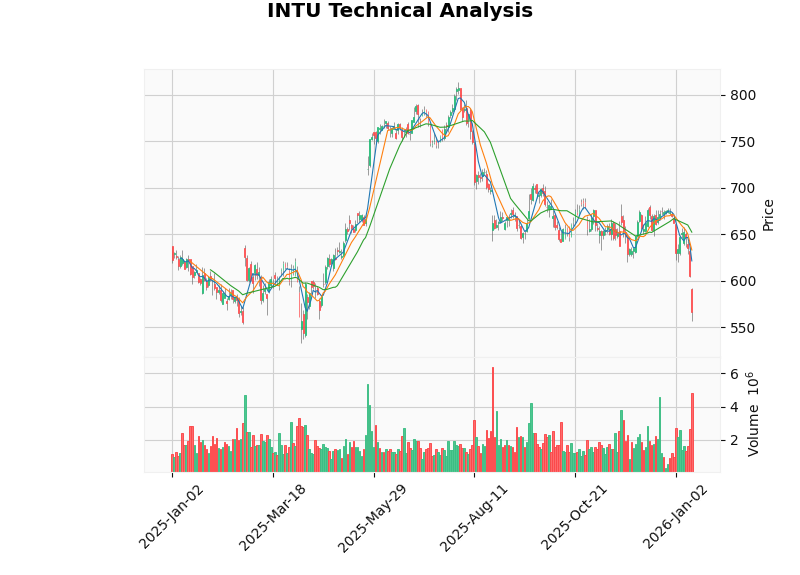
The chart above shows INTU’s share price trend since 2025, marking key AI events (OpenAI partnership announcement, Enterprise AI agent launch) and technical indicators (moving averages, MACD). The share price is currently in the oversold zone, and confirmation of a bottom pattern from technicals is needed.
[1] Delia Tax Attorneys - “Intuit’s $100 Million Partnership With OpenAI” (https://deliataxattorneys.com/intuits-100-million-partnership-with-openai-what-businesses-should-know/)
[2] Fintech Magazine - “Intuit Scales AI Ambitions as Sixth-Ranked Fintech” (https://fintechmagazine.com/news/intuit-scales-ai-ambitions-as-sixth-ranked-fintech)
[3] Klover AI - “Intuit’s AI Strategy: Analysis of AI Dominance in Financial Technology” (https://www.klover.ai/intuit-ai-strategy-analysis-of-ai-dominance-in-financial-tech/)
[4] SEC EDGAR - Intuit Inc. FY2025 10-K Filing (https://www.sec.gov/Archives/edgar/data/896878/000089687825000035/intu-20250731.htm)
[5] Jinling AI Financial Database - Real-Time Quotes and Company Overview
[6] Matrix BCG - “Growth Strategy and Future Prospects of Intuit” (https://matrixbcg.com/blogs/growth-strategy/intuit)
[7] Investing.com - “Intuit at Mizuho Conference: AI-Driven Growth Strategy” (https://www.investing.com/news/transcripts/intuit-at-mizuho-conference-aidriven-growth-strategy-93CH-4089870)
[8] Yahoo Finance - “Buy shares of this AI winner into earnings next week: Mizuho” (https://finance.yahoo.com/news/buy-shares-ai-winner-earnings-122215375.html)
Insights are generated using AI models and historical data for informational purposes only. They do not constitute investment advice or recommendations. Past performance is not indicative of future results.
About us: Ginlix AI is the AI Investment Copilot powered by real data, bridging advanced AI with professional financial databases to provide verifiable, truth-based answers. Please use the chat box below to ask any financial question.