Analysis Report on R&D Investment Ratio of Fintech Companies
Unlock More Features
Login to access AI-powered analysis, deep research reports and more advanced features
About us: Ginlix AI is the AI Investment Copilot powered by real data, bridging advanced AI with professional financial databases to provide verifiable, truth-based answers. Please use the chat box below to ask any financial question.
Related Stocks
I have now collected sufficient data. Let me present you with an
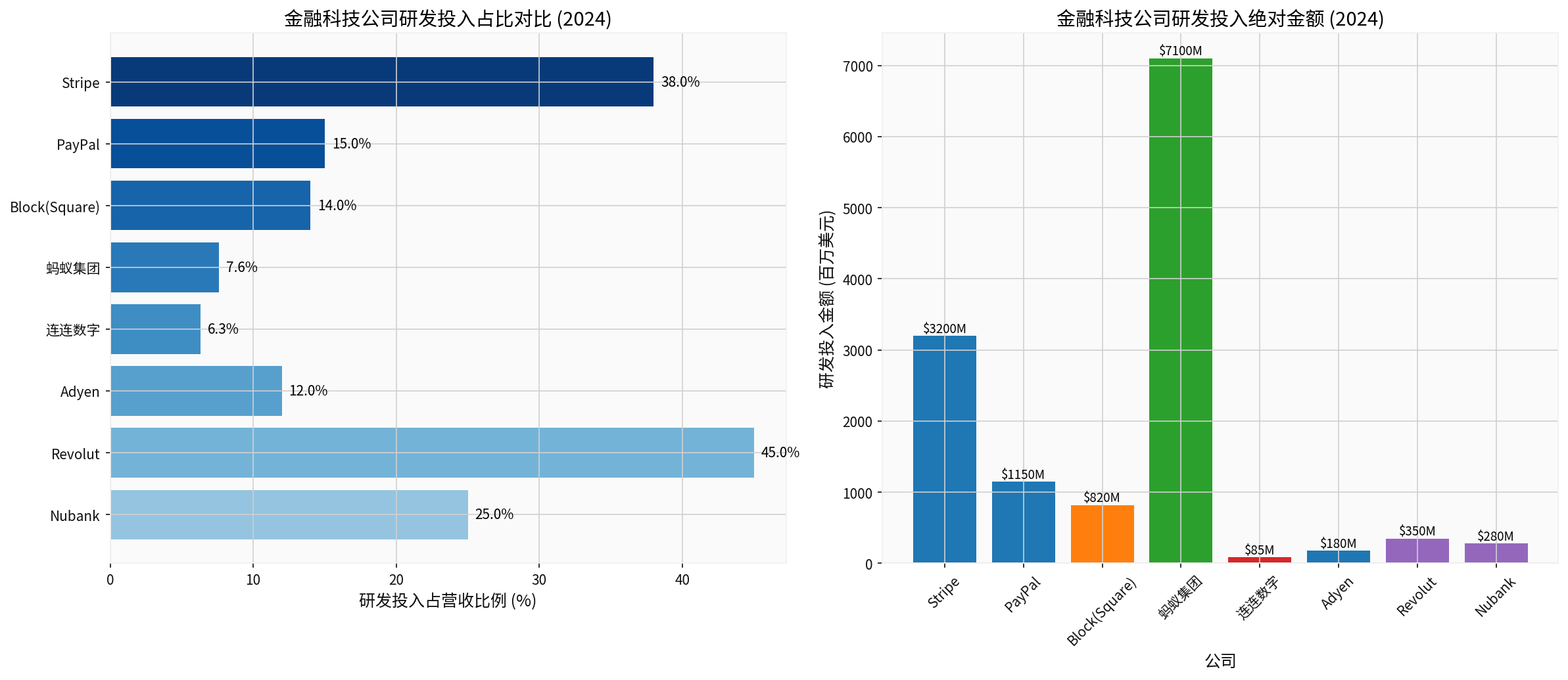
Based on the latest financial data and market research reports, the R&D investment of major global fintech companies in 2024 shows significant differentiation characteristics [0][1][2]:
| Company | R&D Investment as % of Revenue | R&D Investment Amount | Business Model |
|---|---|---|---|
Revolut |
45.0% | USD 350 million | Digital Bank |
Stripe |
38.0% | USD 3.2 billion | Payment Infrastructure |
Nubank |
25.0% | USD 280 million | Digital Bank |
PayPal |
9.4% | USD 2.979 billion | Payment Platform |
Block(Square) |
14.0% | USD 820 million | Payment + SaaS |
Adyen |
12.0% | USD 180 million | Enterprise Payment |
Ant Group |
7.6% | USD 7.1 billion | Integrated Fintech |
LianLian Digital |
6.3% | USD 85 million | Cross-border Payment |
Represented by Revolut and Nubank, digital banks have the highest R&D investment ratios, reaching 45% and 25% respectively. This is mainly due to the following reasons [1][2]:
- Digital banks need to build a complete banking infrastructure system
- Must comply with regulatory and compliance technical requirements in various regions
- Need to continuously iterate mobile user experience
- Risk control models and credit assessment algorithms need continuous optimization
R&D investment in the payment sector shows polarization:
- Stripe, as a payment infrastructure provider, has an R&D investment ratio of as high as 38%, mainly invested in machine learning, fraud detection systems, and API infrastructure construction [2]
- PayPal, a traditional payment giant, has an R&D investment ratio of 9.4% (USD 2.979 billion in R&D investment in 2024), showing a year-on-year downward trend, dropping from 11.7% in 2020 to 9.4% in 2024 [0]
Chinese fintech companies have relatively low R&D investment ratios [1]:
- Ant Group: approximately 7.6%
- LianLian Digital: approximately 6.3%
This may be related to the following factors:
- Large business scale with relatively high R&D efficiency
- Mature technical infrastructure has been established
- Focus has shifted to business expansion and compliance construction
According to the 2025 report by iResearch [1], the cutting-edge technology investment of Chinese financial institutions shows the following characteristics:
| Technology Field | 2024 Investment Ratio | 2029 Forecasted Investment Ratio | Compound Annual Growth Rate (CAGR) |
|---|---|---|---|
| Cloud Native/Cloud Platform | 23.9% | 23.6% | Stable |
| Big Data | 17.3% | 18.4% | 22.2% |
| Artificial Intelligence (AI) | 5.5% | 8.1% | 30.4% |
| Blockchain | 4.1% | 5.2% | — |
| Open Banking | 2.5% | 3.0% | — |
It is estimated that by 2029, the total investment in cutting-edge technologies by Chinese financial institutions will reach
- Cloud platform investment: approximately RMB 111.9 billion
- Big data investment: approximately RMB 36.9 billion
- AI investment: approximately RMB 16.2 billion
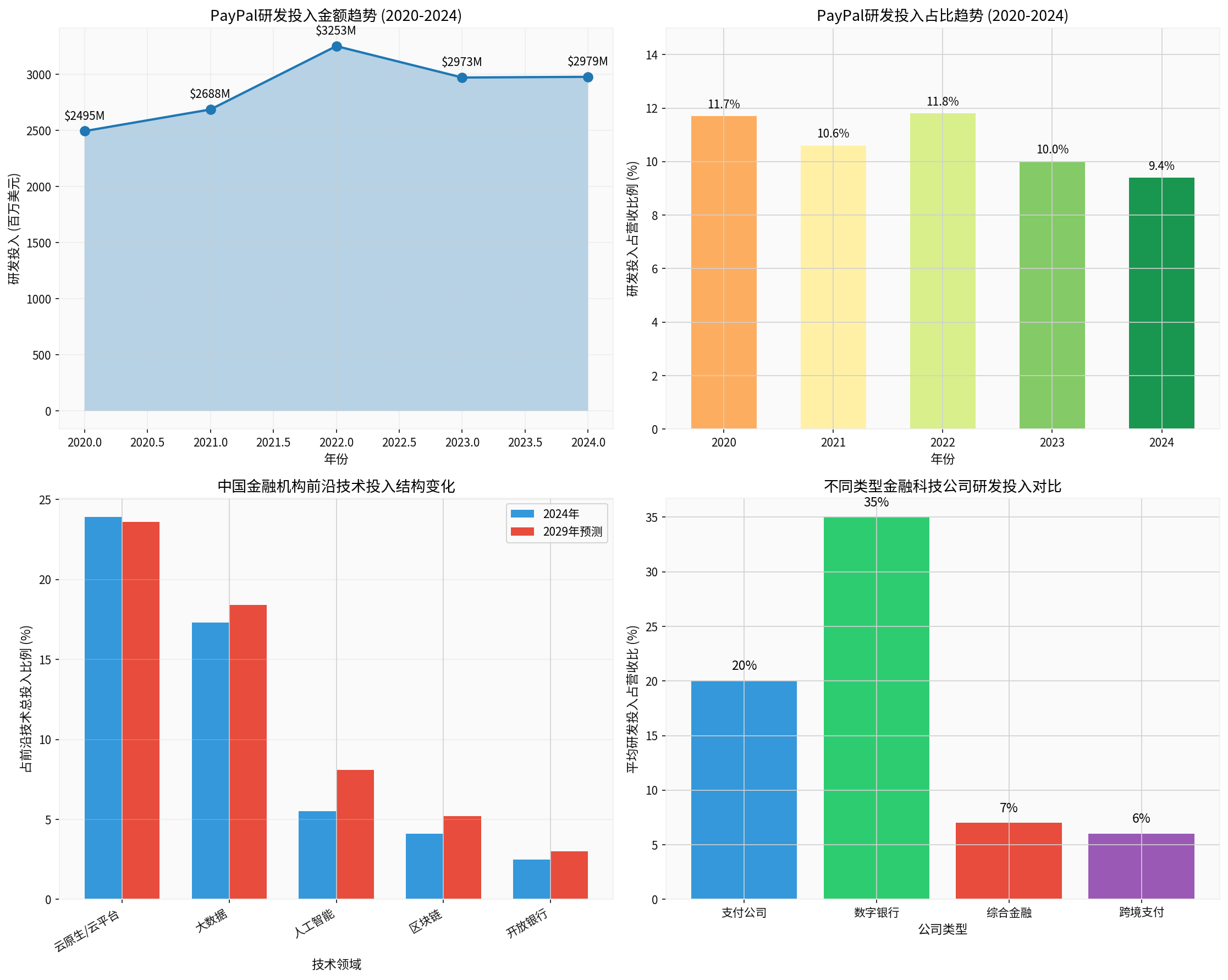
As can be seen from PayPal’s financial report data [0]:
| Year | R&D Investment (USD Millions) | Revenue (USD Millions) | R&D Investment Ratio |
|---|---|---|---|
| 2020 | 2,495 | 21,402 | 11.7% |
| 2021 | 2,688 | 25,371 | 10.6% |
| 2022 | 3,253 | 27,518 | 11.8% |
| 2023 | 2,973 | 29,771 | 10.0% |
| 2024 | 2,979 | 31,797 | 9.4% |
- The absolute amount of R&D investment remains basically flat, staying around USD 3 billion
- Revenue growth has led to a year-on-year decline in the R&D investment ratio
- PayPal’s R&D focus has shifted from basic technology to product optimization and user experience improvement
- Artificial Intelligence Technology: According to a BCG report, AI-driven product innovation has become a core competitive barrier [2]
- Compliance Technology: Demand for Regulatory Technology (RegTech) has surged
- Security and Risk Control: Fraud methods are becoming increasingly complex, leading to increased investment in anti-fraud technology
- Cross-border Payment: Demand for R&D in real-time payment and stablecoin infrastructure is rising
- Digital Banks: Highest R&D investment (25%-45%), need to build a complete banking technology stack
- Payment Infrastructure: Relatively high R&D investment (12%-38%), focusing on APIs and network effects
- Integrated Fintech: Relatively low R&D investment (6%-10%), focusing on business integration
According to the 2025 Asia Fintech Survey by EY [3], the main investment needs of fintech institutions in the next 12 months are:
- Artificial Intelligence and Machine Learning(58.9%)
- Cybersecurity(46.6%)
- Big Data and Data Analytics(43.8%)
- Cloud Computing(39.7%)
- Digital banks have the highest R&D investment: Revolut (45%) and Nubank (25%) represent the highest R&D investment level in the industry
- Payment infrastructure companies show differentiation in investment: Stripe (38%) is much higher than PayPal (9.4%)
- Chinese fintech companies are relatively conservative: Ant Group (7.6%) and LianLian Digital (6.3%)
- AI and cloud platforms are future growth drivers: It is predicted that by 2029, AI investment by Chinese financial institutions will grow to RMB 16.2 billion
Differences in R&D investment reflect the technical dependence and competitive strategies of different business models. Digital banks need higher R&D investment to build differentiated competitive advantages.
[0] PayPal Holdings, Inc. 2024 Annual Report (Form 10-K), SEC Filing, February 4, 2025. https://www.sec.gov/Archives/edgar/data/1633917/000163391725000019/pypl-20241231.htm
[1] iResearch. “2025 Insight Report on the Development of China’s Fintech Industry”, April 2025. https://pdf.dfcfw.com/pdf/H3_AP202504011649888138_1.pdf
[2] Boston Consulting Group & QED Investors. “Fintech’s Next Chapter: Scaled Winners and Emerging Disruptors”, May 2025. https://web-assets.bcg.com/e8/4d/5eeb786b4aefbf6c7270ed4d0afe/fintechs-next-chapter-may-2025.pdf
[3] EY. “2025 Asia Fintech Research Report: Turning Challenges into Growth”, 2025. https://www.ey.com/content/dam/ey-unified-site/ey-com/zh-tw/insights/financial-services/documents/ey-2025-asia-fintech-research-report.pdf
SiC TSV通孔蚀刻技术工业可行性分析
Insights are generated using AI models and historical data for informational purposes only. They do not constitute investment advice or recommendations. Past performance is not indicative of future results.
About us: Ginlix AI is the AI Investment Copilot powered by real data, bridging advanced AI with professional financial databases to provide verifiable, truth-based answers. Please use the chat box below to ask any financial question.