In-Depth Analysis of Insider Buying and Investment Value for Rocky Mountain Chocolate (RMCF)
Unlock More Features
Login to access AI-powered analysis, deep research reports and more advanced features
About us: Ginlix AI is the AI Investment Copilot powered by real data, bridging advanced AI with professional financial databases to provide verifiable, truth-based answers. Please use the chat box below to ask any financial question.
Related Stocks
Based on public information, the recent buying activities of Jeffrey Richart Geygan, interim CEO of Rocky Mountain Chocolate, are as follows [1]:
| Transaction Date | Number of Shares Purchased | Transaction Amount | Position Change |
|---|---|---|---|
| January 16, 2026 | 11,300 shares | Approx. $22,352 | Position increased by 0.6%, holding 1,792,478 shares |
| November 4, 2025 | Multiple Purchases | - | Cumulative increase in holdings |
- CEO’s Personal Purchases: 7 purchase transactions, totaling 125,715 shares with an aggregate amount of approximately $208,873,zero sales[1]
- Major Shareholder Increases: Global Value Investment Corp (holding over 10% of shares) made 8 purchases over the past 6 months, totaling 133,115 shares with an aggregate amount of approximately $251,435 [1]
- Overall Insider Transactions: 15 insider transactions over the past 6 months,all purchases, no sales
Insider stock purchases are generally regarded as an important signal of management’s confidence in the company’s future in investment analysis, but a comprehensive judgment needs to be made by combining the following factors:
- Interest Alignment: Insiders use personal funds to buy the company’s stock, indicating that their interests are highly aligned with those of shareholders
- Information Advantage: Management has access to internal information about the company’s operations, and their purchase behavior implies confidence in the company’s fundamentals
- Continuous Purchases: Continuous, phased purchases over the past 6 months, rather than a one-time large purchase, indicate that this is based on a judgment of the company’s long-term prospects rather than short-term speculation
- Major Shareholder Endorsement: As a shareholder holding over 10% of shares, Global Value Investment Corp’s 8 purchases demonstrate recognition from a professional institutional investor
| Metric | Value | Evaluation |
|---|---|---|
| Market Capitalization | $15.19M | Micro-cap stock with limited liquidity |
| Current Stock Price | $1.96 | - |
| P/E | -3.79x | In a loss-making state |
| ROE | -62.48% | Significantly negative |
| Net Profit Margin | -13.62% | Loss-making |
| Current Ratio | 1.66 | Adequate short-term solvency |
| P/S | 0.51 | Low price-to-sales ratio |
| Fiscal Quarter | EPS | Revenue (in millions) | Evaluation |
|---|---|---|---|
| Q3 FY2026 (Nov 2025) | -$0.02 | $7.54 | Significant improvement |
| Q2 FY2026 (Aug 2025) | -$0.09 | $6.82 | - |
| Q1 FY2026 (May 2025) | -$0.04 | $6.37 | - |
| Q4 FY2025 (Feb 2025) | -$0.37 | $8.90 | Largest loss |
- FY2025 operating cash flow: -$6.6 million[2]
- FY2025 net loss: $6.1 million[2]
- Debt covenant default exists: The ratio of total liabilities to tangible net assets is 2.21:1, exceeding the 2:1 upper limit specified in the agreement [2]
- Auditors have marked substantial doubt about going concern ability[2]
- Cash balance as of February 2025 is only $0.72 million, a significant decrease from $2.08 million in the previous year [2]
The company’s business consists of three major segments:
- Product Sales (76-77%): Sells homemade chocolate products to franchisees and specialty markets
- Royalty Fees (19-21%): Derived from 141 franchise stores and 117 authorized stores
- Company-Owned Stores (5%): 2 company-owned stores
The
| Indicator | Status | Interpretation |
|---|---|---|
| Trend Judgment | Uptrend (to be confirmed) |
Strict conditions met, price breakout |
| MACD | Bearish Crossover | Medium-term momentum is bearish |
| KDJ | K:42.5, D:54.3 | Neutral to weak |
| RSI | Normal Range | No overbought or oversold conditions |
| Beta | 0.71 | Low correlation with the broader market |
| Support Level | $2.02 | - |
| Resistance Level | $2.25 | Key short-term resistance level |
| Next Target | $2.39 | - |
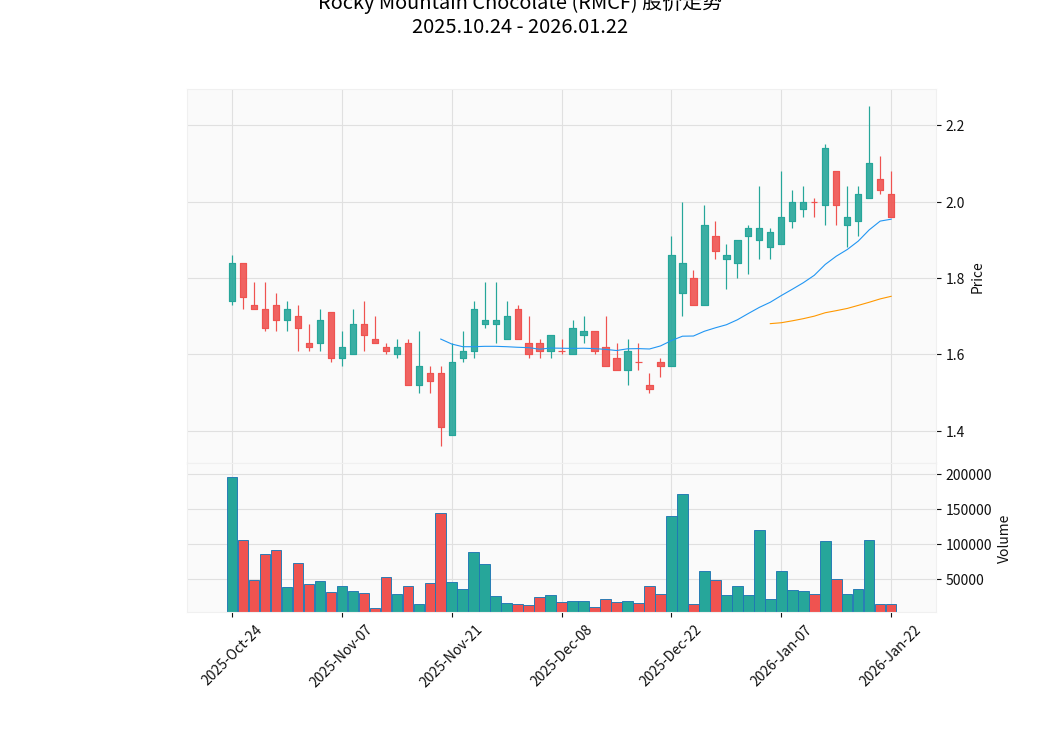
Based on the candlestick chart analysis, the stock price has shown the following characteristics over the past 3 months:
- Range Performance: Rose from $1.74 to $1.96, with an increase of+12.64%[0]
- Fluctuation Range: $1.36 - $2.25, with an amplitude of51.77%[0]
- Moving Average Pattern: The 20-day moving average ($1.95) crossed above the 50-day moving average ($1.75), forming abullish crossoverpattern
- Trading Volume: Average daily trading volume of approximately 48,479 shares, with low liquidity
- Quarterly Performance Improvement: Q3 FY2026 EPS improved significantly from -$0.09 to -$0.02, with revenue growing consecutively [0]
- Healthy Current Ratio: A current ratio of 1.66 indicates adequate short-term solvency
- Growth in Specialty Market Business: Expansion of channels such as e-commerce and wholesale brings new growth drivers
- Continuous Insider Buying: Management and major shareholders have invested real capital, showing confidence in the company’s transformation
- Sustained Losses: Net loss of $6.1 million in FY2025, with consecutive annual losses
- Tight Cash Flow: Operating cash flow of -$6.6 million, with cash reserves of only $0.72 million
- Debt Risks: Debt covenant default exists, with doubt about going concern ability
- Limited Market Space: Market capitalization of only $15.2 million, with poor liquidity as a micro-cap stock
- Industry Competition: The candy retail market is highly competitive, facing challenges from large brands and health trends
| Dimension | Assessment | Weight |
|---|---|---|
| Insider Buying | Strong Buy Signal |
Positive |
| Earnings Trend | Improving but still loss-making |
Neutral to Bearish |
| Cash Flow | Severely Tight |
Negative |
| Debt Risks | Default Risk Exists |
Negative |
| Technical Aspects | Uptrend to be Confirmed |
Neutral to Bullish |
| Valuation | Low P/S Ratio but High Risk |
Neutral |
- High Risk Tolerance Investors: Investors who can bear substantial principal losses
- Micro-Cap Stock Enthusiasts: Investors who are familiar with the investment logic of micro-cap stocks
- Long-Term Investors: Investors willing to wait for the company’s transformation to succeed (at least 1-2 years)
- Principal Loss Risk: Extremely High - The company’s financial condition is unstable
- Liquidity Risk: Extremely High - Average daily trading volume of only approximately 50,000 shares, large transactions may significantly affect the stock price
- Delisting Risk: If the stock price remains depressed or financial conditions deteriorate, delisting may occur
- Execution Risk: Uncertainty exists regarding the success of management’s strategic transformation
| Strategy | Description |
|---|---|
Wait-and-See as Main Approach |
It is recommended to closely monitor the Q4 FY2026 financial report and debt compliance progress |
Phased Position Building |
If deciding to invest, enter positions in phases to avoid one-time large purchases |
Stop-Loss Setting |
It is recommended to set a stop-loss level of 10-15% |
Position Control |
The proportion of micro-cap stocks should not exceed 5-10% of the portfolio |
- Whether quarterly EPS can continue to improve and turn positive
- When operating cash flow turns positive
- Debt covenant compliance status
- Changes in the number of franchise stores
- Growth of the specialty market business
The continuous buying by the interim CEO and major shareholders of Rocky Mountain Chocolate does send a positive signal, and combined with the quarterly performance improvement trend, it may indicate that the company’s most difficult period is passing. However, investors should not make investment decisions solely based on insider buying.
- Insider buying isa reflection of management’s confidence, butdoes not constitutea buy recommendation
- The company’s fundamentals are improving but have not yet emerged from difficulties
- The current stock price mayhave partially reflected improvement expectations, but uncertainty remains high
- Investing in such high-risk micro-cap stocks requires extremely high risk tolerance and strict position management
[0] Jinling AI Financial Database - Company Overview, Financial Analysis, Price Data and Technical Indicators for Rocky Mountain Chocolate (Data as of January 23, 2026)
[1] Quiver Quant - “Insider Purchase: Interim CEO of $RMCF Buys 11,300 Shares” (https://www.quiverquant.com/news/Insider+Purchase%3A+Interim+CEO+of+%24RMCF+Buys+11%2C300+Shares)
[2] U.S. Securities and Exchange Commission SEC Filing - Rocky Mountain Chocolate Factory, Inc. 10-K Annual Report (https://www.sec.gov/Archives/edgar/data/1616262/000095017025088556/rmcf-20250228.htm)
阿里巴巴速卖通"超级品牌出海计划"战略分析报告
Insights are generated using AI models and historical data for informational purposes only. They do not constitute investment advice or recommendations. Past performance is not indicative of future results.
About us: Ginlix AI is the AI Investment Copilot powered by real data, bridging advanced AI with professional financial databases to provide verifiable, truth-based answers. Please use the chat box below to ask any financial question.