Goldman Sachs CEO Predicts Major AI Productivity Wave: Market Impact Analysis
Unlock More Features
Login to access AI-powered analysis, deep research reports and more advanced features
About us: Ginlix AI is the AI Investment Copilot powered by real data, bridging advanced AI with professional financial databases to provide verifiable, truth-based answers. Please use the chat box below to ask any financial question.
Related Stocks
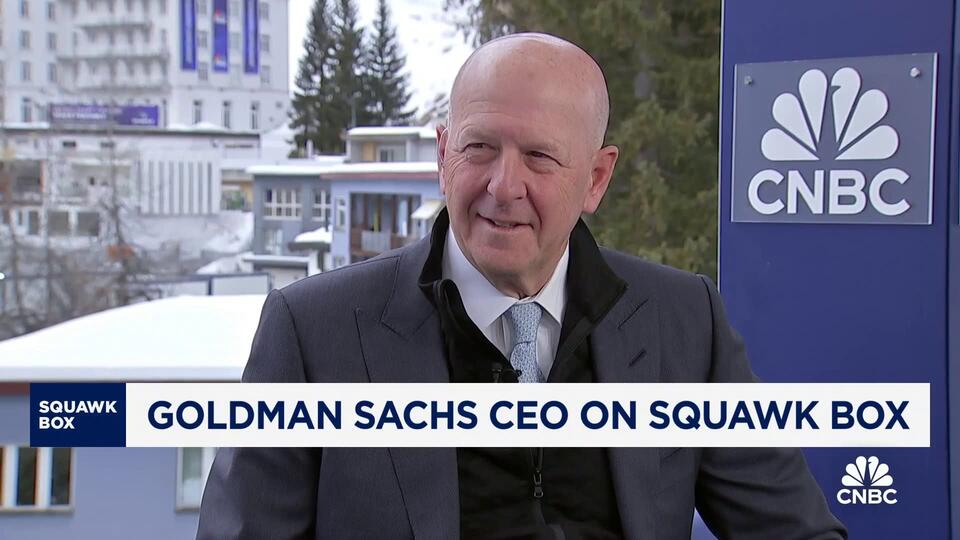
This analysis is based on Goldman Sachs CEO David Solomon’s CNBC interview [1] on November 12, 2025, where he predicted a major wave of AI-driven productivity transformation across industries over the next 3-5 years. Solomon emphasized that CEOs across all sectors are focused on “reimagining and automating processes” to create operating efficiency and expand business capacity [1][2]. This view was echoed by Microsoft CEO Satya Nadella and Nvidia CEO Jensen Huang, with Solomon noting Goldman Sachs’s own evolution to employ 13,000 engineers today compared to minimal engineering staff 25 years ago [1][2].
The AI productivity thesis gained immediate market traction, with all three mentioned stocks showing positive momentum despite mixed broader market performance:
- Goldman Sachs (GS): +3.54% on the day, significantly outperforming markets [0]
- Microsoft (MSFT): +0.48% on the day [0]
- NVIDIA (NVDA): +0.33% on the day [0]
This selective enthusiasm occurred while major indices showed mixed performance:
- S&P 500: -0.25% to 6,850.92 [0]
- NASDAQ Composite: -0.67% to 23,406.46 [0]
- Dow Jones: +0.50% to 48,254.82 [0]
The outperformance of AI-related stocks versus the tech-heavy NASDAQ suggests targeted investor confidence in the AI productivity narrative rather than broad tech optimism.
Solomon’s observation that “CEOs everywhere are trying to ‘reimagine and automateate processes’” [1] suggests AI adoption has reached critical mass across traditional industries, not just tech sectors. This represents a significant shift from AI being viewed as a technology concern to being a core business strategy imperative.
Goldman Sachs’s own evolution from minimal engineering staff to 13,000 engineers [1] illustrates how financial services are fundamentally repositioning for AI-driven operations. This creates dual opportunities: internal efficiency gains and enhanced client advisory capabilities for AI transformation guidance.
Microsoft’s “AI superfactory” development and NVIDIA’s collaboration with telecom providers like Indosat for AI-RAN development [3] indicate massive infrastructure build-out supporting the productivity wave. This suggests a multi-year investment cycle across data centers, edge computing, and network infrastructure.
- Valuation Premium Risk: AI ecosystem stocks trading at elevated multiples (NVDA 54x P/E, MSFT 36x P/E) [0] could face sharp corrections if adoption disappoints
- Implementation Timeline Gap: Enterprise AI adoption typically requires 18-24 months for meaningful productivity gains, creating potential for expectation-reality mismatch
- Regulatory Scrutiny: Increased AI usage in financial services may attract regulatory attention, particularly around data privacy and algorithmic decision-making
- Cross-Industry Productivity Gains: Solomon’s cross-sector observations suggest broad-based productivity benefits could drive sustained investment cycles
- Infrastructure Demand: Multi-year build-out of AI infrastructure (data centers, edge computing, networks) creates predictable demand patterns
- Financial Services Evolution: Banks and investment firms uniquely positioned to benefit from both internal AI efficiency and external AI advisory services
The AI productivity wave represents a significant technological transformation with cross-industry implications. Goldman Sachs’s CEO validation of this trend, combined with similar perspectives from Microsoft and Nvidia leadership, suggests strong institutional backing for the AI investment thesis. However, premium valuations across the ecosystem require careful consideration of implementation timelines and adoption rates.
The market’s selective positive reaction to Solomon’s comments, despite mixed broader market performance, indicates investor confidence in the AI productivity narrative. Financial services firms like Goldman Sachs appear uniquely positioned to benefit from both internal AI-driven efficiency gains and external advisory services for corporate AI transformations.
Monitoring enterprise earnings guidance for AI-related revenue commentary, actual AI deployment metrics versus pilot programs, and infrastructure capacity constraints will be critical for assessing the productivity wave’s progression and investment implications.
Insights are generated using AI models and historical data for informational purposes only. They do not constitute investment advice or recommendations. Past performance is not indicative of future results.
About us: Ginlix AI is the AI Investment Copilot powered by real data, bridging advanced AI with professional financial databases to provide verifiable, truth-based answers. Please use the chat box below to ask any financial question.