Mega Cap Tech Earnings Week: Market Analysis and Key Risk Assessment (January 2026)
Unlock More Features
Login to access AI-powered analysis, deep research reports and more advanced features
About us: Ginlix AI is the AI Investment Copilot powered by real data, bridging advanced AI with professional financial databases to provide verifiable, truth-based answers. Please use the chat box below to ask any financial question.
Related Stocks
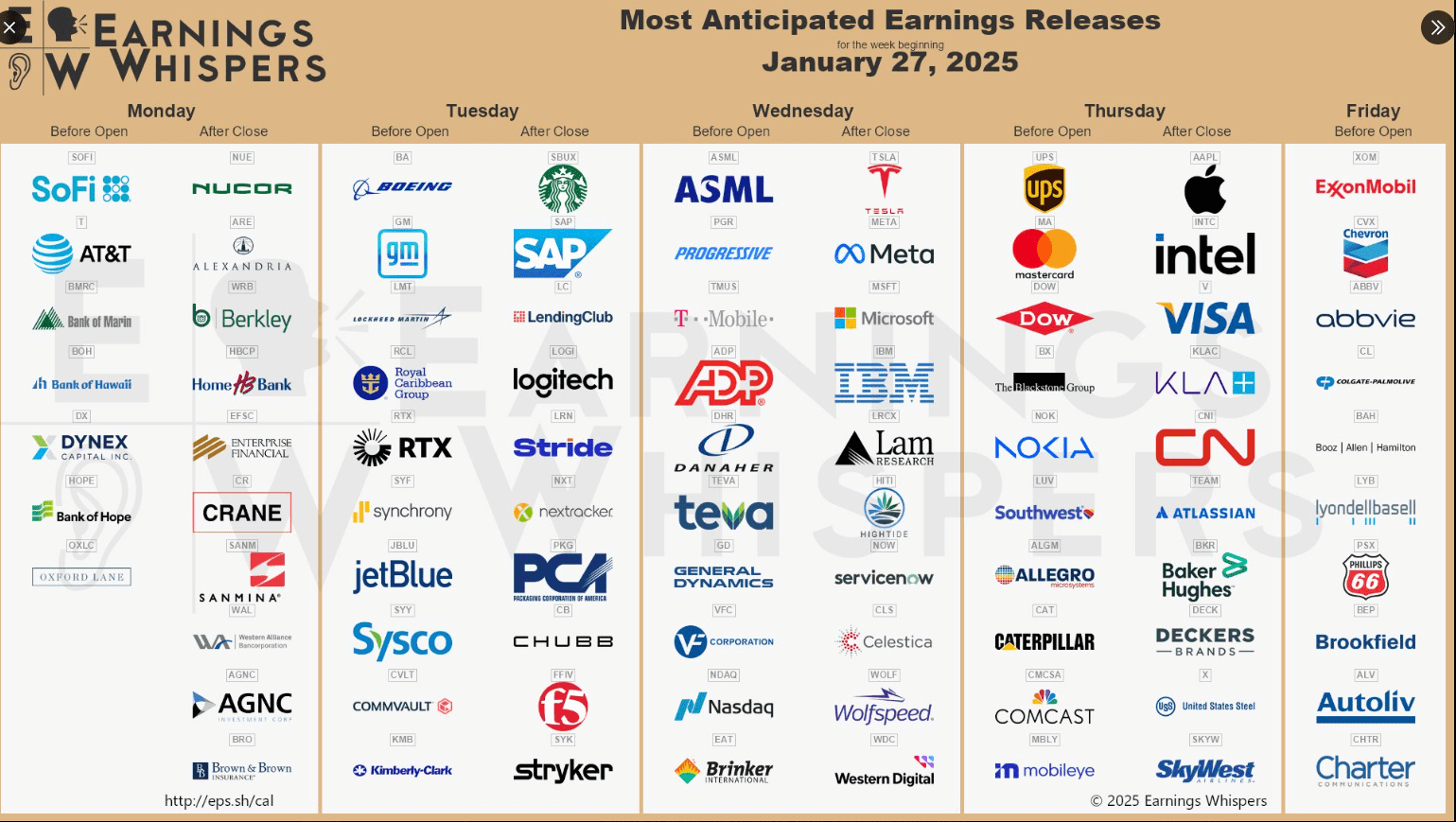
The Investment Committee’s characterization of the upcoming week as “pivotal” reflects the convergence of multiple high-impact events that will collectively shape market direction in early 2026 [0]. Six mega cap tech companies representing approximately 30% of S&P 500 market capitalization are scheduled to report earnings between January 25-29, 2026, creating an unusually concentrated catalyst window [1][2]. This earnings cluster coincides with a Federal Reserve meeting, adding a monetary policy dimension to an already complex market environment.
The current market posture suggests cautious optimism, with the S&P 500 closing at 6,920.57 (+0.18%) and the NASDAQ leading gains at 23,538.29 (+0.42%) with the highest trading volume of 5.06 billion shares [0]. However, the Russell 2000’s 1.41% decline indicates continued small-cap weakness, suggesting a bifurcated market structure where mega cap tech continues to attract capital while broader market breadth remains uncertain.
Technology sector strength (+1.13%) and Communication Services (+0.92%) dominate the current session, while Financial Services (-1.17%) and Utilities (-0.54%) lag significantly [0]. This sector rotation pattern suggests investors are positioning defensively ahead of earnings season, gravitating toward quality tech names with strong balance sheets and established market positions. The concentration of gains in mega cap technology stocks reflects a “quality tilt” approach as investors await concrete evidence of AI monetization progress.
The pre-earnings trading patterns reveal significant dispersion among the key reporters [0]:
Microsoft (MSFT) demonstrates exceptional strength at +4.08%, trading at $469.54 with a 33.35x P/E ratio and $3.49 trillion market cap. This performance suggests positive pre-earnings sentiment, potentially reflecting confidence in the company’s Azure cloud and AI services growth trajectory. Meta (META) shows solid momentum at +2.83% ($665.95, 29.47x P/E), while Amazon (AMZN) gains +2.25% ($239.62, 33.84x P/E).
In contrast, Alphabet (GOOGL) and Apple (AAPL) trade marginally lower at -0.28% and -0.17% respectively, suggesting more cautious positioning ahead of their reports. Tesla (TSLA) trades down -0.29% at $448.06, but its extraordinary 235.82x P/E ratio represents the most significant risk factor of the week, as virtually no positive outcome may be sufficient to justify current valuations [0].
SPY is currently experiencing a sideways trading pattern with support at $686.68 and resistance at $692.70 [0]. The MACD indicator suggests bearish momentum, while KDJ shows slight bullish characteristics, indicating market indecision ahead of the earnings catalyst. This technical backdrop suggests that directional clarity will likely emerge following the initial wave of earnings reports, particularly Microsoft’s report on January 28.
The Federal Reserve meeting scheduled during this earnings week introduces additional complexity [2]. Rates are expected to remain unchanged, but political independence concerns stemming from Powell-Trump tensions could introduce unexpected volatility. Market participants will parse Fed commentary for policy direction signals, potentially creating cross-currents with earnings-driven stock movements.
The market’s focus has definitively shifted from AI infrastructure spending to actual profitability and revenue generation [1][2]. Microsoft alone spent over $88.2 billion on capital expenditures in 2025, primarily directed toward AI infrastructure. Investors now demand evidence that these investments are translating into measurable returns through cloud services growth, productivity improvements, and new AI-powered product revenue. This quarter’s earnings reports will serve as a critical inflection point for assessing the “ROI thesis” on AI spending.
The S&P 500’s 22x earnings multiple reflects elevated expectations baked into current prices [2]. With earnings expected to climb more than 15% in 2026, the market is pricing in continued growth acceleration. However, this multiple requires consistent execution and guidance affirmation from mega cap leaders. Any indication of slowing growth or margin pressure could trigger multiple contraction, making this earnings week a potential valuation test.
Tesla’s unique position among mega cap reporters stems from the extreme disconnect between its 235x P/E ratio and fundamental expectations [0][4]. The projected 39.7% YoY EPS decline, margin compression to 4.58%, and automotive price competition create significant headroom for disappointment. However, the market will scrutinize Energy business performance (Powerwall, Megapack), Optimus robot progress, and robotaxi timeline updates as potential offsetting narratives. Tesla’s report carries the highest single-company volatility potential of the week.
With 81% of 59 companies that have already reported beating estimates, the early season momentum supports risk appetite for mega cap tech [2]. This beat rate significantly exceeds seasonal norms and suggests an environment where beat-and-raise guidance could provide additional upside. However, mega cap expectations are already elevated, meaning beats may need to be substantial to generate meaningful stock appreciation.
The immediate risk window spans January 25-29, 2026, with Tesla’s report on January 28 representing the highest single-day volatility risk. Microsoft and Meta’s simultaneous reporting on January 28 creates a concentrated catalyst day with elevated implied volatility across technology sectors. The Fed meeting on January 29 adds an additional layer of time-sensitive risk/opportunity for positioning.
The upcoming mega cap earnings week represents a critical inflection point for markets, with six major technology companies scheduled to report alongside a Federal Reserve meeting. The convergence of these events creates elevated short-term volatility expectations while establishing medium-term market direction based on AI monetization progress and earnings growth sustainability.
Market positioning reflects cautious optimism, with the NASDAQ leading gains and technology sector strength dominating session performance. However, the Russell 2000’s weakness indicates continued breadth concerns and potential vulnerability if mega cap results disappoint. The 22x S&P 500 earnings multiple requires strong execution to maintain current valuations.
Tesla presents the most significant individual risk factor due to its extreme valuation (235x P/E) and projected fundamental decline (39.7% YoY EPS drop). Microsoft demonstrates the strongest technical and sentiment setup, while Meta and Amazon show solid pre-earnings momentum. Apple faces iPhone headwinds but services segment strength could provide offsetting performance.
The AI monetization theme has transitioned from infrastructure buildout to application and revenue generation, with investors demanding evidence that $88+ billion in capital expenditures by major players is translating into measurable returns. This quarter’s earnings reports will provide the first meaningful data point on AI investment ROI across the technology sector.
Risk monitoring should focus on EPS surprises versus estimates, AI revenue contribution in commentary, forward guidance updates, and any capital expenditure guidance changes for 2026. The Fed meeting adds a policy dimension that could amplify or override earnings-driven movements, warranting close attention to language regarding inflation, growth, and policy trajectory.
Insights are generated using AI models and historical data for informational purposes only. They do not constitute investment advice or recommendations. Past performance is not indicative of future results.
About us: Ginlix AI is the AI Investment Copilot powered by real data, bridging advanced AI with professional financial databases to provide verifiable, truth-based answers. Please use the chat box below to ask any financial question.