AI-Driven Business Investment Emerges as Unexpected Source of US Economic Strength in 2026
Unlock More Features
Login to access AI-powered analysis, deep research reports and more advanced features
About us: Ginlix AI is the AI Investment Copilot powered by real data, bridging advanced AI with professional financial databases to provide verifiable, truth-based answers. Please use the chat box below to ask any financial question.
Related Stocks
The MarketWatch analysis published on January 26, 2026, highlights a significant economic phenomenon: while higher tariffs have created headwinds for businesses over the past year, capital investment in artificial intelligence and robotics technologies has emerged as a critical driver of economic resilience [1]. This development represents a notable shift in capital allocation strategies, with businesses prioritizing AI infrastructure even in the face of trade policy uncertainty.
The timing of this report carries particular significance, arriving at the start of 2026 when economic projections indicate continued acceleration in AI-related infrastructure spending. The convergence of several factors—robust corporate earnings, technological maturation of AI applications, and favorable policy environments—has created unprecedented investment momentum in the technology sector [2][3]. Chief Economist Gad Levanon of the Burning Glass Institute characterizes the current moment as being in “the early stages of a once-in-a-generation technological shift” [3].
The magnitude of AI-related capital expenditure has reached historic proportions that distinguish the current cycle from previous technology investment waves. According to CreditSights data cited by Forbes, projected capital expenditures on AI data-center infrastructure total
Global AI spending is projected to exceed
Major technology companies have announced substantial capital expenditure plans that collectively demonstrate the strategic priority placed on AI infrastructure:
| Company | 2026 AI Capex | Year-over-Year Growth |
|---|---|---|
| Amazon | >$125 billion | +61% |
| Microsoft | $94-140 billion | Significant |
| Alphabet | ~$92 billion | Substantial |
| Meta | $72 billion | Notable |
Source: CreditSights via Forbes [2]
These investments reflect strategic commitments to maintaining competitive positions in AI infrastructure, with companies demonstrating willingness to borrow heavily to fund expansion. Meta, for instance, is borrowing $30 billion to support its AI capital expenditure plan [2]. The combined valuation of leading LLM providers—including OpenAI, Anthropic, and xAI—has reached
The U.S. economy demonstrated surprising resilience throughout 2025, with GDP growth of
The relationship between AI investment and broader economic growth extends beyond direct capital expenditure effects. Enterprise technology predictions for 2026 indicate that AI is creating headwinds for traditional SaaS seat expansion while simultaneously driving new monetization models based on usage and outcomes [6]. IT budget growth is projected at approximately
The AI investment wave is creating substantial demand across upstream supply chains, with semiconductor manufacturers and industrial robotics providers experiencing accelerated growth cycles. Taiwan Semiconductor Manufacturing (TSM) has seen its market share gradually increase as the AI chip market has expanded, while NVIDIA maintains approximately
The industrial robotics market is experiencing particularly robust growth, valued at
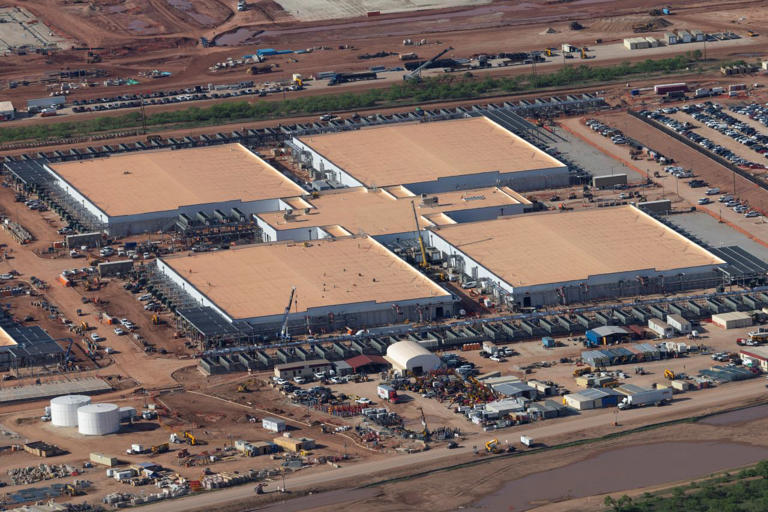
Data center infrastructure spending is projected at
A significant competitive dynamic emerging in 2026 is what analysts term the “Great Rotation,” wherein institutional and retail investors are reallocating capital from mega-cap technology stocks—the so-called “Magnificent Seven”—to value and small-cap equities [2]. Jefferies forecasts small-cap stock growth of approximately
This rotation suggests investor expectations are evolving regarding AI investment returns. While hyperscalers have driven AI infrastructure buildout, investors are increasingly looking for opportunities in companies that may benefit from AI-driven productivity gains without bearing the full burden of capital-intensive infrastructure investment. The implications for market leadership and sector performance merit continued monitoring as the year progresses.
Venture capital flows have overwhelmingly concentrated in AI-related companies, with
The current investment cycle presents several compelling opportunities for market participants. The scale of capital flowing into AI infrastructure—$602 billion in 2026 alone—justifies careful consideration of exposure to hyperscalers, semiconductor manufacturers, and data center operators. Organizations that develop coherent AI strategies may capture significant productivity gains, while those that fail to engage risk competitive disadvantage.
The majority of enterprises plan to invest
Despite strong investment momentum, several risks merit monitoring and consideration. Valuation concerns represent the most prominent risk, with extreme bullish sentiment and elevated valuations across equities and gold creating potential for sharp corrections [2]. The Federal Reserve chair transition and ongoing tariff rate decisions introduce policy uncertainty that could affect investment planning horizons.
Moody’s Analytics places recession probability at approximately
The transition to AI-driven operations also creates workforce transformation risks. 2026 is expected to be the year when AI’s labor impact becomes visible in enterprise headcount decisions, led initially by hiring constraints in large organizations followed by rising reductions, while demand for specialized blue-collar roles expands alongside data center buildout [6]. This labor market dislocation may create both social and economic friction points that affect consumer spending and political dynamics.
The analysis reveals that AI-driven business investment has emerged as a primary source of economic strength for the United States in early 2026, with $602 billion in projected AI data center capital expenditures representing a 36% year-over-year increase. Despite tariff-related headwinds, business investment in robotics and artificial intelligence technologies has provided unexpected resilience, contributing to strong GDP growth and positioning AI as the primary driver of current economic expansion.
The investment cycle’s scale—potentially $7 trillion over five years for data centers alone—represents the largest infrastructure buildout in modern history, with transformative implications for supply chains, labor markets, and competitive dynamics across industries. Market data from January 26, 2026, reveals sector performance variations, with Technology (+0.77%) and Communication Services (+1.07%) outperforming Financial Services (-1.63%) and Healthcare (-0.52%), reflecting investor confidence in AI-driven growth [12].
The convergence of hyperscaler investment commitments, enterprise adoption trends, and venture capital allocation suggests the AI investment cycle has achieved self-sustaining momentum. However, elevated valuations, policy uncertainty, and the gap between capital expenditure and monetization timelines introduce risks that warrant continued monitoring. The economic data indicates AI—not tariffs or political factors—is the primary driver of current economic momentum, suggesting this investment cycle may define economic performance for years to come.
Insights are generated using AI models and historical data for informational purposes only. They do not constitute investment advice or recommendations. Past performance is not indicative of future results.
About us: Ginlix AI is the AI Investment Copilot powered by real data, bridging advanced AI with professional financial databases to provide verifiable, truth-based answers. Please use the chat box below to ask any financial question.