India-EU Free Trade Agreement: Comprehensive Analysis of Trade Liberalization Impact
Unlock More Features
Login to access AI-powered analysis, deep research reports and more advanced features
About us: Ginlix AI is the AI Investment Copilot powered by real data, bridging advanced AI with professional financial databases to provide verifiable, truth-based answers. Please use the chat box below to ask any financial question.
Related Stocks
The India-EU Free Trade Agreement represents one of the most comprehensive trade deals either partner has ever concluded, establishing a framework that extends far beyond traditional tariff reductions to encompass services, digital trade, and investment facilitation [5][6]. The agreement’s scope reflects a strategic realignment at a time of increasing global protectionism, with European Commission President Ursula von der Leyen characterizing it as providing “the highest level of access ever granted to a trade partner in the traditionally protected Indian market” [5].
India has committed to eliminating or reducing duties on 96.6% of EU goods exports, while the EU will liberalize 99.5% of its tariff lines on goods imported from India over a seven-year implementation period [1][6]. This asymmetry in market opening reflects the negotiated balance between India’s traditionally protected manufacturing sectors and Europe’s interest in accessing the massive Indian consumer market of 1.4 billion people. The European Commission estimates annual tariff savings of approximately €4 billion for European products entering the Indian market [1][6].
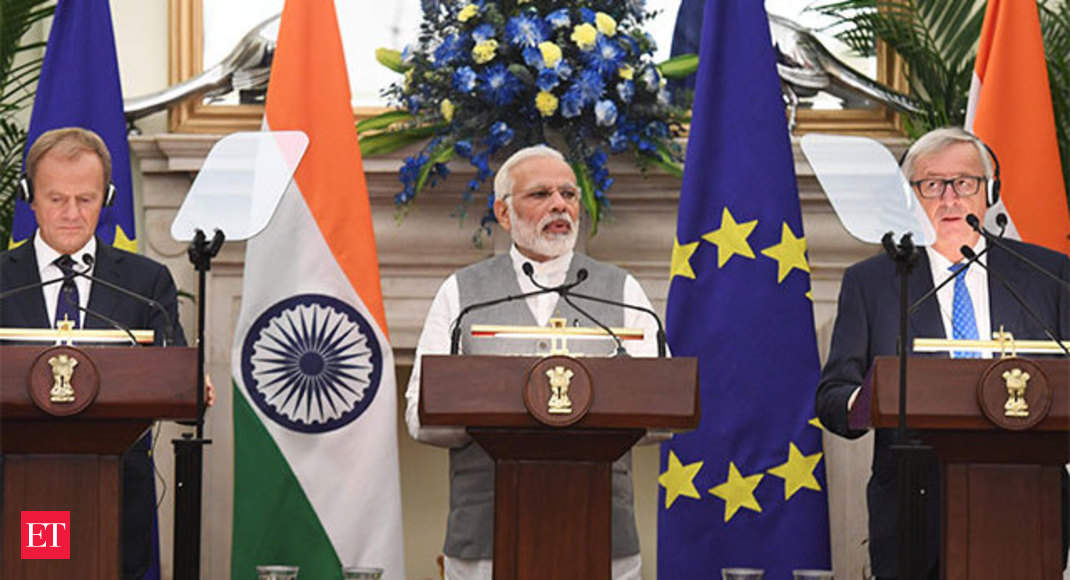
The timing of this agreement carries significant geopolitical weight, coming amid escalating tariff tensions between major trading blocs and following protracted negotiations that were accelerated over the past six months [4][5]. Prime Minister Narendra Modi described the deal as the “mother of all trade deals,” signaling its strategic importance for India’s economic diversification and global positioning [3][5].
The agreement creates distinct winner and loser categories across industries, with the transitional timeline (5-10 years for sensitive sectors like automobiles) providing adjustment windows for affected domestic industries [10][11]. Indian textiles, leather, marine products, and gems & jewelry emerge as clear beneficiaries, gaining immediate zero-duty access to the €263.5 billion EU textiles market and €100 billion leather and footwear market [8][9]. The Apparel Export Promotion Council projects Indian textile exports could double within three years, representing a transformative opportunity for labor-intensive sectors that employ millions of workers [9].
Conversely, Indian automotive manufacturers face significant competitive pressure as European premium brands gain access with 10% tariffs under a 250,000 vehicle annual quota [1][10]. The immediate market reaction saw Mahindra & Mahindra decline up to 5.1% and the Nifty Auto Index fall 2.1%, though analysts characterized this as an overreaction given the gradual implementation timeline [10][11]. Similarly, Indian alcoholic beverage producers face increased competition from EU wines and spirits as tariffs on wine (30-150%) and spirits (up to 50%) are reduced to 20-30% and 40% respectively [1].
The agreement facilitates fundamental restructuring of EU-India supply chains across multiple industrial corridors [12]. European machinery and equipment manufacturers, currently facing tariffs up to 44%, gain substantial cost advantages that position them favorably in Indian industrial procurement decisions [2]. Simultaneously, Indian chemical manufacturers benefit from improved access to European specialty chemicals while facing intensified competition in domestic markets as EU chemicals (€3.2 billion in exports) become more competitive with zero-tariff access [2][12].
The digital trade chapter establishes a framework for e-commerce and data flows that positions both parties to capture growing cross-border digital services demand [6]. Financial services liberalization provides EU banks and insurers privileged access to India’s developing financial services market, while enhanced mobility provisions for business visitors and intra-corporate transfers facilitate deeper economic integration [6].
The agreement reshapes competitive dynamics for companies without FTA access, particularly Asian competitors and other trading nations that may now face disadvantages in both EU and Indian markets [7]. This development accelerates a broader trend toward bilateral and regional trade agreements as alternatives to multilateral frameworks, with companies increasingly basing investment decisions on trade agreement network access [7][13].
The agreement creates substantial opportunity windows across multiple dimensions [6][8][9]:
The India-EU Free Trade Agreement, finalized January 27, 2026, establishes one of the world’s largest free trade zones, encompassing 2 billion people and removing tariffs on over 90% of goods traded between the two economies [1][3]. Implementation will proceed on a sector-specific timeline, with immediate tariff elimination on machinery, chemicals, pharmaceuticals, and optical/medical equipment, while automobiles benefit from a gradual 5-10 year phase-in with protective quotas [1][6].
European companies gain annual tariff savings of approximately €4 billion and privileged access to India’s 1.4 billion consumer market, while Indian exporters in textiles, leather, marine products, and gems & jewelry gain zero-duty access to EU markets worth hundreds of billions of euros [1][6][8]. The services and digital trade chapters provide frameworks for expanded cooperation in financial services, maritime transport, and cross-border data flows [6].
Market reactions on announcement day reflected investor assessment of sectoral impacts, with Indian auto stocks declining on competitive concerns while marine exporters and textile companies experienced positive sentiment [10][11]. The agreement requires further ratification steps before entry into force, with implementation expected in 2026 following EU legal review and approval processes [6].
The deal represents a strategic realignment in global trade architecture at a time of rising protectionism, creating opportunities for deeper EU-India economic integration while requiring affected industries to develop adaptation strategies for the changing competitive landscape [5][7][13].
Insights are generated using AI models and historical data for informational purposes only. They do not constitute investment advice or recommendations. Past performance is not indicative of future results.
About us: Ginlix AI is the AI Investment Copilot powered by real data, bridging advanced AI with professional financial databases to provide verifiable, truth-based answers. Please use the chat box below to ask any financial question.