Nvidia CEO's China AI Race Comments: Long-Term NVDA Implications Analysis
Unlock More Features
Login to access AI-powered analysis, deep research reports and more advanced features
About us: Ginlix AI is the AI Investment Copilot powered by real data, bridging advanced AI with professional financial databases to provide verifiable, truth-based answers. Please use the chat box below to ask any financial question.
Related Stocks
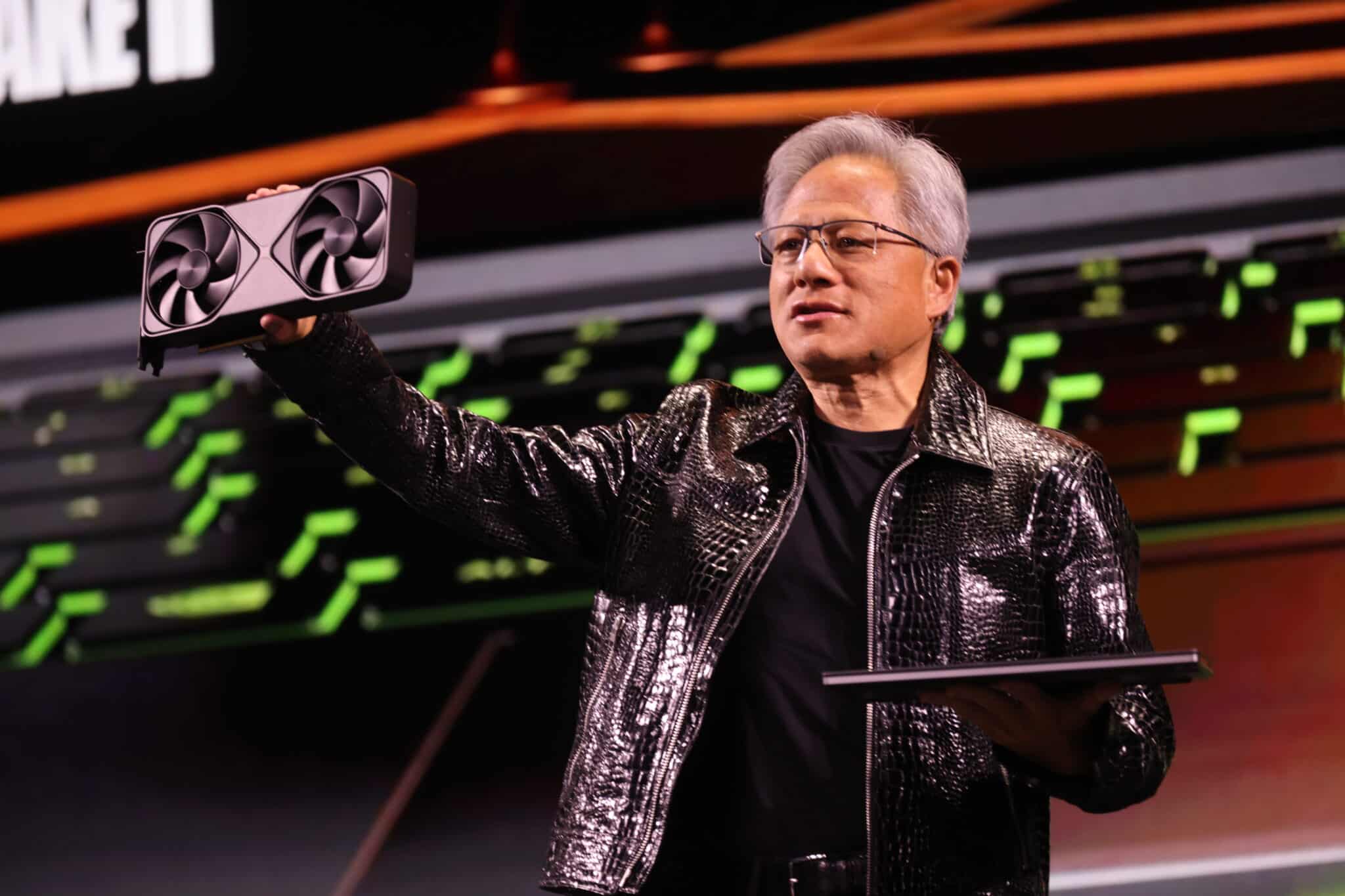
This analysis examines Jensen Huang’s controversial November 5-6, 2025 comments about China’s AI leadership potential and their implications for Nvidia’s long-term positioning. Initially stating “China is going to win the AI race” [1][2], Huang later clarified that China is “nanoseconds behind America” and emphasized U.S. leadership through developer acquisition [2]. The comments occur amid significant technological and geopolitical developments, including China’s breakthrough analog AI chip claiming 1,000x faster performance than Nvidia’s H100 GPU [3][4], and continued U.S. export restrictions that have effectively eliminated Nvidia’s China market access [2].
Nvidia’s stock has experienced notable volatility, declining approximately 7% from its November 3 peak of $206.88 to $186.86 on November 13, 2025 [0]. This decline aligns with broader tech sector weakness, with the Nasdaq plunging 2.5% on AI bubble concerns and interest rate pressures [1]. Despite this, analyst consensus remains bullish with a $235 target price (+25.7% upside) and 75.9% of analysts rating NVDA as Buy/Strong Buy [0].
The China market represents critical exposure at $17.11 billion (13.1% of total revenue) in FY2025 [0], but Nvidia’s market share has been “reduced to zero” due to national security reviews and China’s push for domestic alternatives [2]. The Trump administration’s effective ban on H20 chip sales in April 2025 resulted in a $5.5 billion quarterly charge for Nvidia [2].
The most significant development comes from Peking University researchers who published an analog AI chip in Nature Electronics claiming:
- 1,000 times fasterperformance than Nvidia’s H100 GPU
- 100 times lesspower consumption
- Precision comparable to digital systems, solving what researchers call a “century-old problem” in analog computing [3][4]
This breakthrough represents a potential paradigm shift from digital to analog computing, which could fundamentally challenge Nvidia’s GPU dominance if commercial viability is proven.
- CUDA ecosystem: Remains the default AI development platform outside China
- Developer lock-in: Critical for maintaining U.S. technological leadership
- Global market dominance: Strong position in non-China markets
- Complete China market shutdown: Loss of 13.1% revenue base
- Technology paradigm disruption: Analog computing could bypass GPU architecture
- Energy cost disadvantage: China’s lower energy costs provide sustainable competitive advantage [1][2]
China appears to be using Nvidia’s market access as strategic leverage in broader trade negotiations [2]. This suggests potential for resolution but also extended uncertainty. The situation reflects a broader bifurcation of global AI ecosystems along geopolitical lines.
The emergence of fundamentally different computing paradigms (analog vs. digital) suggests the global AI market may split into technological spheres rather than competing within the same architecture. This could reduce direct competition but also limit market opportunities for each approach.
China’s lower energy costs for AI operations represent a sustainable structural advantage that Western companies must address through efficiency improvements or alternative energy sources [1][2]. This advantage compounds with potential technological breakthroughs.
The convergence of Jensen Huang’s comments, Chinese technological breakthroughs, and restrictive trade policies creates significant uncertainty for Nvidia’s long-term positioning. While the company maintains strong software advantages and analyst support, the emergence of analog computing technology from China represents a potential paradigm shift. Critical factors include the commercial viability timeline for Chinese analog chips, resolution of regulatory restrictions, and Nvidia’s ability to adapt its business model to address market challenges. The situation warrants careful monitoring of both technological developments and geopolitical negotiations [0][1][2][3][4].
Insights are generated using AI models and historical data for informational purposes only. They do not constitute investment advice or recommendations. Past performance is not indicative of future results.
About us: Ginlix AI is the AI Investment Copilot powered by real data, bridging advanced AI with professional financial databases to provide verifiable, truth-based answers. Please use the chat box below to ask any financial question.