LimX Dynamics Global Expansion: Chinese Humanoid Robots Target U.S. and Middle East Markets
Unlock More Features
Login to access AI-powered analysis, deep research reports and more advanced features
About us: Ginlix AI is the AI Investment Copilot powered by real data, bridging advanced AI with professional financial databases to provide verifiable, truth-based answers. Please use the chat box below to ask any financial question.
LimX Dynamics, a Shenzhen-based humanoid robot startup founded in 2022, is executing an ambitious international expansion strategy that positions it as a significant challenger in the rapidly evolving global humanoid robotics market. The company’s founder, Will Zhang—a former Ohio State University electrical and computer engineering professor—has disclosed in an exclusive interview that the company is in advanced discussions with U.S. business partners while simultaneously closing a funding round with its first foreign backer from the Middle East [1]. This dual-track expansion approach represents a strategic calculated move to establish global market presence while navigating the complex geopolitical landscape surrounding U.S.-China technology relations.
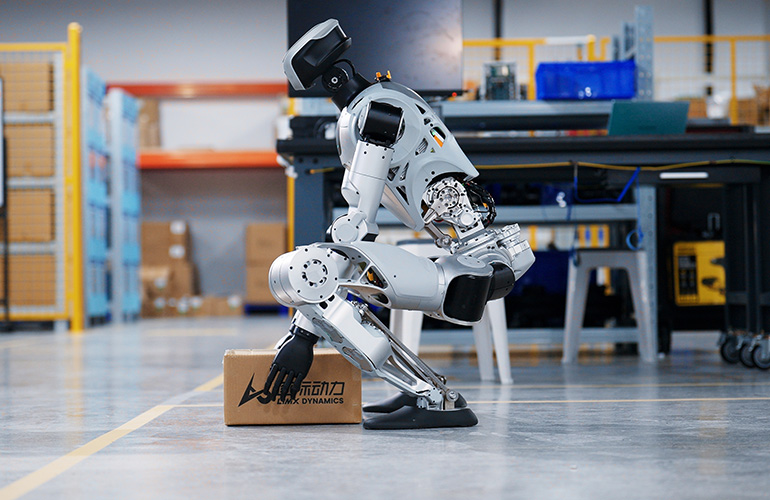
The company’s flagship product, the Oli humanoid robot, was launched in summer 2025 with a competitive pricing structure ranging from ¥158,000 (approximately $22,660) for the base model to ¥290,000 (approximately $41,500) for the developer-integrated version [1]. This pricing strategy positions LimX’s offerings significantly below anticipated Tesla Optimus pricing while remaining competitive with other Chinese manufacturers. The recent announcement of the COS A agentic AI operating system in early 2026 demonstrates the company’s commitment to software innovation, featuring real-time motion adjustment and autonomous decision-chain capabilities that address critical industrial automation requirements [1].
The competitive landscape presents both opportunities and substantial challenges. Tesla has deployed over 1,000 Optimus robots in its factories with public sales targeted for late 2027 and manufacturing cost targets of approximately $20,000 per unit [9][10]. Boston Dynamics, backed by Hyundai and Google DeepMind, has achieved production commitments for Atlas robots with Hyundai planning deployment of “tens of thousands” of units [11][12]. Chinese domestic competitors including Unitree (14,300+ global shipments in 2025) and Agibot (5,100+ robots shipped to the U.S.) have already established international market presence [8][14]. The humanoid robot market is projected to grow from $2.24 billion in 2024 to $41.02 billion by 2032, representing a substantial opportunity for established and emerging players alike [3].
LimX Dynamics’ expansion strategy reveals several significant market dynamics that extend beyond the company’s individual prospects. First, the company’s successful coordination of 18 Oli humanoid robots operating in unison without direct human control demonstrates swarm coordination capabilities that address essential industrial automation requirements for manufacturing and logistics applications [2]. This technological achievement positions LimX favorably for enterprise customers requiring multi-robot workflow solutions, an area where competitors have yet to demonstrate comparable capabilities.
Second, Will Zhang’s explicit prioritization of “local partnerships” over capital represents a deliberate strategic approach to navigating international market entry [1]. This partnership-focused model contrasts sharply with Tesla’s vertically integrated manufacturing approach and may prove advantageous in addressing regulatory and geopolitical concerns that could otherwise impede market access. The Middle East serves as a strategic beachhead—providing capital and reference customers while avoiding the heightened scrutiny associated with immediate U.S. or European market entry.
Third, the broader market context reveals an acceleration of industrial deployment across the sector. Tesla’s production ramp, Boston Dynamics’ manufacturing commitments with Hyundai, and strong Chinese policy support under the 15th Five-Year Plan collectively validate the commercial viability of humanoid robots [7]. The Themes Humanoid Robotics ETF’s significant inflows in early 2026 indicate growing investor confidence in the sector’s near-term prospects [18].
Fourth, the competitive dynamics among Chinese manufacturers themselves present both opportunities and risks. While LimX ranks among the top five Chinese humanoid manufacturers by shipments, aggressive pricing from competitors like Agibot (offering models as low as $1,370) creates significant pricing pressure domestically [17]. The company’s positioning as a dedicated humanoid robot developer—rather than a diversified technology conglomerate—represents both a focused competitive advantage and a vulnerability relative to better-capitalized competitors.
The international expansion strategy opens substantial opportunity windows across multiple dimensions. The Middle East partnership represents LimX’s first foreign capital, validating international credibility and providing crucial funding for scaling production capabilities [1]. U.S. partnership discussions signal ambition to compete in the world’s largest advanced robotics market, with potential timeline advantages over Tesla’s public launch anticipated for late 2027 [10][16]. The company’s three-year plan to deploy “several thousand units” to the Middle East establishes a foundation for global operational experience and reference customers that could facilitate subsequent market entry in Europe and North America.
The broader market growth trajectory presents significant opportunity for established players. The humanoid robot market is projected to expand from $2.24 billion in 2024 to $41.02 billion by 2032, representing a compound annual growth rate that rewards early market entrants who can establish customer relationships and operational track records [3]. Morgan Stanley’s long-term projection of a $5 trillion market by 2050 suggests substantial upside for companies that successfully navigate the transition from R&D to commercial-scale production [5].
Regulatory approval risks represent the most significant near-term concern for LimX’s U.S. expansion strategy. Geopolitical tensions between the United States and China could create substantial barriers to partnership approval, particularly given technology transfer concerns and national security considerations related to advanced robotics systems. Enterprise customers in sensitive industries may harbor reservations about deploying Chinese-made robots with AI systems that transmit data internationally, potentially limiting addressable market size in critical sectors.
Competitive response risks present substantial challenges across multiple time horizons. Tesla’s manufacturing scale advantages, combined with target costs of approximately $20,000 per unit, could quickly undercut LimX’s pricing advantage if achieved at scale [9]. Boston Dynamics’ production commitments with Hyundai and the Google DeepMind partnership for AI capabilities position established Western competitors favorably for enterprise customers prioritizing proven technology and established service networks [11][12]. The timing gap until Tesla’s public launch in late 2027 provides a narrow window for LimX to establish market presence before intensified competition.
Technical and production challenges require careful attention as the company scales. Transitioning from current production levels to “several thousand units” for Middle East deployment represents significant manufacturing and supply chain challenges [1]. The developer-integrated version’s success depends on building a robust third-party software ecosystem, while international expansion requires establishing service and support networks critical for enterprise customer confidence. Will Zhang’s acknowledgment of current reliance on remote controls in demonstrations highlights that full autonomous capability remains developmental, potentially affecting customer perceptions of product readiness.
The analysis reveals that LimX Dynamics represents a credible and significant challenger in the emerging global humanoid robot market. The company’s combination of commercial products, innovative software architecture, and strategic expansion plans positions it competitively against both American leaders and domestic Chinese rivals. Market projections indicating growth from $2.24 billion (2024) to $41.02 billion (2032) validate the commercial opportunity underlying the company’s international ambitions [3].
Technical differentiation centers on the COS A agentic AI operating system, which enables real-time motion adjustment and autonomous decision chains—a capability that positions LimX competitively against Tesla’s FSD architecture being adapted for Optimus [1]. The swarm coordination demonstration of 18 robots operating simultaneously addresses critical industrial automation requirements for multi-robot workflows [2].
Competitive dynamics remain intense across both Western and Chinese markets. Tesla’s production ramp and cost targets, Boston Dynamics’ manufacturing commitments with Hyundai, and aggressive pricing from Chinese domestic competitors collectively create a challenging environment for market entry [9][11][17]. The timing of LimX’s expansion—coinciding with these competitive developments—suggests 2026-2027 will be a decisive period for establishing market position.
Regional expansion strategy prioritizes the Middle East as an initial beachhead before subsequent U.S. and European market entry [1]. This approach reflects careful navigation of geopolitical sensitivities while building international operational experience and credibility. Will Zhang’s partnership-focused approach may prove advantageous in addressing regulatory and competitive challenges that could otherwise impede market access.
The fundamental question underlying LimX’s prospects concerns whether Chinese manufacturers can establish technological and market leadership in an industry historically dominated by American companies. As Zhang explicitly stated, “We don’t think it has to be that the U.S. leads and China follows” [1]. The company’s expansion strategy represents a direct challenge to this historical paradigm, with the coming 24-36 months likely to provide initial indications of success or failure.
Insights are generated using AI models and historical data for informational purposes only. They do not constitute investment advice or recommendations. Past performance is not indicative of future results.
About us: Ginlix AI is the AI Investment Copilot powered by real data, bridging advanced AI with professional financial databases to provide verifiable, truth-based answers. Please use the chat box below to ask any financial question.