Federal Reserve Interest-Rate Policy: FOMC Voting Structure and Political Pressure in 2026
Unlock More Features
Login to access AI-powered analysis, deep research reports and more advanced features
About us: Ginlix AI is the AI Investment Copilot powered by real data, bridging advanced AI with professional financial databases to provide verifiable, truth-based answers. Please use the chat box below to ask any financial question.
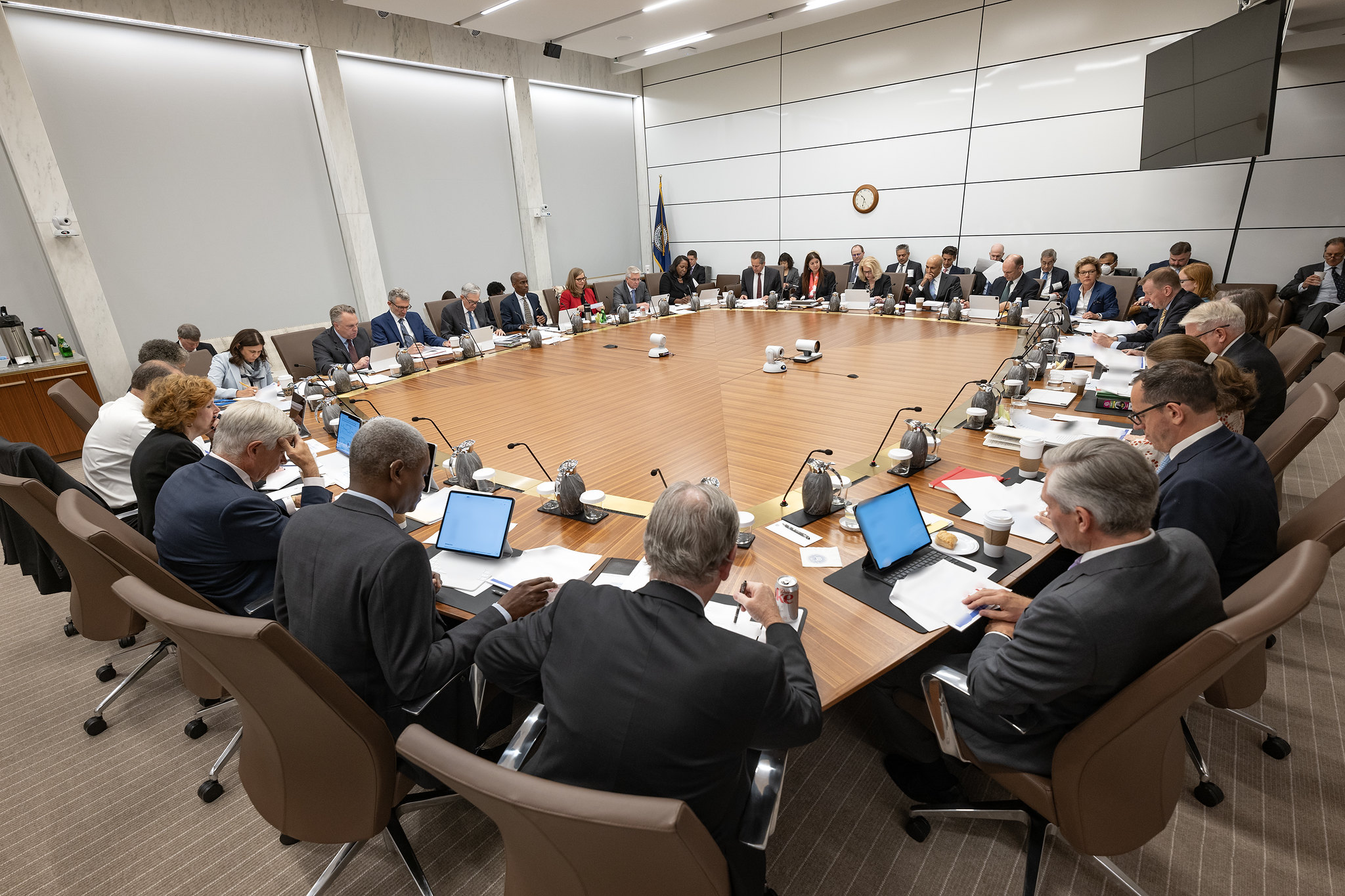
The Federal Reserve’s monetary policy is determined by the 12-member Federal Open Market Committee, a structure specifically designed to prevent concentration of power and insulate rate decisions from political pressure [1]. This committee operates through a carefully balanced composition: seven members consist of the Board of Governors in Washington, including the Chair, Vice Chair, and Vice Chair for Supervision, while the remaining five positions are filled by regional Federal Reserve Bank presidents, with four of these seats rotating on an annual basis [1].
For 2026, the voting membership includes several key figures whose perspectives will shape the trajectory of U.S. monetary policy. Jerome Powell continues as Chair through his term expiration on May 15, 2026, though his term as a Board Governor extends until January 2028 [2]. Vice Chair Philip Jefferson and Vice Chair for Supervision Michelle Bowman remain in their positions as voting members, along with Governor Michael Barr [1]. The rotating regional voters for this year include four new faces, with Philadelphia Fed President Anna Paulson among them—analysts have characterized her as potentially dovish in her policy orientation [1][3].
The WSJ report arrives at a moment of heightened tension between the Trump administration and the Federal Reserve. President Trump has publicly and directly demanded that Chair Powell implement interest-rate cuts, marking an unprecedented level of direct political pressure on the central bank’s leadership [1]. This pressure campaign raises fundamental questions about the independence of monetary policy decision-making in the United States.
The Trump administration’s position extends beyond mere commentary on current rates. Administration officials have indicated intentions to appoint a Fed Chair who would be more inclined toward accommodative monetary policy, with specific interest in individuals who would “cut interest rates even more” than the current trajectory [1][2]. This stated objective creates a complex backdrop for the current FOMC deliberations, as committee members must navigate between economic data-driven decisions and the political realities surrounding potential leadership changes.
The policy landscape presents competing forces that complicate the rate-cut argument. Trump’s tariff policies may contribute to sustained inflationary pressures, potentially limiting the economic justification for rate reductions despite political demands [3]. This creates a tension between political preferences and the Fed’s dual mandate of price stability and maximum employment.
The four new rotating regional voters introduce additional complexity to the committee’s dynamics. Regional Federal Reserve presidents often bring perspectives grounded in local economic conditions, which may differ from the Board Governors’ views or the political priorities of the administration [1][3]. This diversity of perspective was deliberately built into the FOMC structure to ensure that monetary policy decisions reflect broad economic realities rather than narrow political interests.
The FOMC’s twelve-member structure represents a deliberate institutional safeguard against both concentration of power and external political pressure. Even if President Trump were to successfully appoint a more accommodative Fed Chair following Powell’s term expiration in May, that individual would still need to convince eight other committee members to support any policy direction [1]. This structural reality means that rate decisions continue to be “guided by economic reality” rather than political pressure alone, providing a meaningful check on unilateral policy shifts [1].
The rotating regional presidency system ensures that the committee’s composition evolves annually, preventing any single regional bank or political faction from maintaining permanent influence over monetary policy. The four rotating voters for 2026 will participate in all eight scheduled FOMC meetings this year, contributing to decisions on the federal funds rate, quantitative tightening, and forward guidance [1].
The impending leadership transition at the Federal Reserve introduces a layer of policy uncertainty that extends beyond the immediate interest-rate environment. While Powell’s Board Governor term continues until 2028, his Chair-specific authority expires on May 15, 2026 [2]. The nomination and confirmation process for his successor will unfold against the backdrop of an administration that has made its rate-cutting preferences explicitly clear.
Markets are closely monitoring this succession timeline and its implications for the policy trajectory. Current market data indicates relatively stable conditions, with the S&P 500 trading around 6,978 (up 0.18% on January 27) and the NASDAQ maintaining around 23,817, though caution remains prevalent ahead of the FOMC decision [0]. The potential for increased volatility exists both around individual FOMC decisions and as the succession process unfolds, particularly if nomination hearings generate uncertainty about the future direction of monetary policy.
The diversity of perspectives within the 2026 FOMC may serve as an implicit check on political pressure. The new rotating voters bring regional economic perspectives that may not align with the administration’s rate-cutting agenda, particularly if regional economic data suggests different policy needs [1][3]. This committee diversity, combined with the requirement for broad consensus-building, means that even significant political pressure is unlikely to produce immediate or dramatic policy shifts without corresponding economic justification.
The Federal Reserve’s interest-rate policy in 2026 will be determined by a twelve-member committee comprising seven Board Governors and five regional Federal Reserve Bank presidents, with four rotating regional seats changing annually [1]. Despite President Trump’s direct demands for rate cuts, the Fed’s institutional structure ensures that no single official, including the Chair, controls monetary policy decisions independently [1].
Chair Jerome Powell’s term expires on May 15, 2026, while his Board Governor appointment continues until January 2028 [2]. The four new rotating regional voters for 2026 bring diverse perspectives to the committee, potentially complicating any unified push for aggressive rate cuts [1][3]. Markets are monitoring the situation with caution, showing relative stability ahead of the current FOMC meeting while remaining attentive to the broader political-economic dynamics [0].
The confluence of political pressure, leadership transition, and committee diversity creates a complex environment for monetary policy decision-making. Understanding the FOMC’s structural safeguards and the diverse perspectives within the committee provides context for interpreting future policy announcements and assessing the sustainability of political pressure on central bank independence.
Insights are generated using AI models and historical data for informational purposes only. They do not constitute investment advice or recommendations. Past performance is not indicative of future results.
About us: Ginlix AI is the AI Investment Copilot powered by real data, bridging advanced AI with professional financial databases to provide verifiable, truth-based answers. Please use the chat box below to ask any financial question.