Airline Stock Analysis: Winter Storm Fern's Impact on Carrier Operations and Financial Performance
Unlock More Features
Login to access AI-powered analysis, deep research reports and more advanced features
About us: Ginlix AI is the AI Investment Copilot powered by real data, bridging advanced AI with professional financial databases to provide verifiable, truth-based answers. Please use the chat box below to ask any financial question.
Related Stocks
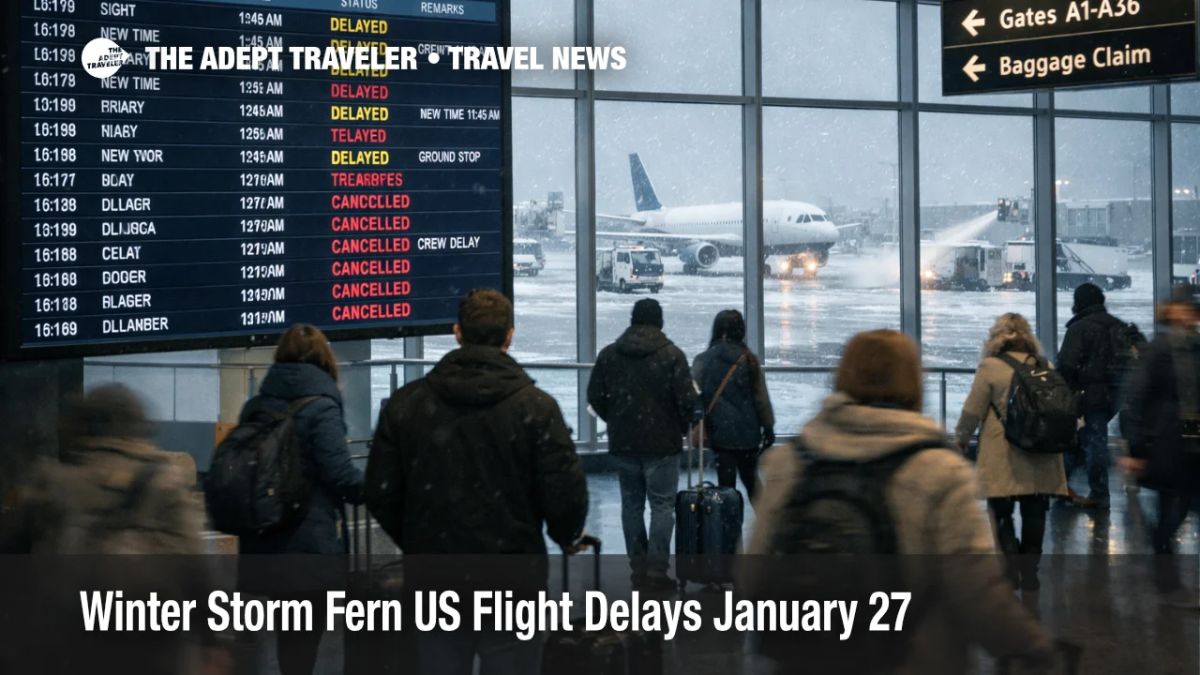
Winter Storm Fern swept across the United States from January 23-28, 2026, resulting in approximately 14,000 flight cancellations across the airline industry [2]. American Airlines Group (AAL) bore the brunt of the disruption, with CEO Robert Isom acknowledging it represented “the largest weather-related operational disruption” in the carrier’s history [3][5]. The Seeking Alpha analysis published on January 28, 2026, provided context suggesting the financial impact may not be as severe as initial market reactions implied, particularly for carriers beyond American Airlines [1].
The operational challenges centered on Dallas-Fort Worth International Airport, American’s primary hub, which experienced nearly six hours of ice pellets and over three inches of snow within a 48-hour period [5]. This overwhelmed infrastructure designed for milder winter conditions and created cascading crew scheduling problems. Flight crews were stranded across the network with hotel shortages forcing the company to offer double pay to flight attendants willing to work extended shifts [5]. By January 28, American still maintained approximately 400 daily cancellations (roughly 15% of its schedule), while competitors United and Delta had reduced cancellations to fewer than a dozen flights per day [5].
American Airlines faces the most substantial financial exposure from the storm event. The estimated $150-200 million revenue impact represents approximately 1.5% of expected Q1 revenue, a significant but potentially manageable hit given the carrier’s $54.6 billion annual revenue base [1][5][7]. However, this disruption compounds existing operational and financial challenges. The carrier’s full-year 2025 net income declined 86.8% to $111 million from $846 million in 2024, while Q4 2025 net profit fell 83.2% to $99 million [7]. These pre-existing earnings pressures amplify investor concerns about the carrier’s operational resilience and recovery trajectory.
JetBlue Airways (JBLU) demonstrated the most favorable investor response, with shares advancing 6.55% in after-hours trading [0]. This positive reaction reflects investor recognition that JetBlue’s limited exposure to the most severely affected hub airports and favorable contract structures should minimize full-year financial impact [1]. The carrier’s smaller network presence in the Midwest winter storm corridor provided natural insulation against the worst operational disruptions.
Delta Air Lines (DAL) and United Airlines (UAL) experienced moderate network disruptions but achieved substantially faster recovery than American Airlines. United shares gained 0.84% while Delta declined only 0.47%, indicating investor confidence in their operational management and the limited financial implications of the disruption [0]. Both carriers returned to near-normal operations by mid-week, demonstrating superior resilience compared to American’s extended recovery timeline.
The Industrials sector, which encompasses airline stocks, was the worst-performing sector on January 28, 2026, declining 1.59% [0]. This broader sector weakness created a challenging backdrop for airline stocks during the storm aftermath. American Airlines trading volume reached 51.43 million shares, approaching the 55.58 million daily average and indicating heightened investor attention to the disruption’s implications [0].
The flight attendants’ union’s public call for CEO Robert Isom’s resignation represents a significant escalation of labor tensions at American Airlines [4]. The Association of Professional Flight Attendants characterized the operational failures as “no longer an anomaly, but rather a pattern of failure under the leadership of CEO Robert Isom and the American Airlines Board of Directors” [4]. This governance concern extends beyond the immediate weather disruption and suggests underlying organizational challenges that may affect operational performance and investor confidence over time.
The union’s characterization of “broken sequences that the company has been unable to repair” implies systemic operational issues rather than isolated weather-related challenges [5]. While the winter storm represented an extreme weather event, competitors’ substantially faster recovery suggests that American Airlines may have structural vulnerabilities in its operational resilience framework.
The 1.5% Q1 revenue impact projection from Seeking Alpha requires contextualization against American Airlines’ full-year 2025 performance [1][7]. With total operating revenues finishing essentially flat at $54.6 billion despite a 2.5% revenue increase in Q4 2025 to $14 billion, the carrier faces structural revenue challenges beyond the weather disruption. The $150-200 million storm impact, while material, represents a smaller percentage of annual revenue (approximately 0.5-0.7%) than the Q1-focused figure suggests.
However, the timing of the disruption during the critical Q1 period may disproportionately affect earnings given seasonal revenue patterns and the carrier’s need to restore customer confidence. The offering of double pay to flight attendants to restore operations introduces immediate labor costs that may offset some revenue protection measures [5].
The divergent recovery trajectories among major carriers following Winter Storm Fern may influence competitive market positioning in coming quarters. Delta and United’s demonstrated operational resilience relative to American Airlines strengthens their value propositions for business and frequent travelers who prioritize reliability. American Airlines’ extended disruption period and labor strife may accelerate market share shifts toward competitors, particularly in high-yield business routes originating from affected hubs.
The analysis identifies several elevated risk factors warranting attention. First, governance uncertainty stemming from the flight attendants’ union’s call for CEO resignation creates leadership instability that may affect strategic execution and investor confidence [4]. The Board of Directors’ response to these demands, if any, will be a critical monitoring factor in coming weeks. Second, the pattern of operational challenges relative to competitors suggests potential structural vulnerabilities in American Airlines’ operational infrastructure and crew scheduling systems that weather events expose [3][5]. Third, the substantial 86.8% decline in full-year 2025 net income demonstrates fundamental business pressures that compound disruption-related concerns [7]. Fourth, ongoing labor relations deterioration increases the risk of work stoppages or reduced operational flexibility during recovery and beyond [4][5].
Despite elevated risks, several factors may mitigate the disruption’s long-term impact. The Seeking Alpha analysis suggests the financial implications may be less severe than initial market reactions imply, particularly for carriers beyond American Airlines [1]. JetBlue’s positive stock response demonstrates that limited exposure to affected regions and favorable contract structures can transform disruption events into relative strength opportunities. The relatively modest sector decline of 1.59% suggests investor discrimination among carriers based on exposure severity rather than blanket sector repricing [0]. Additionally, weather-related disruptions historically prove transitory, with demand patterns typically normalizing as operational,恢复 resumes and customer confidence rebuilds.
Critical monitoring items include daily cancellation rate trajectories through early February 2026, any Board or regulatory response to union concerns, Q1 2026 guidance updates from all major carriers, and booking trend indicators as the disruption resolves. The 2-3 day recovery timeline projected by CEO Isom remains uncertain given ongoing elevated cancellation rates and crew positioning challenges [5].
The January 28, 2026 Seeking Alpha analysis provides important context for evaluating airline stock performance amid Winter Storm Fern’s operational disruptions [1]. American Airlines experienced the most severe impact with approximately 9,000-10,000 flight cancellations over four days, representing the largest weather-related operational disruption in company history and an estimated $150-200 million revenue impact [3][5]. The carrier’s stock declined 0.81% in after-hours trading while demonstrating elevated volume of 51.43 million shares [0].
JetBlue’s 6.55% advance reflects investor recognition of limited exposure and favorable contract structures that should contain full-year financial impact [1]. Delta’s modest 0.47% decline and United’s 0.84% advance indicate market confidence in their operational resilience and rapid recovery relative to American Airlines [0].
The disruption occurs against a backdrop of challenging full-year 2025 financial results for American Airlines, which reported an 86.8% decline in net income and faces governance concerns following the flight attendants’ union’s call for CEO resignation [4][7]. These pre-existing challenges amplify the significance of the operational disruption and recovery trajectory for investor assessment.
The Industrials sector’s 1.59% decline on January 28, 2026, created a challenging sector backdrop for airline stocks, though differential stock performance suggests investor discrimination based on carrier-specific exposure and operational management [0]. The storm’s financial impact appears manageable for well-positioned carriers while potentially accelerating competitive repositioning for American Airlines as operational reliability concerns persist.
Insights are generated using AI models and historical data for informational purposes only. They do not constitute investment advice or recommendations. Past performance is not indicative of future results.
About us: Ginlix AI is the AI Investment Copilot powered by real data, bridging advanced AI with professional financial databases to provide verifiable, truth-based answers. Please use the chat box below to ask any financial question.