Canada's Carney Challenges Trump on Trade Tariffs; Markets Remain Calm Amid USMCA Renegotiation
Unlock More Features
Login to access AI-powered analysis, deep research reports and more advanced features
About us: Ginlix AI is the AI Investment Copilot powered by real data, bridging advanced AI with professional financial databases to provide verifiable, truth-based answers. Please use the chat box below to ask any financial question.
Related Stocks
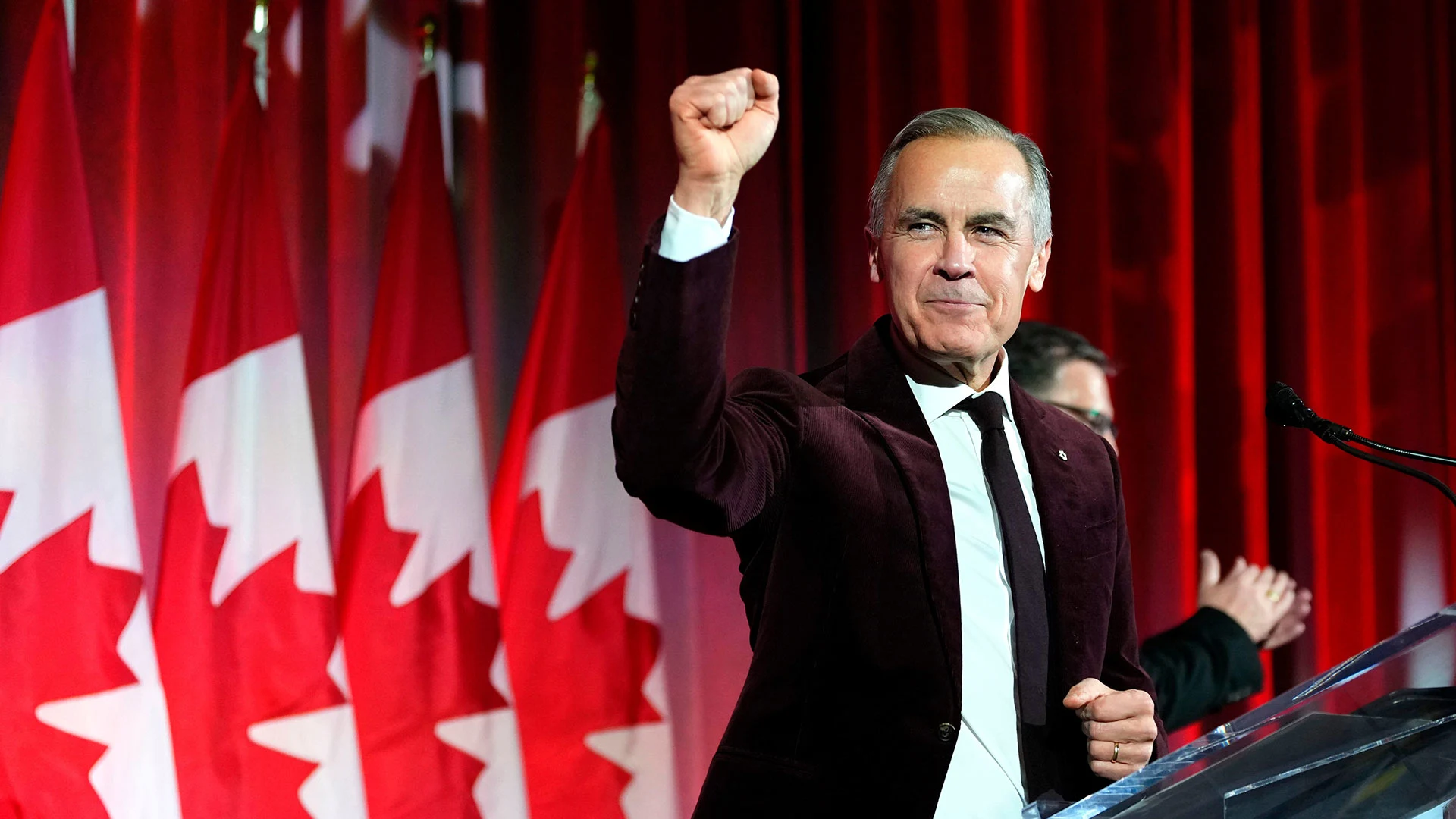
The escalating trade tensions between Canada and the United States have intensified throughout late January 2026, with Prime Minister Mark Carney positioned at the center of a high-stakes negotiation with President Donald Trump. The confrontation originated from Trump’s threat of 100% tariffs on Canadian goods if Canada pursues any form of free trade agreement with China—a characterization Carney has firmly rejected, stating Canada has “no intention” of such a deal [1][2]. This initial dispute has evolved into a broader confrontation over the future of the USMCA (United States-Mexico-Canada Agreement), which is scheduled for renegotiation.
Carney’s public response has been notably defiant, characterizing Trump’s tariff threats as “bluster” and “prepositioning” designed to establish negotiation leverage rather than signal imminent economic action [3]. This rhetorical stance represents a strategic positioning by the Canadian government, aimed at demonstrating domestic resolve while maintaining diplomatic channels open for substantive negotiations. The Prime Minister’s approach reflects Canada’s dual challenge: maintaining sovereignty in the face of U.S. pressure while recognizing that approximately 75% of Canadian merchandise exports depend on the American market [1].
The historical context of Canada-U.S. trade relations provides essential perspective on the current standoff. The USMCA, which replaced NAFTA in 2020, is approaching its scheduled review period, creating both urgency and opportunity for renegotiation. Trump’s return to office has introduced additional complexity, with his administration signaling intentions to leverage tariff threats as primary negotiation tools—a pattern observed in previous trade disputes under his administration.
Despite the escalating rhetorical confrontation, Canadian financial markets have displayed notable calmness, providing crucial insight into investor sentiment regarding the trade dispute. The Canadian dollar has maintained relative stability against the U.S. dollar, with no significant depreciation recorded during the most intense phases of tariff threats [0]. Similarly, the Toronto Stock Exchange (TSX) has shown resilience, with major indices holding steadier than might be expected given the potential economic implications of prolonged trade disruption.
This market behavior reflects several underlying factors that merit examination. First, the “TACO” (Trump Always Chickens Out) narrative has become deeply embedded in market psychology following previous trade disputes where tariff threats were ultimately negotiated or reduced [1]. Investors appear to be pricing in an expectation that the current confrontation will ultimately resolve through negotiation rather than escalate into sustained economic warfare. Second, Canada’s fundamental economic position—while dependent on U.S. trade—is also characterized by significant diversification, stable institutions, and a resource-based economy that maintains global demand independent of U.S. market conditions.
The bond market has also provided stabilizing signals, with Canadian government bond yields showing no significant widening of spreads relative to U.S. Treasuries. This suggests that institutional investors and sovereign wealth managers view Canadian credit risk as fundamentally unchanged by the trade rhetoric. The disconnect between political tensions and market pricing represents a notable phenomenon that may influence both governments’ calculation of negotiation strategies.
Both leaders are engaged in sophisticated strategic positioning that extends beyond immediate economic concerns. Trump’s characterization of Carney as “Governor”—mirroring his earlier reference to Justin Trudeau—suggests a negotiating framework that views Canada not as an independent nation but as a potential addition to the United States [1]. This framing, whether calculated rhetoric or genuine policy orientation, fundamentally complicates traditional trade negotiations by introducing sovereignty questions into economic discussions.
Carney’s response has emphasized Canadian sovereignty while simultaneously leaving door open for productive negotiations. By explicitly denying any Canada-China free trade agreement, Carney has addressed one of Trump’s stated concerns while maintaining Canada’s broader trade policy autonomy [2]. The Prime Minister’s characterization of tariff threats as “prepositioning” represents an attempt to reframe the narrative—suggesting the U.S. position is fundamentally negotiation tactic rather than substantive policy objective [3].
The underlying economic reality provides context for these strategic calculations. The existing 25% tariff on most Canadian goods—recently raised to 35%—has already altered trade flows and supply chain configurations [3]. The additional threat of 100% tariffs would theoretically represent an existential challenge to Canada-U.S. trade, which exceeds $800 billion annually in two-way commerce. However, the economic interdependence cuts both ways: many American industries depend on Canadian raw materials, components, and agricultural products, creating mutual vulnerability that may constrain escalation.
The Canada-U.S. economic relationship represents one of the most deeply integrated bilateral trade partnerships in the global economy. This integration creates structural constraints on extreme policy actions regardless of political rhetoric. Automotive manufacturing, energy infrastructure, agricultural supply chains, and retail distribution networks have all developed cross-border dependencies that cannot be easily severed or redirected. The depth of this integration means that tariff escalation would impose significant costs on American consumers and businesses, not merely Canadian exporters—a reality that historically has constrained trade war dynamics.
The energy sector provides a particularly instructive example of this interdependence. Canadian oil and gas exports to the United States have expanded significantly under the USMCA framework, with pipelines and rail infrastructure representing billions of dollars in sunk investments. Disruption of these flows would immediately affect energy prices in the American Midwest and Gulf Coast, creating political pressure on the Trump administration from domestic constituencies. Similar dynamics apply to agricultural commodities, forestry products, and manufactured goods, creating multiple veto points against extreme policy moves.
The current confrontation occurs within a specific USMCA renegotiation timeline that creates both urgency and opportunity. The agreement’s built-in review provisions mean that substantive negotiations must proceed within defined windows, creating natural pressure for compromise. Carney’s strategic approach—simultaneously pushback against tariff threats while offering negotiation pathways—reflects understanding of these timeline dynamics.
The resolution of the Canada-China trade deal question removes an immediate flashpoint while leaving broader structural issues unresolved. Carney’s explicit denial of any intention to pursue such an agreement addresses one of Trump’s stated concerns while preserving Canada’s broader right to conduct independent trade policy [2]. This partial de-escalation creates space for focusing negotiations on core USMCA issues: automotive rules of origin, labor provisions, intellectual property protections, and agricultural market access.
The “TACO” phenomenon reflects a learned market response to Trump-era trade negotiations, where initial tariff threats frequently resulted in negotiated settlements or delayed implementations rather than sustained trade barriers. This pattern has created a somewhat paradoxical market environment where dramatic political rhetoric produces limited pricing impact due to expectations of eventual resolution.
However, this paradigm carries risks if tested. The current tariff levels—already at 25-35%—represent significant economic costs that are not merely negotiating positions but operational realities for Canadian exporters [3]. If these tariffs remain in place or escalate, market calm would likely dissipate rapidly. The current stability should be understood as conditional on expectations of resolution, not indifference to trade policy outcomes.
The primary risk in the current situation remains the potential for tariff escalation beyond negotiation positioning to actual economic policy. The threat of 100% tariffs on Canadian goods represents an existential economic challenge that would fundamentally alter North American trade relationships if implemented [1]. Even the existing 25-35% tariff regime has created measurable disruption to trade flows, supply chain configurations, and corporate planning horizons.
Currency volatility represents a secondary risk factor, with potential for significant Canadian dollar depreciation if trade tensions escalate meaningfully. Such depreciation could create imported inflation pressures while also providing competitive relief for Canadian exporters—a complex dynamic that would require careful Bank of Canada policy response. The current currency stability reflects market expectations of resolution; these expectations could shift rapidly with new policy announcements or negotiation breakdowns.
Corporate planning disruption represents a third-order risk with potentially significant economic implications. The uncertainty surrounding trade policy has already prompted some companies to delay investment decisions, explore supply chain diversification options, and build contingency plans for various scenarios. Prolonged uncertainty could result in permanent changes to investment patterns even if ultimate trade outcomes prove favorable.
The current confrontation also presents opportunity for Canadian strategic repositioning. Carney’s assertiveness signals to both domestic audiences and international partners that Canada will not passively accept external pressure, potentially strengthening negotiating position through demonstrated resolve. The calm market response provides political space for maintaining firm positions without incurring immediate domestic economic costs.
The resolution of the Canada-China trade deal question demonstrates Canada’s ability to address U.S. concerns while maintaining policy independence, potentially establishing a template for managing other contentious issues. Carney’s explicit statement that Canada has “no intention” of pursuing such an agreement [2] addresses a specific Trump concern while preserving broader Canadian trade policy flexibility for future negotiations.
The Canada-U.S. trade confrontation under Prime Minister Mark Carney and President Donald Trump represents a high-stakes negotiation with significant implications for North American economic integration. Carney has adopted a confrontational but strategically measured stance, dismissing tariff threats as “bluster” while addressing specific concerns about Canada-China trade relations. The existing tariff regime of 25-35% has already impacted trade flows, while the threat of 100% tariffs hangs over negotiations pending resolution of USMCA renegotiation.
Canadian market stability—reflected in currency and equity market resilience—suggests investor confidence in diplomatic resolution and echoes the “TACO” narrative from previous trade disputes. However, this stability is conditional on expectations of negotiation rather than escalation. The deep economic integration between Canada and the United States creates mutual vulnerability that may ultimately constrain extreme policy actions by either side.
Key metrics to monitor include official USMCA renegotiation announcements, Canadian dollar volatility, Bank of Canada policy responses, and corporate guidance from major Canada-U.S. cross-border enterprises. The resolution of immediate flashpoints, such as the Canada-China trade deal question, creates space for focusing on substantive negotiation issues while maintaining overall relationship stability.
Insights are generated using AI models and historical data for informational purposes only. They do not constitute investment advice or recommendations. Past performance is not indicative of future results.
About us: Ginlix AI is the AI Investment Copilot powered by real data, bridging advanced AI with professional financial databases to provide verifiable, truth-based answers. Please use the chat box below to ask any financial question.