Geopolitical Analysis: US Naval Movements in the Middle East and Market Implications
Unlock More Features
Login to access AI-powered analysis, deep research reports and more advanced features
About us: Ginlix AI is the AI Investment Copilot powered by real data, bridging advanced AI with professional financial databases to provide verifiable, truth-based answers. Please use the chat box below to ask any financial question.
Based on my research, I can now provide a comprehensive analysis of the geopolitical situation and its potential market implications.
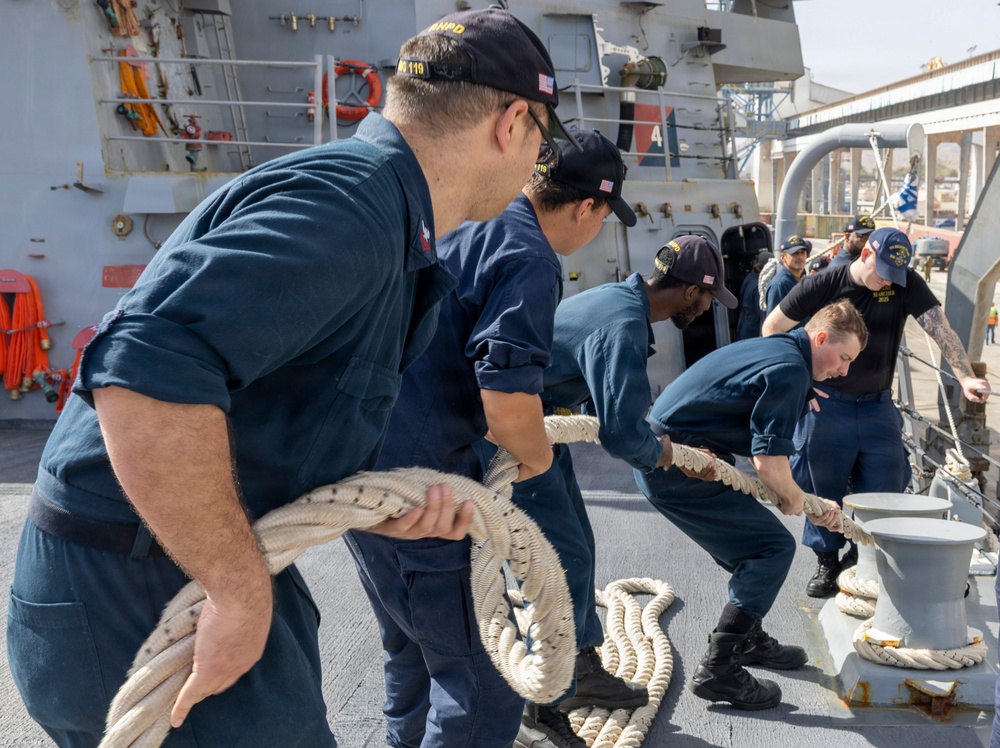
The Arleigh Burke-class guided-missile destroyer USS Delbert D. Black concluded its scheduled port visit to Israel’s southern Red Sea port of Eilat on February 1, 2026 [1]. The vessel, equipped with the advanced Aegis combat system and Tomahawk cruise missiles capability, arrived after transiting the Suez Canal from the Mediterranean [2]. According to official statements from the Israel Defense Forces and the US Navy Central Command, the visit was described as “routine and pre-planned,” serving to reinforce standard US-Israeli military cooperation [1][2]. The visit included tours of the ship for senior US Embassy staff and Israeli Navy officials, as well as meetings with the commander of the Eilat Naval Base [1].
The USS Mitchell is currently deployed as part of the expanded US naval presence in the Middle East, operating under the US Central Command’s Fifth Fleet, which is headquartered in Bahrain [3]. This deployment occurs amid a significant buildup of US military assets in the region, which includes:
- USS Abraham Lincoln (CVN-72): A nuclear-powered aircraft carrier now positioned in the Arabian Sea within striking distance of Iran [4]
- Multiple Arleigh Burke-class destroyers: Including USS McFaul (DDG-75), USS Mitscher (DDG-96), and USS Roosevelt (DDG-118), operating throughout the Gulf of Oman and Arabian Sea [3]
- EA-18G Growler electronic warfare jets: Being deployed to augment naval electronic warfare capabilities [3]
The naval movements occur against a backdrop of heightened US-Iran tensions. According to recent reports, the US administration has resumed tough rhetoric toward Iran, with officials weighing potential targeted military strikes while Iran has warned it will not concede its defense capabilities [5]. Israeli media has suggested that the increased US naval presence may be linked to preparations for possible military actions against Iran [2].
The strategic significance of these deployments is underscored by several factors:
Oil prices have responded to the geopolitical tensions, with Brent crude futures reaching a five-month high before settling at approximately $70.71 per barrel as of late January 2026 [6]. According to Citi’s analysis, there is currently a
Key market observations include:
- Brent crude: Closed at $70.69 per barrel (down marginally but near six-month highs) [5]
- WTI crude: Finished at $65.21 per barrel [5]
- Risk premium: Analysts estimate $4 to $8 per barrel currently embedded in prices, with Citi forecasting potential spikes to $72 if tensions escalate [7]
Analysts have outlined several potential scenarios and their oil price implications:
| Scenario | Probability | Price Impact |
|---|---|---|
| Limited US-Israel action, de-escalation | 70% | Risk premium would decline |
| Heightened but limited conflict | 30% | Brief price spikes possible |
| Major supply disruption (civil unrest + military action) | 10% | Brent could reach $91/bbl [8] |
The Strait of Hormuz remains a critical concern for oil markets. Approximately 20% of the world’s oil supply passes through this narrow waterway, making it a potential flashpoint for supply disruptions [9]. If Iran were to attempt to close the strait, analysts warn this could trigger significant price spikes, though recent reports indicate oil transportation costs have dropped and shipping traffic has increased following ceasefire developments [10].
Despite geopolitical tensions, several factors are moderating price increases:
- Strong US dollar: Inflation-driven dollar strength is weighing on demand for oil priced in foreign currencies [5]
- Rising US crude output: Production increases following post-shutdown resumption [5]
- Expected supply additions: Restart of Kazakhstan’s Tengiz refinery adding to oversupply concerns [5]
The departure of USS Delbert D. Black from Eilat, while officially described as routine, occurs within a broader pattern of increased US military posturing in the Middle East. The combination of carrier strike groups, advanced destroyers, and electronic warfare assets represents a significant deterrence capability positioned to respond to various scenarios involving Iran.
The naval presence serves multiple purposes:
- Deterrence: Maintaining credible military capability to discourage Iranian aggression
- Assurance: Demonstrating support for regional allies, particularly Israel
- Response readiness: Positioning forces for rapid response to emerging situations
The oil market appears to be pricing in a moderate risk premium while remaining sensitive to escalation indicators. Citi’s base case scenario (70% probability) anticipates limited US-Israel actions and eventual US-Iran de-escalation, which would likely reduce the current risk premium [6]. However, the 30% probability of heightened but limited conflict suggests continued volatility in the near term.
Key factors to monitor include:
- Developments in US-Iran diplomatic negotiations
- Any incidents involving Iranian proxy forces
- Movements in US naval assets (particularly carrier strike groups)
- Saudi Arabia and OPEC+ production decisions
- Global inventory levels and demand indicators
The fundamental supply-demand balance remains relatively loose, which may cap upside potential for prices even if geopolitical tensions escalate. However, the concentration of oil supply through regional chokepoints means that even limited disruptions could have outsized market impacts.
[1] VIN News - “US Navy Destroyer Departs Israel’s Eilat Port After Scheduled Visit” (https://vinnews.com/2026/02/01/us-navy-destroyer-departs-israels-eilat-port-after-scheduled-visit/)
[2] Xinhua News Agency - “U.S. destroyer docks at Israeli port amid military threats” (https://english.news.cn/20260130/b76af5fc3f134b65b16fa98e4260b9ee/c.html)
[3] Middle East Eye - “What military assets does the US have in the Middle East?” (https://www.middleeasteye.net/explainers/what-military-assets-does-us-have-middle-east)
[4] The Sun via YouTube - “America’s mega WAR SHIP moves within striking distance of Iran” (https://www.youtube.com/watch?v=GogGKUx-W5o)
[5] OE Digital - “Investors track US-Iran tensions as oil hovers at a six-month high” (https://energynews.oedigital.com/energy-markets/2026/02/01/investors-track-usiran-tensions-as-oil-hovers-at-a-sixmonth-high)
[6] Reuters - “Citi expects limited US-Israel action on Iran to avoid escalation” (https://www.reuters.com/business/energy/citi-expects-limited-us-israel-action-iran-avoid-escalation-2026-01-30/)
[7] The Merchant’s News - “Iran Tensions Push Oil Into Repricing Mode” (https://themerchantsnews.substack.com/p/iran-tensions-push-oil-into-repricing)
[8] Energy News Beat - “Iran’s Impact on Oil Mounts as US Warships Draw Near” (https://energynewsbeat.co/irans-impact-on-oil-mounts-as-us-warships-draw-near/)
[9] 19FortyFive - “How to Start World War III and Spike Oil Prices” (https://www.19fortyfive.com/2026/01/how-to-start-world-war-iii-and-spike-oil-prices-iran-decides-to-close-the-strait-of-hormuz/)
[10] Middle East Monitor - “Iran says it has ‘complete control’ of Strait of Hormuz” (https://www.middleeastmonitor.com/20260128-iran-says-it-has-complete-control-of-strait-of-hormuz-as-threat-of-war-with-us-looms/)
Insights are generated using AI models and historical data for informational purposes only. They do not constitute investment advice or recommendations. Past performance is not indicative of future results.
About us: Ginlix AI is the AI Investment Copilot powered by real data, bridging advanced AI with professional financial databases to provide verifiable, truth-based answers. Please use the chat box below to ask any financial question.