OBBBA Legislative Impact Analysis: Tax Cuts, Consumer Spending, and Equity Market Outlook
Unlock More Features
Login to access AI-powered analysis, deep research reports and more advanced features
About us: Ginlix AI is the AI Investment Copilot powered by real data, bridging advanced AI with professional financial databases to provide verifiable, truth-based answers. Please use the chat box below to ask any financial question.
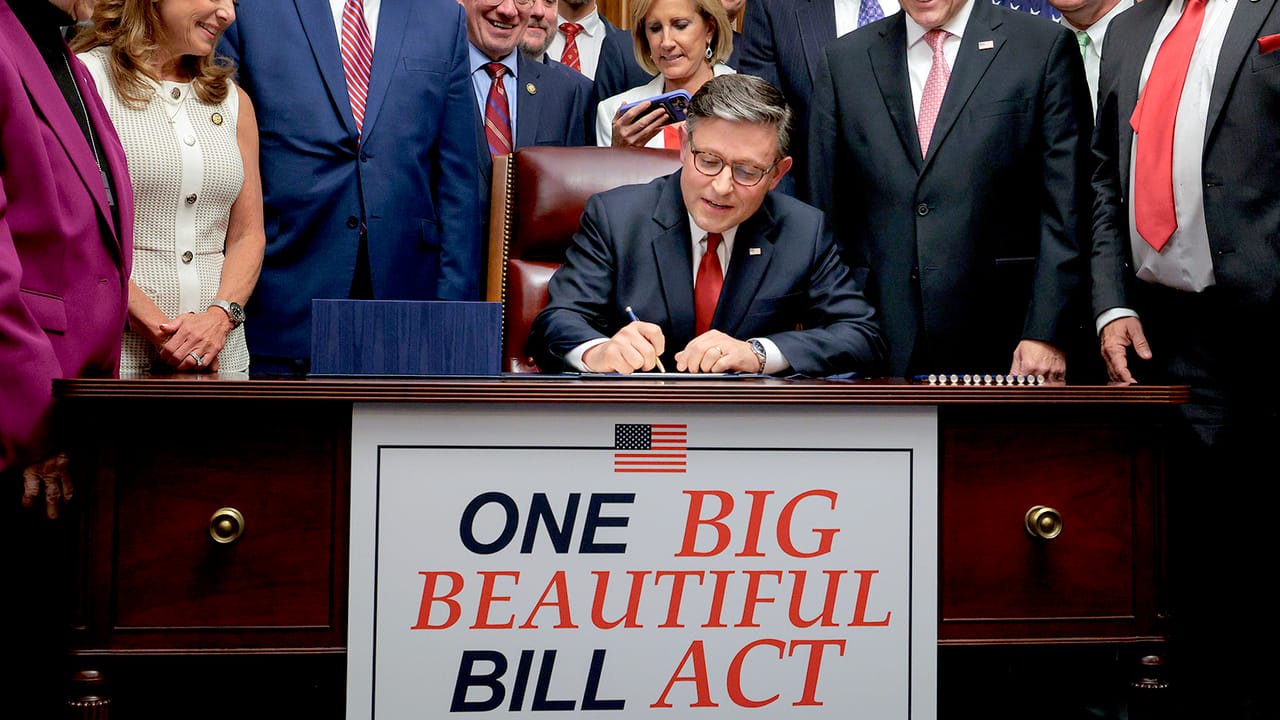
The One Big Beautiful Bill Act (OBBBA) represents a comprehensive budget reconciliation law that has generated substantial attention across investment, policy, and legal communities since its enactment on July 4, 2025 [1][2]. This legislation delivers approximately $344 billion in annualized tax cuts, representing one of the most significant fiscal policy interventions in recent years and creating a meaningful transmission mechanism from government policy to household finances to corporate earnings [1].
The economic pathway articulated by Templeton traces a clear cause-and-effect relationship: the tax relief provisions directly increase disposable household income by approximately 8.3% in Q1, which in turn drives consumer spending growth, thereby boosting corporate revenues and supporting higher equity valuations [1]. This framework positions large-cap U.S. equities, particularly those within the S&P 500 index, as primary beneficiaries of the legislative action. The Atlanta Fed’s GDPNow model projecting 4.2% GDP growth in Q4 provides additional validation for an economy experiencing sustained expansion, reinforcing the constructive outlook on equity markets [1].
Current market performance data from February 2, 2026, demonstrates notable alignment with Templeton’s thesis [0]. The Consumer Defensive sector posted the strongest gains at +2.04%, followed by Consumer Cyclical at +1.36% and Technology at +1.16%—all sectors with direct exposure to increased consumer spending power [0]. The broad-based nature of the market advance, with all major indices closing higher (S&P 500 +0.98%, NASDAQ +1.15%, Dow Jones +1.24%, Russell 2000 +1.80%), suggests market participants are indeed positioning for the consumer spending boost that OBBBA provisions may deliver [0].
The legislative context extends beyond pure tax considerations, encompassing startup tax provisions described as “the biggest startup tax break in years” [3], payroll implications for businesses [2], and modifications to 2025 federal income tax brackets [4]. While bipartisan attention underscores the legislation’s significance, sources indicate it also carries controversial spending cuts—most notably affecting programs for disabled populations [5]—which may create headwinds for certain economic segments and warrant monitoring by investors focused on social responsibility or concerned about potential consumer confidence effects.
The analysis reveals several interconnected insights that extend beyond the immediate fiscal policy discussion. First, Templeton’s attribution of the favorable 21.7% annualized return observed over the past three years to the OBBBA represents a significant claim that connects current legislative policy to recent market outcomes [1]. While causality cannot be definitively established, the temporal correlation between the legislation’s implementation and sustained market strength provides a plausible narrative framework that many investors appear to be adopting.
Second, the article’s deliberate avoidance of specific stock recommendations while providing sector-wide guidance represents a noteworthy methodological choice [1]. Rather than identifying individual beneficiaries, Templeton’s “singles and doubles” steady-growth philosophy emphasizes consistent earnings growth across large-cap U.S. equities, suggesting a preference for broad market participation over concentrated bets [1]. This approach aligns with the legislation’s economy-wide impact, which affects multiple sectors simultaneously rather than creating isolated winners.
Third, the sector performance divergence on February 2, 2026, provides real-time validation of the thesis [0]. The +2.04% gain in Consumer Defensive stocks—typically considered recession-resistant but not high-growth—combined with +1.36% in Consumer Cyclical suggests investors are specifically positioning for increased consumer spending rather than simply rotating into traditional growth sectors [0]. The Utilities sector’s -1.65% decline further reinforces this interpretation, as defensive, interest-rate-sensitive sectors tend to underperform in growth-oriented environments driven by fiscal stimulus [0].
Fourth, the historical performance context matters significantly for current positioning. If the OBBBA has indeed contributed to the strong three-year annualized returns Templeton references, investors face the question of whether current valuations already incorporate these benefits or whether further upside remains available as the legislation’s full effects continue to materialize [1].
The analysis identifies several risk factors that warrant attention alongside the constructive outlook.
The OBBBA legislation represents a comprehensive fiscal policy intervention with measurable implications for consumer finances and equity market performance. The $344 billion in annualized tax cuts translate to approximately 8.3% increased disposable income for affected households in Q1, creating direct purchasing power expansion that flows through to corporate revenues in consumer-sensitive sectors [1]. The legislation’s enactment on July 4, 2025, positions its effects to influence market performance throughout 2026 and beyond, with the Atlanta Fed’s 4.2% Q4 GDP projection suggesting sustained economic momentum [1].
David I. Templeton’s analysis, published on Seeking Alpha on February 2, 2026, presents a framework rather than specific stock recommendations, emphasizing large-cap U.S. equities as primary beneficiaries while advocating for a “singles and doubles” steady-growth investment approach [1]. The author’s CFA credential and established reputation in the investment community provides credibility to the analysis, though investors should note the constructive bias inherent in investment-focused publications [1].
The current market environment on February 2, 2026, demonstrates sector performance patterns consistent with the OBBBA thesis [0]. Consumer Defensive stocks’ leadership position, combined with broad-based advances across major indices, suggests market participants are actively positioning for consumer spending increases while rotating away from traditional defensive sectors like Utilities [0]. This real-time market behavior provides circumstantial support for the investment framework presented.
Information gaps remain regarding specific provision details, the duration of tax provisions (whether permanent, temporary, or phased), quantitative impact modeling connecting disposable income gains to earnings growth, and sector-specific analysis differentiating performance expectations within large-cap equities [1]. Investors seeking more granular guidance may need to supplement this broad framework with additional research on individual sectors and companies.
Insights are generated using AI models and historical data for informational purposes only. They do not constitute investment advice or recommendations. Past performance is not indicative of future results.
About us: Ginlix AI is the AI Investment Copilot powered by real data, bridging advanced AI with professional financial databases to provide verifiable, truth-based answers. Please use the chat box below to ask any financial question.