SpaceX Orbital Data Center Initiative: $5 Trillion Annual Capital Analysis
Unlock More Features
Login to access AI-powered analysis, deep research reports and more advanced features
About us: Ginlix AI is the AI Investment Copilot powered by real data, bridging advanced AI with professional financial databases to provide verifiable, truth-based answers. Please use the chat box below to ask any financial question.
Related Stocks
This analysis examines the February 3, 2026 report from MoffettNathanson research analysts estimating that Elon Musk’s vision for SpaceX orbital data centers could require
The MoffettNathanson analysis emerges against the backdrop of two landmark corporate developments announced contemporaneously. SpaceX’s merger with xAI, valued at $1.25 trillion, creates a vertically integrated entity combining space launch infrastructure with artificial intelligence capabilities [2]. Simultaneously, SpaceX is progressing toward an initial public offering anticipated in June 2026, with reports indicating the company seeks to raise approximately $50 billion at a $1.5 trillion valuation [3]. The orbital data center initiative represents the strategic rationale underlying these transactions, positioning the combined entity to pursue compute infrastructure deployment at scales previously considered unattainable.
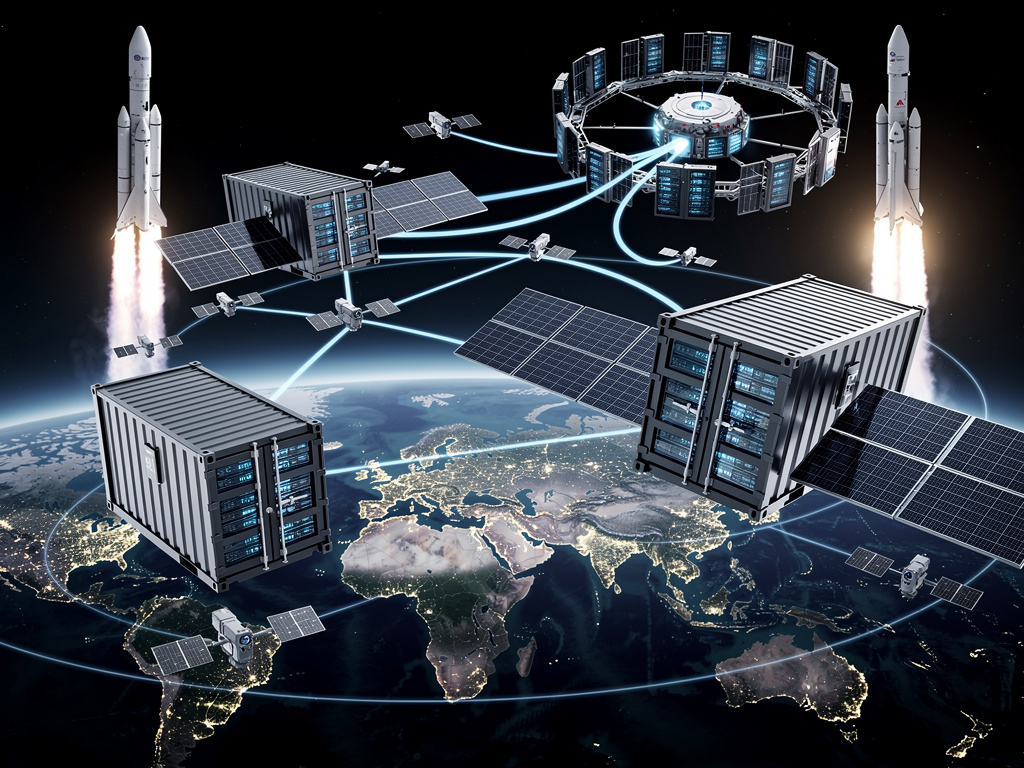
MoffettNathanson analysts specifically addressed the capital intensity of SpaceX’s orbital compute ambitions, which envision satellite constellations capable of delivering substantial AI processing power from low Earth orbit [1]. The firm characterized the funding requirements as exceeding conventional infrastructure investment frameworks, suggesting that public equity markets may be necessary to finance portions of the deployment. This assessment introduces important considerations for institutional investors evaluating the SpaceX IPO, as capital allocation strategies will significantly impact shareholder returns and operational flexibility.
SpaceX has disclosed preliminary specifications for its orbital data center initiative, though detailed implementation roadmaps remain forthcoming. The company has sought regulatory authorization to deploy up to
The technical challenges associated with orbital data centers extend beyond launch capacity. Thermal management in the space environment, radiation hardening of computing hardware, satellite-to-ground communication latency, and on-orbit servicing capabilities all present engineering obstacles that have yet to be fully addressed at scale. While SpaceX has demonstrated operational excellence with the Starlink constellation, which currently comprises several thousand satellites, the transition to data center infrastructure introduces substantially different performance and reliability requirements.
US space sector equities demonstrated positive price movements following the SpaceX-xAI merger announcement, reflecting investor confidence in the strategic rationale underlying the transaction [2]. Competitors including Rocket Lab (RKLB) and AST SpaceMobile (ASTS) experienced share price appreciation, suggesting the market interprets Musk’s announcement as validating the broader orbital communications and compute thesis rather than exclusively benefiting the combined SpaceX-xAI entity.
This market response indicates several possibilities. Institutional investors may view the merger as de-risking space sector investments by confirming large-scale capital commitment from proven operators. Alternatively, the announcement could trigger competitive responses from other market participants seeking to establish positions in orbital infrastructure before potential market concentration occurs. The competitive landscape will likely intensify as regulatory frameworks for mega-constellations evolve and financing options crystallize.
The $5 trillion annual capital projection from MoffettNathanson requires careful interpretation within appropriate analytical contexts. This figure represents an upper-bound estimate that, if realized, would exceed the combined annual revenue of the global aerospace and defense sector. Important distinctions exist between annual operating expenditures, cumulative capital investment requirements, and incremental funding needs above existing operational budgets.
The analysis raises questions regarding the specific methodology employed by MoffettNathanson analysts, as detailed calculations have not been publicly disclosed [1]. Additionally, the temporal horizon over which the $5 trillion annual requirement would apply remains unspecified—whether this represents peak annual spending during deployment phases or sustained operational expenditure remains ambiguous. Investors and analysts should seek clarification on these methodological considerations before incorporating the projections into valuation models.
The SpaceX-xAI merger represents a strategic整合 of complementary assets positioned to capture emerging opportunities in AI infrastructure. SpaceX provides launch capabilities, satellite manufacturing expertise, and orbital deployment experience, while xAI contributes AI software development and large language model capabilities. The orbital data center vision essentially verticalizes the AI compute supply chain, potentially reducing dependence on terrestrial data center operators and geographic constraints on facility placement.
However, this integration strategy introduces significant resource allocation complexities. Elon Musk’s portfolio across Tesla, xAI, SpaceX, The Boring Company, Neuralink, and X Corp creates substantial executive bandwidth constraints. Institutional investors in the SpaceX IPO will effectively be betting on Musk’s capacity to allocate attention and organizational resources across ventures with potentially competing priorities. The orbital data center initiative, if pursued as described, would likely command substantial executive focus during critical deployment phases.
Authorization for 1 million satellites necessitates regulatory engagement across multiple jurisdictions, most notably the United States Federal Communications Commission and international bodies governing spectrum allocation and orbital debris mitigation. Existing frameworks for satellite constellation approval were not designed for deployments of this scale, potentially introducing timeline uncertainty and compliance costs that are difficult to quantify at present.
The orbital debris implications of million-satellite constellations merit particular scrutiny. Current international guidelines recommend mitigation measures that may prove impractical at the proposed scale, and regulatory evolution during the deployment timeline could introduce operational constraints or require costly redesigns. SpaceX’s demonstrated commitment to debris mitigation through Starlink deorbit procedures provides some basis for confidence, though orbital data centers present different operational profiles than communications satellites.
Analysts and investors should distinguish between SpaceX’s established revenue-generating operations and the speculative orbital data center initiative. Starlink’s subscriber base and recurring revenue provide cash flow visibility that orbital data centers cannot currently match. The $5 trillion projection, if accurate, would represent capital-intensive development with uncertain near-term returns, potentially compressing margins and extending payback periods relative to historical SpaceX investment profiles.
The merger with xAI introduces additional complexity regarding valuation attribution. Separating the value of existing SpaceX operations from speculative orbital compute projections will prove challenging for IPO pricing, potentially introducing volatility as market participants refine their assessments of the combined entity’s fundamentals.
The $5 trillion annual capital projection creates significant questions regarding SpaceX’s post-IPO capital allocation strategy. If orbital data center deployment requires capital substantially exceeding the company’s operational cash generation and traditional financing capacity, the combined entity may face repeated dilution through secondary equity offerings, potentially depressing share prices relative to IPO pricing. Underwriters and institutional investors participating in the SpaceX IPO should carefully model various capital expenditure scenarios and their implications for shareholder returns.
Conversely, the scale of the opportunity—if realized—could generate returns that substantially exceed historical benchmarks for infrastructure investments. AI compute demand continues growing at rates that strain terrestrial data center capacity, and orbital deployment could address constraints related to land availability, power grid capacity, and geographic latency requirements. The combination of SpaceX’s launch cost advantages and vertically integrated manufacturing may provide structural cost benefits that justify capital intensity.
Musk’s track record of achieving ambitious technological objectives provides some basis for confidence in SpaceX’s capacity to execute on orbital data center plans. SpaceX has successfully developed reusable launch vehicles, deployed the world’s largest satellite constellation, and substantially reduced launch costs through operational innovations. These achievements demonstrate organizational capabilities relevant to orbital infrastructure deployment.
However, orbital data centers differ qualitatively from existing SpaceX operations in several respects. The computational hardware requirements for AI processing at the proposed scale would necessitate substantial external supply chain dependencies, potentially including semiconductor fabrication capacity that faces its own constraints. Manufacturing yields for radiation-hardened AI accelerators in space environments remain unproven at scale, introducing technical risk that historical SpaceX achievements may not fully mitigate.
The orbital data center vision, if successfully executed, could substantially disrupt terrestrial data center operators and cloud service providers. This disruption potential may trigger competitive responses from well-capitalized technology companies, including potential entry into satellite-based compute infrastructure. The $5 trillion capital requirement, while substantial for any single entity, may prove more manageable if industry-wide deployment aggregates similar initiatives.
Market demand for AI compute remains robust, with projections indicating continued growth across multiple scenarios. However, the orbital value proposition requires validation through demonstrated performance, reliability, and cost competitiveness. Early deployment phases will provide critical data regarding actual market reception and operational performance, potentially informing subsequent capital commitment decisions.
The February 3, 2026 MoffettNathanson analysis identifies the orbital data center initiative as the strategic centerpiece of SpaceX’s $1.25 trillion merger with xAI and the anticipated $1.5 trillion initial public offering [1][2][3]. Analysts characterize the annual capital requirements as “simply enormous,” with the $5 trillion estimate exceeding the total annual output of the global aerospace industry.
Key quantitative parameters disclosed include authorization requests for up to 1 million satellites, initial compute capacity targets of 100 gigawatts, and planned scaling to 1 terawatt [1][4]. US space sector stocks demonstrated positive price movements following the announcement, with competitor equities including Rocket Lab and AST SpaceMobile also advancing.
Pending verification includes MoffettNathanson’s specific methodology for calculating the $5 trillion projection, SpaceX’s official response to analyst estimates, and detailed implementation timelines for orbital data center deployment [1]. The distinction between annual operating costs, cumulative capital investment, and incremental funding needs requires clarification before incorporation into investment frameworks.
Regulatory considerations for mega-constellation approval, technical feasibility of orbital data center operations at scale, and Musk’s capacity to execute multiple mega-projects simultaneously represent key risk factors warranting ongoing monitoring [1]. Institutional investors should assess these considerations alongside SpaceX’s demonstrated operational capabilities and track record of achieving ambitious objectives when evaluating the anticipated IPO.
Insights are generated using AI models and historical data for informational purposes only. They do not constitute investment advice or recommendations. Past performance is not indicative of future results.
About us: Ginlix AI is the AI Investment Copilot powered by real data, bridging advanced AI with professional financial databases to provide verifiable, truth-based answers. Please use the chat box below to ask any financial question.