Atlanta Fed's Bostic Advocates Rate Stability Amid Persistent Inflation Concerns
Unlock More Features
Login to access AI-powered analysis, deep research reports and more advanced features
About us: Ginlix AI is the AI Investment Copilot powered by real data, bridging advanced AI with professional financial databases to provide verifiable, truth-based answers. Please use the chat box below to ask any financial question.
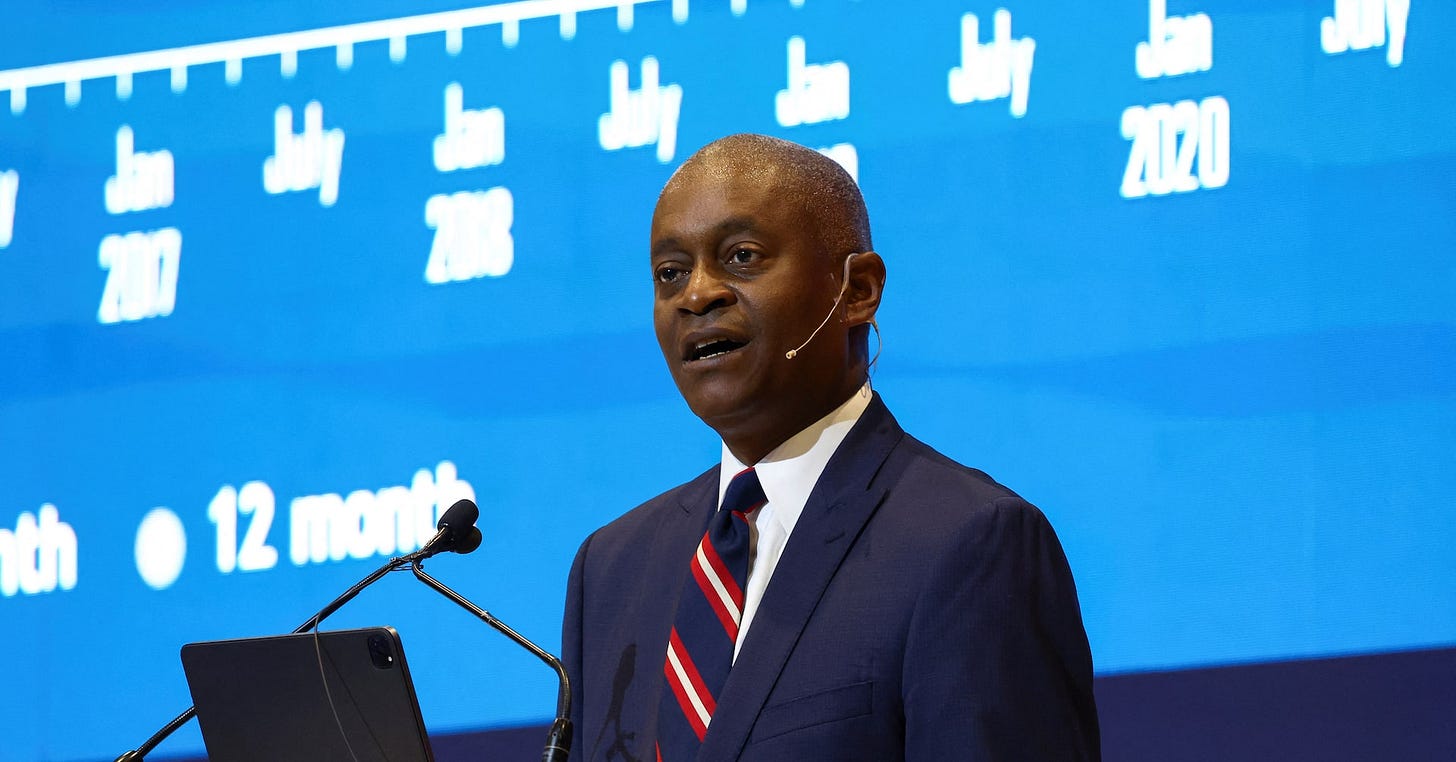
Federal Reserve Bank of Atlanta President Raphael Bostic’s February 5, 2026 remarks provide critical insight into the current monetary policy consensus within the Federal Reserve. Bostic’s statement that “inflation has been too high for too long” reinforces the FOMC’s 10-2 vote on January 29, 2026, to maintain the federal funds rate at 3.50%-3.75% [1][3]. As a rotating non-voting member of the FOMC this year, Bostic’s views nonetheless carry significant weight in shaping the collective policy stance, as he continues to participate in all FOMC discussions and deliberations.
The timing of Bostic’s comments—published approximately one week after the latest FOMC decision—suggests a coordinated communication strategy to explain the rationale behind the rate hold decision. His emphasis on consensus-building within the committee, as noted in his Atlanta Fed regional economics discussion, indicates that while the vote was nearly unanimous, achieving alignment among diverse regional perspectives requires deliberate effort [2][3]. This contextualizes the Fed’s approach to policy communication during a period of economic uncertainty.
Bostic’s projection of strong economic performance for the first half of 2026 appears somewhat at odds with his cautionary stance on inflation persistence. Market data from internal analytical sources [0] indicates that the S&P 500 traded near 6,832 on February 5, reflecting a 0.07% decline, while the NASDAQ showed volatility with a 0.49% gain on the same day following a 1.35% decline on February 4. The Russell 2000, often viewed as a barometer of domestic economic health, remained under pressure at approximately 2,596 [0].
This divergence between Bostic’s optimistic economic growth forecast and the modestly softening equity markets suggests that investors may be pricing in a more protracted period of monetary restraint than the Fed’s official projections imply. The minor market corrections across multiple indices—particularly the 1.24% decline in the Russell 2000 on February 4 and the 1.74% drop in the NASDAQ on February 3—align with a market environment adjusting to the “higher for longer” rate narrative that Bostic’s comments reinforce [0].
A particularly significant aspect of Bostic’s remarks involves his explicit identification of tariff effects as a source of inflationary pressure [1][2]. This acknowledgment represents an important data point for market participants attempting to gauge the Fed’s reaction function to externally-driven price pressures. Unlike monetary policy decisions that the Fed directly controls, tariff-related inflation introduces an external variable that complicates the central bank’s path toward its 2% inflation target.
The internal analytical database [0] suggests that upcoming CPI and PPI releases—particularly the February 12 CPI report—will serve as critical tests of Bostic’s characterization of inflation as “still too high.” These data points will likely influence market expectations for the March 17-18 FOMC meeting, where the updated dot plot will provide additional insight into the committee’s rate trajectory expectations.
Bostic’s characterization of Kevin Warsh’s prospective role as Fed chair as a “tall task” offers rare visibility into how current FOMC members perceive the upcoming leadership transition [2]. This candid assessment suggests that the incoming chair will inherit a complex policy environment characterized by persistent inflation pressures, external economic headwinds from trade policy, and the challenge of maintaining committee consensus. Market participants should anticipate that Warsh’s Senate confirmation process may provide additional signals regarding potential policy direction shifts, though no specific timeline for these hearings has been established.
The FOMC’s 10-2 vote to maintain rates steady, with only two dissenting members advocating for a 25 basis point cut, reveals a substantial but not unanimous consensus around the current policy stance [1][3]. Bostic’s emphasis on trust-building and consensus formation within the committee suggests that divergences exist among regional Fed presidents regarding the appropriate policy path. These internal dynamics could become more pronounced if incoming data presents conflicting signals about inflation trajectories or economic growth.
The observed market movements—characterized by day-to-day fluctuations rather than dramatic shifts—indicate that markets are processing Fed communications with a measured response. The NASDAQ’s recovery on February 5 following February 4’s decline demonstrates continued investor appetite for growth assets, even as rate-sensitive sectors may face headwinds [0]. This pattern suggests that while the “higher for longer” narrative has been absorbed into market pricing, opportunities for tactical positioning remain within specific market segments.
The analysis reveals several risk factors warranting attention from market participants. First, Bostic’s explicit characterization of inflation as persistently elevated signals that the Fed may maintain its hawkish stance longer than certain market participants anticipate [1]. This creates risk for asset classes that have priced in earlier rate cuts. Second, the tariff-driven inflation component identified by Bostic introduces policy uncertainty beyond the Fed’s control, potentially creating volatility in sectors exposed to trade policy changes [2].
Third, the combination of strong economic growth projections and persistent inflation creates stagflationary dynamics that historically challenge equity valuations. The modest equity market softening observed in recent trading sessions [0] may represent the initial market response to this complex environment. Fourth, leadership transition uncertainty during the Warsh confirmation process could introduce additional policy uncertainty that markets may need to price in [2].
Several opportunity windows emerge from the current policy environment. The rate stability implied by Bostic’s comments provides a predictable backdrop for medium-term capital allocation decisions, particularly in fixed income markets where yield curve positioning can be optimized. The six-week window until the March FOMC meeting [2] allows for strategic positioning based on the upcoming CPI release and any additional Fed communications.
Sector-specific opportunities may exist in industries less sensitive to interest rate movements or those positioned to benefit from continued economic growth despite elevated rates. Additionally, international markets with different monetary policy trajectories may present relative value opportunities as global rate differentials evolve.
The analytical findings indicate that the Federal Reserve, as articulated through Bostic’s February 5 remarks, maintains a cautiously hawkish stance with emphasis on completing the inflation fight before considering rate adjustments [1][3]. Current market indicators reflect modest caution consistent with this policy orientation, though volatility remains within normal ranges [0]. Key data points to monitor include the February 12 CPI release, upcoming Fed official speeches to assess collective stance consistency, and developments in the Warsh confirmation process that may signal policy direction [2].
The convergence of strong H1 2026 growth projections with persistent inflation concerns suggests that markets should expect continued rate stability through at least the first quarter of 2026, with any policy changes contingent on clear evidence of sustained inflation moderation. The FOMC’s near-unanimous support for the current rate level, combined with explicit acknowledgment of external inflationary pressures, frames the near-term monetary policy outlook as one of watchful patience rather than active adjustment.
Insights are generated using AI models and historical data for informational purposes only. They do not constitute investment advice or recommendations. Past performance is not indicative of future results.
About us: Ginlix AI is the AI Investment Copilot powered by real data, bridging advanced AI with professional financial databases to provide verifiable, truth-based answers. Please use the chat box below to ask any financial question.