Treasury Secretary Bessent Declines to Rule Out DOJ Action Against Fed Nominee Warsh; Warren Challenges on Fed Independence
Unlock More Features
Login to access AI-powered analysis, deep research reports and more advanced features
About us: Ginlix AI is the AI Investment Copilot powered by real data, bridging advanced AI with professional financial databases to provide verifiable, truth-based answers. Please use the chat box below to ask any financial question.
Related Stocks
The February 5, 2026 Senate Banking Committee hearing represented a pivotal moment in the ongoing tensions between the Trump administration and the Federal Reserve, highlighting unprecedented questions about central bank independence in the United States. At the center of this confrontation is President Trump’s announcement of Kevin Warsh as his nominee to replace current Fed Chair Jerome Powell, a selection that has raised alarms among monetary policy watchers given Warsh’s perceived willingness to align with executive branch preferences. [1][2]
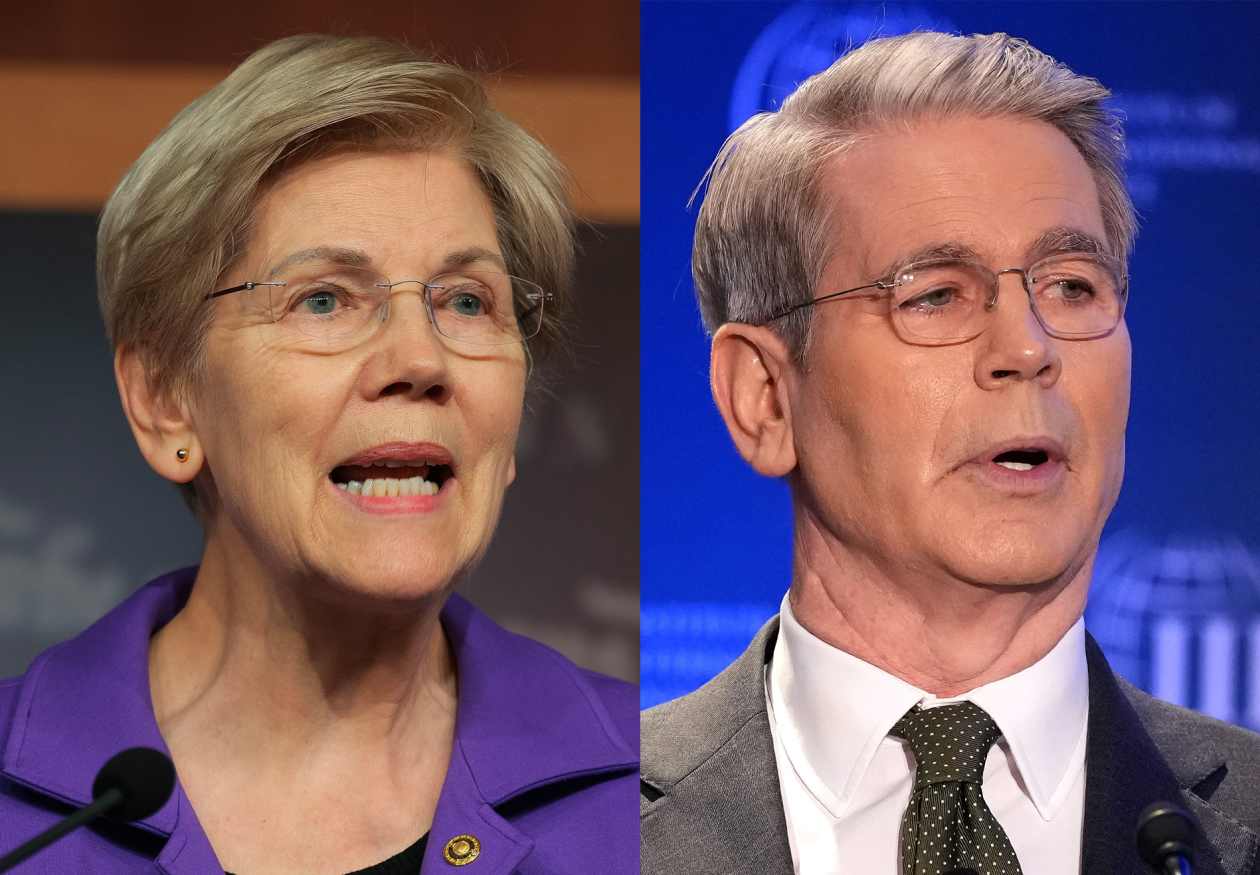
Senator Elizabeth Warren’s direct line of questioning to Treasury Secretary Bessent exposed the gravity of the situation: she demanded a commitment that Warsh would not face DOJ lawsuits or investigations if he failed to cut interest rates “exactly the way Donald Trump wants.” Bessent’s categorical refusal to provide such assurance—“That is up to the President”—effectively acknowledged that legal action against a Fed nominee remains a possibility contingent solely on presidential discretion. This response carries profound implications for the independence of monetary policy decision-making and the institutional norms that have historically insulated the Federal Reserve from political pressure. [2]
The exchange must be understood within the broader context of President Trump’s rare public criticism of Fed leadership and Powell’s unprecedented rare public statement accusing the administration of seeking to “bully Federal Reserve leaders into compliance.” This reciprocal escalation represents a fundamental challenge to the central bank’s autonomy, an institution that has operated with substantial independence since the Federal Reserve Act of 1913 precisely to prevent political interference in monetary policy decisions. [1]
The timing of this confrontation carries particular significance given concurrent market weakness across major indices. U.S. equities experienced their third consecutive session of declines on February 5, with the S&P 500 falling 0.55%, NASDAQ dropping 1.35%, and the Russell 2000 declining 2.86% over the three-day period from February 3-5. While market declines appear broadly based rather than exclusively tied to Fed-related news, the political uncertainty surrounding monetary policy leadership introduces an additional layer of investor concern during an already fragile market environment. [0]
The cumulative market performance data reveals meaningful breadth concerns, with smaller-cap stocks (Russell 2000) underperforming significantly more than large-cap indices, potentially reflecting investor anxiety about economic policy uncertainty affecting smaller businesses most sensitive to interest rate fluctuations. The NASDAQ’s 2.74% three-day decline suggests particular sensitivity among growth and technology sectors, which historically demonstrate elevated valuation sensitivity to interest rate expectations. [0]
Bessent’s testimony reveals a troubling institutional dynamic in which the Treasury Secretary, typically expected to support broader economic stability including central bank independence, declined to serve as a check on potential executive overreach. This absence of institutional resistance within the cabinet raises questions about the administrative framework’s capacity to buffer the Federal Reserve from political pressure. The Treasury Secretary’s position as the administration’s chief economic spokesperson traditionally carries an implicit responsibility to advocate for policy continuity and institutional stability. [2]
The lack of any governmental commitment protecting Warsh from potential legal action creates an environment of uncertainty that could fundamentally alter the calculus for future Fed nominees and sitting governors. If political disagreement with presidential preferences becomes grounds for DOJ scrutiny, the practical independence of monetary policy decision-making becomes compromised regardless of formal legal protections. [1][2]
The exchange between Warren and Bessent exposes a structural vulnerability in the constitutional framework governing Federal Reserve independence. While the Federal Reserve Act and subsequent legislation establish formal independence for monetary policy decisions, no explicit constitutional provision prevents executive branch legal action against Fed officials based on policy disagreements. This legal ambiguity has apparently been tested by the Trump administration’s willingness to contemplate DOJ action against a nominee who fails to meet presidential expectations. [1][2]
The unprecedented nature of threatening legal action against a Fed nominee based on anticipated policy decisions represents a significant departure from historical norms. Previous administrations, regardless of party affiliation, generally respected the informal conventions protecting Fed independence even when disagreeing with policy choices. The current willingness to contemplate formal legal measures marks a potential institutional inflection point with long-term implications for monetary policy credibility. [1]
Kevin Warsh’s confirmation trajectory has become substantially more uncertain following these revelations. Senate Banking Committee members now face a choice between confirming a nominee who may be subject to presidential legal pressure and rejecting the selection, potentially triggering a prolonged vacancy at Fed leadership during an economically sensitive period. Warsh’s previous experience as a Fed governor (2006-2011) and his academic credentials provide conventional qualifications, yet the political context surrounding his nomination complicates standard confirmation analysis. [2]
The confirmation hearing process will likely probe Warsh’s commitments to independence and his willingness to resist political pressure, creating awkward dynamics given Trump’s stated expectations for rate cuts. Warsh’s responses may prove determinative of his confirmation prospects, though any commitments made during hearings could prove difficult to enforce against subsequent executive action. [2]
The broader pattern emerging from these events suggests a fundamental recalibration of the relationship between the executive branch and independent regulatory agencies. The willingness to contemplate DOJ action against a Fed nominee signals an expansion of executive authority claims that could extend to other independent agencies facing political pressure. This institutional dynamic bears monitoring across multiple regulatory domains for evidence of systematic policy approaches. [1][2]
Federal Reserve communication has already demonstrated sensitivity to this environment, with Powell’s rare public statement representing an unusual departure from the central bank’s traditional reticence regarding political controversies. This institutional response indicates recognition within the Fed that conventional quiet diplomacy may prove insufficient to counter unprecedented political pressure, potentially heralding a new era of more public defense of central bank independence. [1]
The risk landscape associated with these developments encompasses multiple dimensions requiring careful monitoring. First, the precedent of threatening legal action against a Fed nominee creates unprecedented uncertainty for monetary policy expectations, potentially introducing risk premiums into asset valuations across interest-rate-sensitive categories. The娘子quantitative assessment of this uncertainty premium remains challenging given the absence of historical parallels. [0][1]
Second, the confirmation process uncertainty introduces legislative timeline risk that could leave Fed leadership transitions unresolved for extended periods. Prolonged vacancies at the Fed chair position typically introduce policy continuity concerns that may affect market expectations regarding the monetary policy path. [2]
Third, broader market weakness coinciding with political uncertainty amplifies downside risks through interaction effects. When fundamental political uncertainty overlays technical market weakness, historical patterns suggest elevated volatility potential. The three-day consecutive decline across major indices, particularly the Russell 2000’s 2.86% decline, indicates emerging risk aversion among market participants. [0]
The current environment also presents opportunity considerations for monitoring purposes. Congressional oversight represents an opportunity to establish clearer institutional boundaries through legislative action, though partisan dynamics complicate rapid legislative solutions. The Senate Banking Committee hearing format provides a public forum for institutional defense that could establish precedents supporting future independence protections. [2]
Market volatility during periods of policy uncertainty historically creates opportunities for information-advantaged participants to position for eventual resolution. The uncertainty premium currently embedded in interest rate expectations and equity valuations may compress favorably upon resolution of the confirmation process or clarification of the administration’s intentions regarding Fed independence. [0]
The confluence of unprecedented political pressure on Fed independence, market weakness, and confirmation process uncertainty suggests elevated risk levels warranting heightened attention from market participants. While the specific outcomes remain uncertain, the interaction of these factors creates conditions for continued volatility. Investors should maintain awareness of these risk factors while avoiding alarmist interpretations of events that remain in early stages of development. [0][1][2]
The February 5, 2026 Senate Banking Committee hearing featuring Treasury Secretary Scott Bessent and Senator Elizabeth Warren revealed significant tensions regarding Federal Reserve independence under the Trump administration. President Trump’s joke about suing his Fed chair nominee Kevin Warsh if he doesn’t lower rates “exactly the way the president wants” was directly confronted by Warren, who demanded Bessent commit that Warsh would not face DOJ action for policy disagreements. Bessent’s response that such decisions are “up to the President” provided no institutional buffer against potential executive action. [1][2]
Market performance during this period showed consecutive declines across major indices, with the S&P 500 falling 1.67% over three sessions, NASDAQ dropping 2.74%, and Russell 2000 declining 2.86%. While these declines appear broadly based rather than exclusively tied to Fed-related news, political uncertainty regarding monetary policy leadership contributes to an already fragile market environment. [0]
The Federal Reserve’s institutional response, including Powell’s rare statement accusing Trump of seeking to “bully” Fed leaders, signals recognition of unprecedented political pressure requiring public defense of independence norms. The confirmation process for Kevin Warsh now proceeds under heightened scrutiny regarding his commitment to monetary policy independence and his relationship to presidential rate expectations. [1][2]
The Senate Banking Committee’s oversight role provided a public forum for raising these concerns, though legislative solutions to institutional tensions remain uncertain given partisan dynamics. The absence of any commitment from Bessent regarding DOJ action against Warsh leaves significant uncertainty regarding the administration’s intentions and the practical boundaries of executive authority over independent agency leadership. [2]
Insights are generated using AI models and historical data for informational purposes only. They do not constitute investment advice or recommendations. Past performance is not indicative of future results.
About us: Ginlix AI is the AI Investment Copilot powered by real data, bridging advanced AI with professional financial databases to provide verifiable, truth-based answers. Please use the chat box below to ask any financial question.