Amazon's Accelerated LEO Satellite Deployment: Market Disruption Analysis
Unlock More Features
Login to access AI-powered analysis, deep research reports and more advanced features
About us: Ginlix AI is the AI Investment Copilot powered by real data, bridging advanced AI with professional financial databases to provide verifiable, truth-based answers. Please use the chat box below to ask any financial question.
Related Stocks
Based on comprehensive research into Amazon’s Project Leo (formerly Project Kuiper) and the competitive landscape, here is a detailed analysis of how Amazon’s accelerated satellite deployment will disrupt the global broadband market and pressure Starlink.
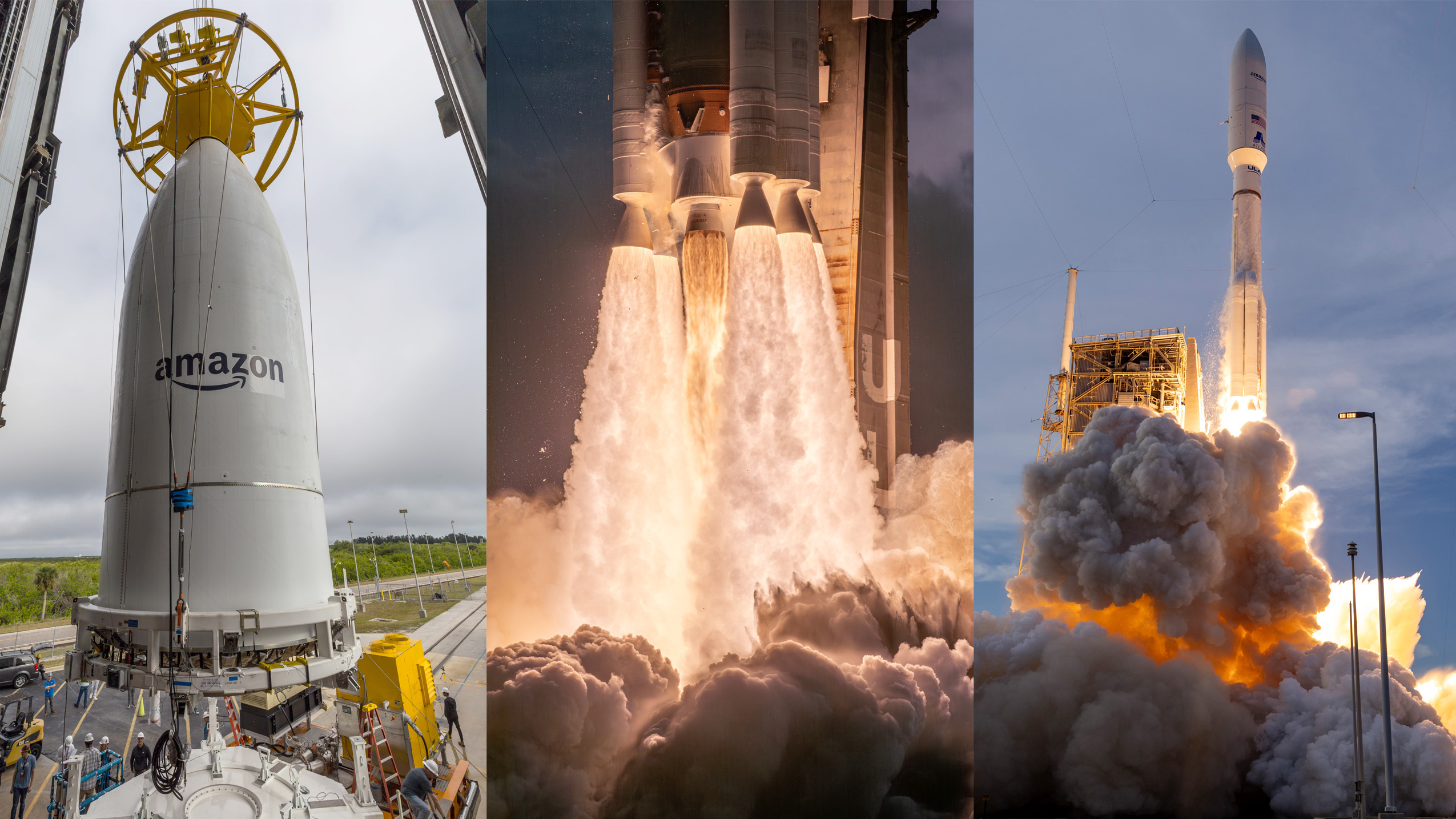
Amazon’s LEO satellite initiative has reached a critical inflection point. According to the latest data, Amazon has successfully launched
CEO Andy Jassy revealed during Amazon’s Q4 2025 earnings call that the company plans
| Launch Provider | Purpose |
|---|---|
SpaceX Falcon 9 |
10 launches contracted (added in late 2025 to accelerate schedule) [1] |
Blue Origin |
New Glenn heavy-lift launches [3] |
ULA Vulcan Centaur |
Primary launch vehicle for early deployments [3] |
Arianespace Ariane 6 |
European launch capacity [1] |
The multi-provider approach reduces dependency on any single launch system and provides schedule resilience.
Amazon has requested a
The addressable market for satellite broadband in underserved regions is substantial and growing rapidly:
| Market Segment | Current Value (2024) | Projected Value (2032) | CAGR |
|---|---|---|---|
Total LEO Satellite Market |
$13.4 billion | $34.7 billion | 12.5% [4] |
LEO Satellite Internet Services |
$4 billion (2022) | $45.3 billion | 22.5% [5] |
The communication segment alone is projected to grow from approximately
Amazon has strategically targeted markets where Starlink has established early presence but where significant connectivity gaps remain:
- Nigeria: NCC granted Amazon license to operate from February 28, 2026, through February 2033 [6]
- Competitive Dynamics: Starlink entered Nigeria in January 2023 and accumulated approximately66,523 subscribersby Q2 2025, making it Nigeria’s second-largest ISP [6]
- Amazon’s Advantage: Plans to offer three terminal models ranging from100 Mbps to 1 Gbps, with pricing expected to undercut Starlink’s $200-$400 hardware cost [6]
- Amazon aims to deploy services across all 54 African nations once regulatory approvals are secured [6]
- Starlink currently operates in 25 African countries with plans to expand to 20 additional markets in 2026 [6]
| Vector | Amazon’s Approach | Market Impact |
|---|---|---|
Hardware Pricing |
Standard terminal under $400 vs. Starlink’s $599 [7] | Lowers adoption barrier in price-sensitive markets |
Service Pricing |
Projected $80-$120/month vs. Starlink’s $110-$200 [8] | Intensifies price competition |
AWS Integration |
Bundled cloud services and ground-station infrastructure [7] | Creates unique enterprise value proposition |
E-commerce Synergies |
Prime membership integration for connected commerce [9] | Expands addressable market beyond traditional broadband users |
Starlink maintains overwhelming market dominance in the satellite internet sector:
| Metric | Value | Source |
|---|---|---|
Global Market Share (Speedtest samples, Q3 2025) |
97.1% |
[10] |
Active Satellites |
6,846 | [1] |
Total Global Subscribers |
~9.2 million | [10] |
Launch Activity (2025) |
165 orbital launches | [10] |
Cumulative Satellites Launched |
10,790+ | [10] |
Traditional GEO competitors like Viasat (1.7%) and HughesNet (1.0%) have been largely marginalized [10].
- Amazon’s $349 standard terminalrepresents a42% discountto Starlink’s $599 kit [7]
- Projected $99/monthservice pricing undercuts Starlink’s $110 base plan [7]
- Enterprise and AWS Prime member discounts could further erode Starlink’s pricing advantage [7]
- Kuiper’s compact 11-square-inch terminalsoffer easier installation than Starlink’s larger dish [7]
- Multiple terminal tiers (Standard, Travel $249, Enterprise) target diverse use cases [7]
- AWS ground-station networkprovides latency advantages for cloud-centric workloads [7]
- Tight integration with Prime membership creates cross-selling opportunities [9]
- Potential bundling with e-commerce and logistics services [9]
- Amazon’s initial mid-latitude focus overlaps with 95% of global population[7]
- Focus on mid-latitudes (US, EU, Asia) where most potential customers reside [7]
- Superior AWS infrastructure support in developed markets [7]
| Advantage | Description |
|---|---|
Capital Resources |
$10 billion initial investment backed by Amazon’s $1.7 trillion market cap [1] |
Launch Diversity |
Contracts with SpaceX, Blue Origin, ULA, and Arianespace reduce schedule risk [1] |
Supply Chain Scale |
Amazon’s manufacturing and logistics expertise enables lower hardware costs [8] |
AWS Infrastructure |
Existing ground-station network and cloud integration provides unique capabilities [7] |
Customer Ecosystem |
200+ million Prime members and millions of AWS enterprise customers [9] |
| Challenge | Impact |
|---|---|
Late Market Entry |
Starlink has established brand recognition and installed base of 9.2 million subscribers [10] |
Regulatory Hurdles |
Country-specific requirements (e.g., South Africa’s minority stake rules) may delay expansion [6] |
Coverage Gap |
Currently limited to mid-latitudes; polar and oceanic coverage under development [7] |
Technical Maturity |
No operational track record compared to Starlink’s proven reliability [7] |
FCC Deadline Pressure |
Potential regulatory consequences if deployment milestones are missed [1] |
| Strength | Description |
|---|---|
First-Mover Advantage |
5+ year head start with proven technology and operational experience [10] |
Scale Advantage |
6,846 active satellites vs. Amazon’s 182 (38x advantage) [1] |
Global Coverage |
Near-global coverage including polar regions and oceanic areas [7] |
Laser Inter-Satellite Links |
Superior latency (20-30ms) via optical laser connections [7] |
Ecosystem Integration |
Tesla vehicle integration, SpaceX launch services, and maritime applications [7] |
The LEO satellite communications market is experiencing explosive growth:
- 2024: $13.4 billion base [4]
- 2030: $20.1 billion (per earlier projections) [4]
- 2032: $34.7 billion (12.5% CAGR) [4]
- LEO Internet Services Segment: $45.3 billion by 2032 (22.5% CAGR) [5]
- Asia-Pacific: Fastest-growing region driven by China, India, and ASEAN markets [5]
- North America: Steady growth from enterprise and government contracts [5]
- Europe: Moderate growth with regulatory harmonization focus [5]
- Latin America/Middle East/Africa: Emerging opportunities with government initiatives [5]
- Amazon launches commercial services in Africa, starting with Nigeria [6]
- Price competition intensifies as both operators compete for market share
- Traditional GEO providers (Viasat, HughesNet) continue to lose share
- Amazon approaches full constellation deployment (3,236 satellites) [1]
- Starlink likely expands to 12,000-42,000 satellites [1]
- Market bifurcation between premium (Starlink) and value (Amazon) segments
- Market consolidation around 2-3 major LEO operators
- New entrants (OneWeb, China-based constellations) intensify competition
- Enterprise and government segments grow faster than consumer broadband [5]
-
Substantial Market Transformation: Amazon’s entry will fundamentally alter the satellite broadband landscape by ending Starlink’s effective monopoly and introducing genuine price competition.
-
Underserved Region Impact: The $45 billion LEO internet services market opportunity by 2032 ensures both operators will aggressively pursue underserved regions, with Africa being a key battleground [5][6].
-
Consumer Benefit: Price reductions from competition will benefit consumers, with potential savings of$100-$200 upfronton hardware and reduced monthly costs [7][8].
| Factor | Amazon’s Position | Pressure on Starlink |
|---|---|---|
Pricing |
40-50% lower hardware cost | HIGH - Forces price restructuring |
Ecosystem |
AWS/Prime integration | MEDIUM - Differentiation opportunity |
Coverage |
Mid-latitude focus | LOW - Starlink maintains global lead |
Scale |
182 vs. 6,846 satellites | LOW - Significant gap to close |
-
Amazon (AMZN): Leo represents along-term growth catalystwith potential to expand addressable market by hundreds of millions of new customers, though near-term financial impact will be modest [9].
-
SpaceX (private): Starlink’s first-mover advantage and scale provide substantial moat, though valuation pressure may emerge as competition intensifies.
-
Traditional Telecoms: Face existential threat from LEO disruption; integration or partnership strategies may be necessary.
[1] Space Intel Report - “Amazon Leo asks FCC for 2-year deadline extension, buys 10 SpaceX Falcon 9s” (https://www.spaceintelreport.com/amazon-leo-asks-fcc-for-2-year-deadline-extension-buys-10-spacex-falcon-9s-evokes-prototype-mission-anomalies/)
[2] MarketWise - Amazon Q4 2025 Earnings Coverage (https://marketwise.com/investing/what-is-amazons-project-kuiper-and-how-to-profit-from-it/)
[3] Max Polyakov - “New Megaconstellations to Compete with Starlink and OneWeb” (https://maxpolyakov.com/new-megaconstellations-to-compete-with-starlink-and-oneweb/)
[4] OpenPR - “LEO Satellite Market to Reach USD 34.7 Billion by 2032” (https://www.openpr.com/news/4373292/leo-satellite-market-to-reach-usd-34-7-billion-by-2032-size)
[5] LinkedIn - “LEO Satellite Communications and Internet Services Market” (https://www.linkedin.com/pulse/leo-satellite-communications-internet-services-0orae/)
[6] Ecofin Agency - “Amazon and Starlink Set Up Satellite Internet Rivalry in Africa” (https://www.ecofinagency.com/news-digital/1901-52031-amazon-and-starlink-set-up-satellite-internet-rivalry-in-africa)
[7] InsightHub Daily - “Starlink vs Project Kuiper 2026: The Ultimate Guide” (https://insighthubdaily.com/2026/01/24/starlink-vs-kuiper-2026/)
[8] OreateAI - “Project Kuiper vs. Starlink: The New Era of Satellite Internet” (https://www.oreateai.com/blog/project-kuiper-vs-starlink-the-new-era-of-satellite-internet/e8212dd28d80a54e4257efc43b12f023)
[9] Seeking Alpha - “Amazon Leo Could Be A Catalyst That Gets The Stock Moving” (https://seekingalpha.com/article/4858390-amazon-leo-could-be-a-catalyst-that-gets-the-stock-moving)
[10] TeslaNorth - “Starlink Now Dominates 97% of All Satellite Internet Usage” (https://teslanorth.com/2026/02/05/starlink-now-dominates-97-of-all-satellite-internet-usage/)
Insights are generated using AI models and historical data for informational purposes only. They do not constitute investment advice or recommendations. Past performance is not indicative of future results.
About us: Ginlix AI is the AI Investment Copilot powered by real data, bridging advanced AI with professional financial databases to provide verifiable, truth-based answers. Please use the chat box below to ask any financial question.