Larry Kudlow Defends Tariff Policy Amid Mixed Market Performance and Democratic Criticism
Unlock More Features
Login to access AI-powered analysis, deep research reports and more advanced features
About us: Ginlix AI is the AI Investment Copilot powered by real data, bridging advanced AI with professional financial databases to provide verifiable, truth-based answers. Please use the chat box below to ask any financial question.
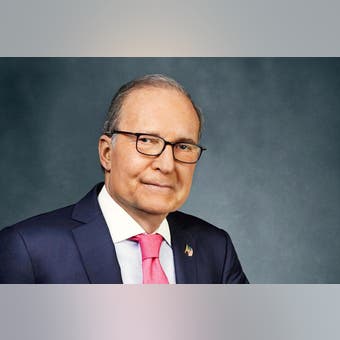
Larry Kudlow’s February 6, 2026 appearance on his eponymous FOX Business program addressed the ongoing partisan debate surrounding tariff policy effectiveness and its economic impacts [3]. The commentary frame—encouraging Democrats to “see the light” and cease criticism of “tariff inflation”—represents a continuation of the administration’s broader narrative that tariffs are producing beneficial economic outcomes. This rhetorical approach contrasts with independent analyses suggesting more contested economic effects [1][2].
The timing of Kudlow’s commentary coincides with notable divergence across U.S. equity indices. Market data indicates the Dow Jones Industrial Average gained 1.86% to reach record levels, while the NASDAQ Composite declined 2.80%, reflecting sector-specific concerns potentially linked to trade policy uncertainty [0]. The S&P 500 remained essentially flat at approximately $6,932, suggesting a market environment where tariff impacts remain ambiguous rather than uniformly positive or negative.
According to the analyst report’s synthesis of multiple sources, the Trump administration’s tariff regime has fundamentally altered the U.S. trade policy landscape [1][2]. The transition from average effective tariffs below 3% in 2024 to approximately 18% currently represents a significant structural change with wide-ranging economic implications. Treasury Secretary Scott Bessent has defended these policies before lawmakers, arguing they contribute to broader economic objectives despite Democratic concerns about inflationary pressure.
Independent economic analysis presents a more nuanced picture. While proponents cite strong GDP growth—3.8% in Q3 2025 and 4.4% in Q4 2025—as evidence of tariff policy success, critics question the sustainability of these gains and their attribution to trade barriers specifically [1][2]. The divergence between political messaging and independent assessment highlights the contested nature of tariff economics during this policy period.
The mixed market performance on February 6, 2026, provides important context for evaluating tariff policy claims [0]. The NASDAQ’s 2.80% decline, particularly notable given the index’s sensitivity to global trade conditions and technology sector supply chains, suggests that at least some market participants are pricing in potential negative consequences of elevated tariff rates. Conversely, the Dow Jones’s record-level gain may reflect sector composition advantages or differing interpretations of tariff impact across industry groups.
The Russell 2000’s modest 0.35% gain indicates small-cap equities—often considered more domestically focused and potentially less exposed to international trade friction—remained relatively stable. This sector-level divergence warrants continued monitoring as a potential indicator of how trade policy uncertainty affects different portions of the economy.
The Kudlow commentary illustrates the broader challenge of separating political narrative from empirical economic assessment during periods of significant policy transition. While administration supporters frame tariffs as producing an “economic miracle,” independent analysis suggests a more complex reality [1]. This distinction matters for stakeholders seeking to understand actual market implications rather than political positioning.
The partisan framing—urging Democratic critics to “stop bellyaching”—reflects the politically charged environment surrounding trade policy debate. However, the underlying economic questions about tariff impact on consumer prices, supply chain efficiency, and long-term competitiveness remain substantive concerns that political rhetoric alone cannot resolve.
The significant performance gap between the NASDAQ’s decline and the Dow Jones’s gains suggests market participants are not uniformly interpreting tariff policy effects [0]. Technology sector exposure to international supply chains and potential retaliatory measures may explain relative weakness in growth-oriented indices, while more diversified or domestically focused components show resilience. This divergence indicates elevated uncertainty regarding the ultimate economic trajectory of current trade policies.
The progression from sub-3% to approximately 18% average effective tariffs represents a rapid transformation of U.S. trade policy [1][2]. Such swift changes create adjustment challenges for businesses, consumers, and investors attempting to plan under uncertain conditions. The absence of clear bipartisan consensus on trade approach introduces additional policy risk, as future administrations might reverse current tariffs, complicating long-term investment decisions.
The analysis identifies several risk considerations warranting attention from market participants and economic observers. First, despite supportive political commentary, independent assessments indicate tariff impacts on consumer prices remain a legitimate concern requiring ongoing monitoring through actual inflation data rather than political claims [1][2]. Second, the NASDAQ’s pronounced weakness signals that at least some market segments perceive meaningful headwinds from current trade policy configurations [0]. Third, the approaching midterm election calendar may intensify political debate around tariffs, introducing additional policy uncertainty. Finally, elevated market valuations combined with tariff-related headwinds present risk/reward considerations that require careful individual assessment.
The mixed market environment creates potential opportunities for investors able to distinguish between sectors likely to benefit from protective trade policies and those facing structural challenges. Domestic-focused industries with limited import exposure may represent relative strength candidates, while international supply chain-dependent sectors may require premium valuations to justify current risk exposures. The ongoing policy debate also creates information arbitrage opportunities for analysts able to distinguish political messaging from underlying economic fundamentals.
Key indicators warranting continued surveillance include actual inflation data releases versus political rhetoric, corporate earnings commentary specifically addressing tariff impacts, any evidence of bipartisan movement on trade policy, and changes in market breadth across sectors as the tariff regime matures. Treasury Secretary Bessent’s congressional appearances provide particularly important signals regarding potential policy adjustments [1].
This analysis synthesizes multiple data sources to present a comprehensive assessment of the economic and market context surrounding Larry Kudlow’s February 6, 2026 tariff commentary. The key findings indicate that while administration supporters frame current tariff policies as economically beneficial, independent analysis presents a more contested picture with mixed market performance reflecting genuine uncertainty about ultimate outcomes.
The transition to approximately 18% average effective tariffs from sub-3% levels represents a fundamental U.S. trade policy shift with wide-ranging implications [1][2]. Market data showing index divergence—the Dow Jones at record levels versus the NASDAQ down 2.80%—suggests sector-specific impacts rather than uniform economic effects [0]. The partisan nature of current trade policy debate complicates objective assessment, necessitating careful attention to empirical economic indicators rather than political positioning alone.
Stakeholders should recognize that the medium impact rating assigned reflects the genuine uncertainty surrounding tariff policy effects rather than dismissal of either political perspective. Continued monitoring of inflation data, corporate commentary, and congressional testimony will provide important updates to current assessment frameworks as this policy environment evolves.
Insights are generated using AI models and historical data for informational purposes only. They do not constitute investment advice or recommendations. Past performance is not indicative of future results.
About us: Ginlix AI is the AI Investment Copilot powered by real data, bridging advanced AI with professional financial databases to provide verifiable, truth-based answers. Please use the chat box below to ask any financial question.