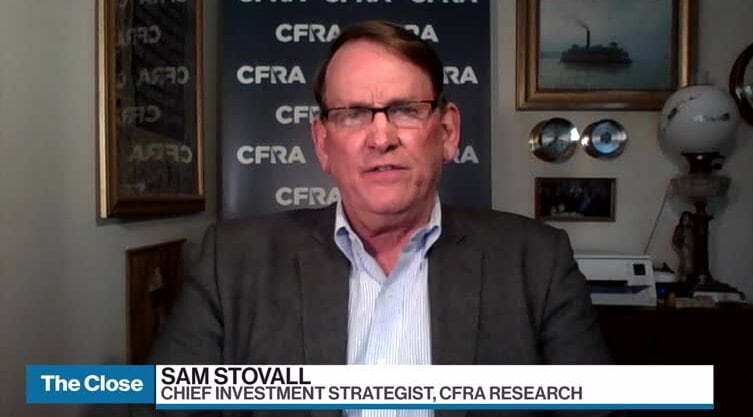
Stovall: "We Will be Rewarded by Holding On" Amid Volatile Markets - February 2026 Market Outlook
Unlock More Features
Login to access AI-powered analysis, deep research reports and more advanced features
About us: Ginlix AI is the AI Investment Copilot powered by real data, bridging advanced AI with professional financial databases to provide verifiable, truth-based answers. Please use the chat box below to ask any financial question.
Related Stocks
This analysis is based on Sam Stovall’s CNBC commentary published on February 9, 2026 [1], which provided insights into broad market action and historical seasonal patterns affecting equity investments. As Chief Investment Strategist at CFRA Research, Stovall’s perspectives carry significant weight in the investment community, drawing upon decades of market analysis and historical data patterns.
Stovall’s core thesis centered on several interconnected seasonal factors that investors should consider when positioning their portfolios. First, he identified February as “the second-worst month of the year” for equity markets [1], establishing a cautionary tone for near-term market expectations. This characterization aligns with broader market research indicating that February has historically presented challenges for stock market performance [3]. Second, Stovall highlighted that in midterm election years—which 2026 represents—markets historically experience a “potential soft patch in the back half of the month” [1], suggesting that the latter portion of February 2026 may face additional headwinds beyond typical seasonal weakness.
The third key element of Stovall’s commentary addressed the well-known “Sell in May” phenomenon, noting that markets traditionally take a “deeper dive” from May through the summer months [1]. This observation connects to a long-standing seasonal pattern in equity markets where stocks have historically demonstrated stronger performance during the November-through-April period compared to the May-through-October timeframe [4][5]. However, Stovall tempered these near-term concerns with a constructive long-term perspective, emphasizing that markets typically recover and finish higher during the fall months [1].
The major U.S. equity indices are demonstrating mixed performance amid elevated volatility as of the February 9, 2026 commentary [0]. The S&P 500 was trading around 6,964.81, showing modest recovery following an early February selloff that tested investor resolve. The Dow Jones Industrial Average had recently achieved a significant milestone, closing above 50,000 for the first time on February 6, 2026, with the index at approximately 50,135.88 during Stovall’s commentary [2]. The NASDAQ, heavily influenced by technology sector movements, was trading near 23,238.67, reflecting the sector’s characteristic volatility. The Russell 2000, representing smaller-capitalization stocks, was positioned around 2,689.05, recovering from early February lows that had prompted concern among market participants [0][2].
Early February 2026 saw significant declines across indices, with technology stocks serving as primary drivers of both rallies and pullbacks. Trading volumes increased substantially during down days, reflecting elevated institutional and retail participation in the volatility [0]. This context is essential for understanding Stovall’s advice to remain patient and maintain investment positions despite short-term market fluctuations.
The seasonal patterns cited by Stovall are supported by substantial historical evidence, though investors should understand both the strength and limitations of these patterns. The “Sell in May and go away” adage reflects documented historical performance differences between the summer and winter months in equity markets [4]. BankRate analysis confirms that stocks have historically performed better during colder months from November through April [4]. This pattern has been attributed to various factors including reduced institutional participation during summer vacation periods, tax-loss harvesting behaviors at year-end, and overall reduced trading activity that can amplify downside movements.
However, modern financial analysis suggests this seasonal pattern may be “more myth than reality” in recent years [5]. IG analysis notes that “idiosyncratic corporate developments, global macroeconomic factors, and central bank monetary policies have demonstrated significantly greater influence on market performance than seasonal trading patterns” [5]. This represents an important caveat for investors relying solely on historical seasonal patterns for investment decisions. The relationship between calendar timing and market returns has weakened as markets have become more sophisticated, globalized, and responsive to real-time information flows.
Stovall’s reference to midterm year seasonality aligns with historical observations about election-year market dynamics. Presidential cycle analysis suggests that the third year of a presidential term has historically been the strongest for stock markets, while the second year (midterm year) tends to be more challenging [6]. This pattern reflects the political dynamics surrounding midterm elections, including potential policy uncertainty and shifts in legislative priorities that can create market volatility.
Current sector performance provides additional context for Stovall’s broader market assessment [0]. Utilities (+2.09%) and Basic Materials (+1.81%) were leading sector performance, reflecting defensive positioning and economic recovery themes respectively. Technology (+1.60%) continued to serve as the primary volatility driver, consistent with its outsized influence on major indices. Lagging sectors included Consumer Defensive (-0.76%), Consumer Cyclical (-0.27%), and Healthcare (-0.14%), representing a defensive rotation consistent with seasonal weakness patterns and broader risk-off sentiment.
This sector rotation pattern aligns with historical observations about seasonal market behavior, where investors often shift toward defensive positioning during periods of anticipated weakness. The relative strength of utilities and basic materials suggests investors are balancing concerns about near-term volatility against longer-term economic optimism.
Stovall’s commentary establishes a clear causal framework linking multiple seasonal phenomena. February weakness compounds with midterm-year election dynamics to create potential headwinds specifically in the latter half of February 2026. This layered approach to seasonal analysis provides investors with a more nuanced understanding of timing risks than simple calendar-based positioning would suggest.
The “deeper dive” from May through summer that Stovall referenced represents a continuation of this seasonal weakness theme, but with an important implication: the traditional autumn recovery creates a favorable risk-reward scenario for patient investors who maintain positions through seasonal weakness periods. This insight transforms what might appear as bearish commentary into a constructive long-term perspective.
Stovall’s closing statement—“We will be rewarded by holding on”—represents the most actionable element of his commentary [1]. This advice positions seasonal weakness not as a reason to exit markets but as an expected temporary condition within longer-term uptrends. The historical tendency for markets to “finish higher” in the fall provides a forward-looking framework that can help investors maintain discipline during challenging seasonal periods.
This perspective aligns with broader investment research demonstrating that timing the market based on seasonal patterns often results in underperformance compared to maintaining consistent investment exposure. The transaction costs, tax implications, and emotional toll of seasonal market timing frequently erode the theoretical benefits of躲避seasonal weakness.
The analyst reports highlight an important tension between historical seasonal patterns and their modern-day reliability [3][4][5]. While February has historically been one of the worst months for stock market performance, and midterm years have presented additional challenges, these patterns should be viewed as probabilistic rather than deterministic guides to market behavior.
MarketWatch analysis confirms February’s historical weakness while also noting that recoveries have historically followed these seasonal weakness periods [3]. This symmetry—weakness followed by recovery—forms the foundation of Stovall’s constructive long-term thesis and suggests that patience during seasonal weakness periods has historically been rewarded.
The risks and opportunities identified in this analysis are time-sensitive to the following degree:
- Immediate (February 2026): Seasonal weakness risks are elevated; defensive positioning warrants attention
- Near-Term (March-April 2026): Presidential election primary season developments may add volatility; transition from weak to stronger seasonal period approaches
- Medium-Term (May-August 2026): Traditional “Sell in May” weakness period; potential summer volatility creates both risks and opportunities
- Long-Term (September-December 2026): Anticipated fall recovery period; historical seasonal strength suggests constructive positioning for year-end
This analysis synthesizes Sam Stovall’s February 9, 2026 CNBC commentary on broad market action and seasonal patterns [1], current market performance data [0], historical seasonal pattern research [3][4][5], and broader market context [2][6] to provide investors with a comprehensive understanding of near-term market dynamics.
- February 2026 presents heightened seasonal weakness risk as the second-worst month historically combined with midterm-year dynamics [1]
- Traditional summer weakness from May through August may extend current market volatility [1]
- Historical evidence supports Stovall’s constructive long-term thesis that markets typically recover and finish higher in fall months [1][3]
- Technology sector concentration represents a key risk factor given its outsized influence on major indices [2]
- Seasonal patterns, while historically supported, may be less reliable in modern markets due to increased sophistication and globalization [5]
| Indicator | Current Level/Status | Implication |
|---|---|---|
| S&P 500 | ~6,964.81 | Modest recovery from early February selloff |
| Dow Jones | ~50,135.88 | First close above 50,000 milestone reached Feb 6 [2] |
| NASDAQ | ~23,238.67 | Technology-driven volatility continues |
| Russell 2000 | ~2,689.05 | Recovering from early February lows |
| Leading Sectors | Utilities, Basic Materials, Technology | Defensive rotation underway [0] |
Several important factors were not addressed in Stovall’s commentary but warrant investor monitoring:
- Federal Reserve policy trajectory and interest rate decisions
- AI and technology sector valuation sustainability
- Key economic indicators (CPI, employment, GDP growth)
- Geopolitical factors including international trade policies
- Corporate earnings trajectory, particularly in technology sector
This analysis is based on historical patterns and current market conditions, neither of which guarantees future performance. Seasonal patterns should be considered as probabilistic guides rather than certainties. Individual investor circumstances vary significantly, and no single analysis can address all relevant considerations for investment decisions.
[0] Ginlix Analytical Database – Market indices and sector performance data (internal database citation)
[1] CNBC/Sam Stovall – “Stovall: ‘We Will be Rewarded by Holding On’ Amid Volatile Markets” (February 9, 2026) – https://www.youtube.com/watch?v=eibRbGTy6Us
[2] CNBC – “S&P 500 scores back-to-back gains as tech rises, Dow touches new record” (February 8, 2026) – https://www.cnbc.com/2026/02/08/stock-market-today-live-updates.html
[3] MarketWatch – “U.S. stocks had a rocky February under Trump’s return” (February 2026) – https://www.marketwatch.com/story/u-s-stocks-had-a-rocky-february-under-trumps-return-should-investors-be-worried-about-march-c6e4f450
[4] BankRate – “Sell In May And Go Away? 3 Reasons Why It’s Risky” – https://www.bankrate.com/investing/sell-in-may-go-away/
[5] IG – “Sell in May myth debunked: why traders shouldn’t exit markets” – https://www.ig.com/en/news-and-trade-ideas/sell-in-may-250528
[6] Presidential cycle market performance analysis – Social media/analysis reference – https://www.facebook.com/groups/2205011669/posts/10163089783991670/
Insights are generated using AI models and historical data for informational purposes only. They do not constitute investment advice or recommendations. Past performance is not indicative of future results.
About us: Ginlix AI is the AI Investment Copilot powered by real data, bridging advanced AI with professional financial databases to provide verifiable, truth-based answers. Please use the chat box below to ask any financial question.