Geopolitical Risks and Defense Procurement Opportunities from Israel's Military Doctrine Transition
Unlock More Features
Login to access AI-powered analysis, deep research reports and more advanced features
About us: Ginlix AI is the AI Investment Copilot powered by real data, bridging advanced AI with professional financial databases to provide verifiable, truth-based answers. Please use the chat box below to ask any financial question.
Related Stocks
Based on my comprehensive research, I can now provide you with a systematic analysis of the geopolitical risks arising from Israel’s military doctrine transition and the implications for defense contractors.
Israel’s establishment of its first new mobile combat division in decades—Tank Division 38—signals a fundamental shift from a primarily defensive posture to an offensive military doctrine. This transformation, led by IDF Chief of Staff Lieutenant General Eyal Zamir, carries significant geopolitical implications for the Middle East and creates substantial procurement opportunities for defense contractors. This analysis examines the strategic, regional, and economic dimensions of this shift, along with the investment implications for defense sector participants.
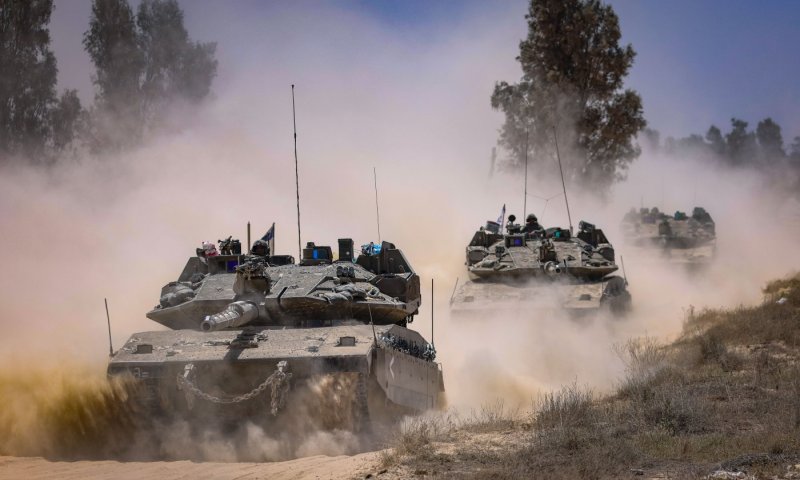
The re-establishment of Tank Division 38 represents Israel’s most significant ground force restructuring in decades. Key characteristics include [1]:
| Attribute | Details |
|---|---|
Initial Strength |
Approximately 1,200 reservists (average age 25-27) |
Projected Strength |
Full division strength of approximately 5,000 personnel |
Primary Equipment |
Merkava Mark 4 main battle tanks |
Training Commencement |
July 2025 |
Full Operational Drill |
October 2026 |
Integration into IDF |
Expected participation in IDF-wide exercises by 2027 |
The doctrine shift is driven by several factors [2]:
-
Lessons from the 2023-25 Israel-Hamas War: The conflict revealed structural deficiencies in command and control, with division commanders sometimes managing 7-8 brigades simultaneously, well above the standard 4-5 brigades.
-
Multi-Front Threat Environment: Israel faces potential threats from Hamas, Hezbollah, Iranian-backed militias across multiple fronts including Gaza, Lebanon, Syria, and Iran.
-
Capability Gaps: Analysis indicates that Iran could be producing 300 missiles per month, potentially overwhelming Israel’s defense systems by 2027-2028.
Israel has approved its largest-ever military budget:
- 2026 Budget: $35 billion
- Projected Decade-Long Spending: $100 billion
The transition toward offensive capabilities introduces several escalation risks:
Israel’s “superpower mindset” doctrine—which rejects restraint policies in favor of proactive strikes—signals to regional actors that Israel will act independently to neutralize threats [2]. This posture:
- Reduces reliance on traditional security guarantors (US, EU)
- May provoke preemptive responses from adversaries
- Increases the likelihood of rapid escalation cycles
The most significant geopolitical flashpoint involves Iran:
| Risk Factor | Implication |
|---|---|
Ballistic Missile Threat |
Iran’s arsenal could overwhelm Israeli defenses by 2027-2028 |
Proxy Forces |
Hezbollah has stated it would “not be neutral” if Iran is attacked, warning of a war that would “set the entire region ablaze” [3] |
Nuclear Facilities |
Potential US strikes on Iranian nuclear infrastructure remain a contingency |
Strait of Hormuz |
20% of global oil transit remains vulnerable to disruption |
The Arab Gulf states face substantial geo-economic vulnerabilities:
| Indicator | Impact |
|---|---|
Saudi Stock Market (TASI) |
Approximately 1.9% decline, representing $60-80 billion market cap loss |
Saudi Aramco |
Shares declined approximately 2.4% during Iran-Israel escalation |
Saudi Banking Stocks |
National Bank shares fell approximately 3% |
Mining Sector |
Declines of approximately 9% |
These market reactions demonstrate the sensitivity of Gulf economies to regional conflict risk [4].
Israel’s doctrine shift may trigger regional responses:
- Neighboring states may accelerate their own military modernization
- Saudi Arabia and UAE may seek enhanced deterrence capabilities
- Iran may further expand its missile and proxy network
Regional leaders have warned that Israel’s military campaign in Gaza is undermining the global legal order, creating diplomatic tensions with European partners and complicating defense cooperation arrangements [5].
The United States has approved substantial defense sales to Israel:
| Contract | Value | Equipment |
|---|---|---|
Joint Light Tactical Vehicle |
$1.98 billion | 3,250 vehicles |
AH-64E Apache Helicopters |
$3.8 billion | Attack helicopters |
Namer APC Power Packs |
$740 million | Armored personnel carrier components |
AW119Kx Light Utility Helicopters |
$150 million | Utility helicopters |
Iron Dome, David’s Sling, Arrow |
$500 million (FY2026) | Missile defense systems |
- Role: Primary F-35 supplier to Israel
- Opportunity: F-35 upgrades and additional aircraft
- Strategic Position: Dual-use capabilities provide flexibility across conflict and deterrence scenarios
- Contract: $8.6 billion F-15 deal for Israel
- Opportunity: Expansion of air superiority fleet
- Strategic Position: Established supplier relationship; recent contract value demonstrates commitment
- Role: THAAD and Patriot PAC-3 systems provider
- Opportunity: Theater missile defense expansion
- Strategic Position: Critical for layered defense architecture
- Recent Contract: $228 million for Iron Fist Active Protection System for US Army Bradley IFVs
- Strategic Position: Dual-role as Israeli defense contractor and US supplier; positioned for both Israeli and international contracts
- Privatization: Israel is considering public share sales of IAI and Rafael, potentially creating investment opportunities [6]
Israel’s defense establishment is undergoing significant transformation:
| Company | Status | Opportunity |
|---|---|---|
IAI (Israel Aerospace Industries) |
Potential privatization (25-30% stake) | International market expansion |
Rafael |
Potential privatization | Technology transfer opportunities |
Elbit Systems |
Privately held (IMI Systems acquisition) | Continued US and international contracts |
The Middle East military build-up creates a
| Strategic Factor | Investment Implication |
|---|---|
Procurement Cycles |
Long-term, multi-year contracts provide revenue visibility |
Dual-Use Assets |
Platforms like F-15 and F-35 serve both conflict and deterrence roles |
Technology Leadership |
Cyber and missile defense capabilities command premium valuations |
Investors should monitor:
- Escalation Likelihood: Kinetic conflict could trigger cost overruns and supply chain disruptions
- Sanctions Exposure: Defense contractors with international operations face regulatory risk
- Budgetary Constraints: Domestic political opposition to foreign military sales could affect pipeline
| Category | Positioning | Rationale |
|---|---|---|
Primary Defense |
Long positions in Boeing, Raytheon, Lockheed Martin | Direct beneficiaries of US Foreign Military Sales |
Missile Defense |
Focus on layered defense architecture | Iran’s missile buildup drives demand |
Ground Forces |
Monitor Merkava upgrades and Namer APC expansion | Doctrine shift emphasizes ground offensive capability |
Israeli Defense |
Watch IAI/Rafael privatization | Potential for international investor participation |
Israel’s military doctrine transition represents a fundamental shift with far-reaching implications:
-
Regional Stability: The shift toward offensive capabilities increases the probability of rapid escalation cycles, particularly with Iran and its proxy networks.
-
Defense Spending: Israel’s $100 billion decade-long military commitment, combined with US Foreign Military Sales, creates substantial opportunities for defense contractors.
-
Market Volatility: Gulf economies remain highly sensitive to regional conflict risk, with potential for significant market corrections during escalation periods.
- Structural Demand: The doctrinal shift creates multi-year procurement tailwinds for ground systems, air assets, and missile defense
- Technology Premium: Cyber, precision strike, and active protection systems command premium positioning
- Risk Management: Diplomatic breakthroughs could moderate demand, while escalation could accelerate procurement cycles
The transformation of Israeli military doctrine from defensive to offensive posture fundamentally alters the regional security landscape while creating sustained opportunities for defense contractors positioned to supply advanced ground, air, and missile defense capabilities.
[1] Yahoo News - “IDF unveils new tank division, marking shift from defense to offense” (https://www.yahoo.com/news/articles/idf-unveils-tank-division-marking-151137590.html)
[2] Macdonald Laurier Institute - “Israel’s long wars—bracing for civilizational conflict in the Mideast” by David M. Weinberg (https://macdonaldlaurier.ca/israels-long-wars-bracing-for-civilizational-conflict-in-the-mideast-david-m-weinberg-for-inside-policy/)
[3] ACLED - “Middle East Overview: February 2026” (https://acleddata.com/update/middle-east-overview-february-2026)
[4] The Week - “How Iran tensions trigger geo-economic shocks in the Middle East” (https://www.theweek.in/news/middle-east/2026/02/08/how-iran-tensions-trigger-geo-economic-shocks-in-the-middle-east.html)
[5] Al Jazeera - “Israel’s Gaza genocide risks global order, leaders warn at Al Jazeera Forum” (https://www.aljazeera.com/news/2026/2/7/israels-gaza-genocide-risks-global-order-leaders-warn-at-al-jazeera-forum)
[6] Times of Israel - “Israel eyes privatization of defense giants IAI and Rafael via public share sale” (https://www.timesofisrael.com/israel-eyes-privatization-of-defense-giants-iai-and-rafael-via-public-share-sale/)
[7] AInvest - “Assessing Geopolitical Risk: Military Build-Up in Middle East Shapes Defense & Energy Markets” (https://www.ainvest.com/news/assessing-geopolitical-risk-military-build-middle-east-shapes-defense-energy-markets-2026-2601/)
私募机构高仓位过节策略深度分析
Insights are generated using AI models and historical data for informational purposes only. They do not constitute investment advice or recommendations. Past performance is not indicative of future results.
About us: Ginlix AI is the AI Investment Copilot powered by real data, bridging advanced AI with professional financial databases to provide verifiable, truth-based answers. Please use the chat box below to ask any financial question.