Amazon Pharmacy Same-Day Delivery Investment Justification Analysis
Unlock More Features
Login to access AI-powered analysis, deep research reports and more advanced features
About us: Ginlix AI is the AI Investment Copilot powered by real data, bridging advanced AI with professional financial databases to provide verifiable, truth-based answers. Please use the chat box below to ask any financial question.
Related Stocks
Based on my comprehensive analysis of Amazon Pharmacy’s same-day delivery expansion and the pharmaceutical logistics industry, here is a detailed assessment of whether the investment justifies the margins and operational complexity.
Amazon Pharmacy announced in February 2026 a significant expansion of its same-day prescription delivery service to approximately
The timing of Amazon’s aggressive expansion coincides with significant distress among traditional pharmacy retailers. CVS Health has experienced declining profit margins at its retail pharmacies, rising costs from its Aetna insurance operations (approximately one-third of revenue), and has implemented a $2 billion cost-reduction plan including 2,900 corporate layoffs [2]. Walgreens Boots Alliance has reported even more severe struggles, with its U.S. healthcare services operating loss doubling to $526 million in FY2024 Q4, and a full-year segment loss of $14.2 billion compared to $1.7 billion in 2023 [2].
Both major pharmacy chains have announced substantial store closure programs—Walgreens planning to close 1,200 stores (approximately 14% of its footprint) over three years, with 500 closures in FY2025 alone [2]. CVS is exiting infusion services and closing or selling 29 Coram-associated pharmacies [2]. This disruption creates an opportunity window for Amazon to capture market share in underserved markets and pharmacy deserts.
The pharmaceutical logistics industry faces inherently constrained margins. According to industry data, retail pharmacy operating margins fell to approximately
-
Low Prescription Reimbursement Rates: Payer negotiations with insurance companies and pharmacy benefit managers (PBMs) continue to compress margins. Walgreens has experienced being cut from Express Scripts networks, directly impacting revenue [2].
-
Operational Complexity Costs: Prescription drugs secured 30.60% revenue share of the pharmaceutical logistics market in 2025, but require specialized handling including temperature-controlled environments for biologics and specialty drugs [4]. The global pharmaceutical logistics market was valued at $101.5 billion in 2024 and requires significant capital investment in cold chain infrastructure [4].
-
Last-Mile Delivery Economics: The prescription delivery market is seeing the introduction of new fees, including fuel surcharges reaching up to $8 per delivery for some mail-order medications, indicating cost pressure on delivery operations [5].
Amazon’s Q4 2025 financial results demonstrate substantial capacity to fund this expansion. The company reported
However, Amazon has not disclosed specific pharmacy segment financial metrics, suggesting the pharmacy business remains relatively small compared to its core segments. Industry analysts estimate Amazon Pharmacy could generate approximately
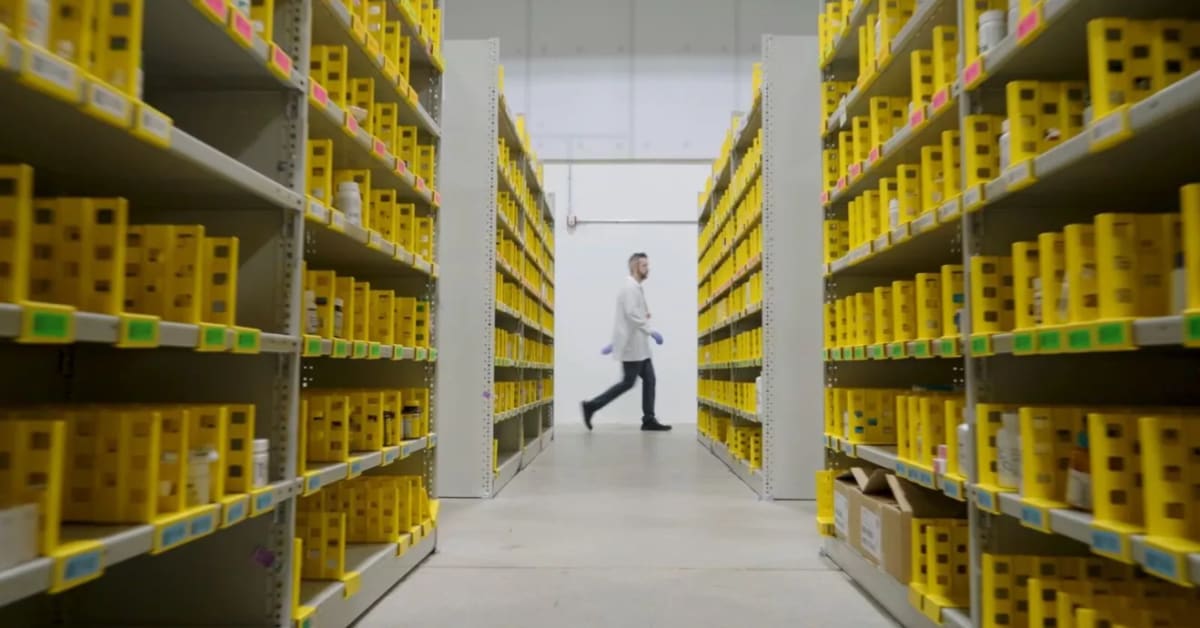
Pharmaceutical logistics introduces significant operational complexity beyond standard e-commerce delivery:
-
Controlled Substance Regulations: Pharmacies must comply with DEA regulations for Schedule II-V controlled substances, requiring separate storage in locked, tamper-proof cabinets, detailed record-keeping for seven years, and strict prescription verification procedures [8].
-
Temperature Control Requirements: Many prescriptions, particularly biologics and specialty medications, require cold chain logistics throughout the delivery process, adding infrastructure costs and failure risk [4].
-
Regulatory Compliance Evolution: Controlled substance compliance continues to evolve in response to healthcare and public safety changes, requiring ongoing investment in compliance systems and training [8].
-
Verification and Trust: Customers must trust that prescriptions are delivered on time and covered by insurance, especially when switching pharmacies—a barrier that requires significant consumer education and payer relationship development [5].
Despite thin industry margins and operational complexity, several factors make Amazon’s investment potentially justified:
-
Ecosystem Integration: Amazon can bundle pharmacy services with Prime membership, Whole Foods, and Amazon Fresh, creating customer lifetime value that offsets per-prescription margins. This integrated ecosystem approach is difficult for traditional pharmacies to replicate [2].
-
Leveraging Existing Infrastructure: Amazon is deploying its established logistics network—including e-bikes, electric vehicles, and delivery kiosks—rather than building a parallel pharmaceutical infrastructure. This amortizes fixed costs across multiple product categories.
-
Market Timing: The simultaneous struggles of CVS and Walgreens create market disruption opportunity. As traditional chains close stores and reduce services, Amazon can capture customers in pharmacy deserts without immediate margin pressure from head-to-head competition.
-
Data and Pricing Advantages: Amazon’s bulk purchasing power and direct-to-consumer model enable competitive pricing. Bain & Company analysis notes that despite efforts by other digital pharmacy entrants, Amazon is investing in pharmacy capabilities that leverage its core advantages [7].
-
Adjacent Revenue Streams: Pharmacy customers tend to be high-engagement healthcare consumers, potentially driving purchases across Amazon’s broader ecosystem including health and wellness products.
The investment carries significant risks:
| Risk Factor | Impact |
|---|---|
Margin Compression |
Industry-average pharmacy margins are already thin; delivery costs may erode profitability further |
Regulatory Burden |
DEA compliance, state pharmacy boards, and evolving healthcare regulations create ongoing operational complexity |
Payer Relationships |
Insurance coverage and PBM networks are critical to prescription economics; Amazon must establish these relationships |
Capital Allocation |
With $200 billion in planned 2026 capex focused on AWS/AI, pharmacy may receive lower priority for resources |
Consumer Trust |
Healthcare and prescription decisions involve high consumer sensitivity; any errors or delays could damage brand reputation |
The expansion is likely
[1] Amazon Corporate. “Amazon Pharmacy will expand Same-Day Delivery to nearly 4,500 U.S. cities and towns.” AboutAmazon, February 2026. https://www.aboutamazon.com/news/retail/amazon-pharmacy-same-day-delivery-medication-expansion
[2] Advisory Board Company. “Inside the financial struggles at CVS, Walgreens.” The Advisory Board, October 2024. https://www.advisory.com/daily-briefing/2024/10/21/retail-pharmacies
[3] CSIMarket. “Pharmacy Services & Retail Drugstore Industry Profitability.” CSIMarket Industry Analysis, 2025. https://csimarket.com/Industry/industry_Profitability_Ratios.php?ind=1304
[4] Mordor Intelligence. “Pharmaceutical Logistics Market Size & Share Analysis.” Market Report, 2025. https://www.mordorintelligence.com/industry-reports/global-pharmaceutical-logistics-market
[5] Associated Press. “More pharmacies offer to speed prescription deliveries to customers.” AP News, 2026. https://apnews.com/article/amazon-walmart-same-day-prescription-deliveries-da887b4416592f2c5b8d8c5999c3b2ed
[6] CNBC. “Amazon (AMZN) Q4 earnings report 2025.” CNBC Business, February 5, 2026. https://www.cnbc.com/2026/02/05/amazon-amzn-q4-earnings-report-2025.html
[7] Yahoo Finance. “Amazon continues to grow its grocery, pharmacy businesses.” Yahoo Finance, 2025. https://finance.yahoo.com/news/amazon-continues-grow-grocery-pharmacy-174544688.html
[8] RxInsider. “Pharmacy Outlook for 2026: Controlled Substance Compliance.” RxInsider Market Buzz, 2026. https://rxinsider.com/market-buzz/pharmacy-outlook-for-2026-controlled-substance-compliance/
Insights are generated using AI models and historical data for informational purposes only. They do not constitute investment advice or recommendations. Past performance is not indicative of future results.
About us: Ginlix AI is the AI Investment Copilot powered by real data, bridging advanced AI with professional financial databases to provide verifiable, truth-based answers. Please use the chat box below to ask any financial question.