Chinese AI Sector Rally: Zhipu AI Surges 30% Amid New Model Releases and Valuation Concerns
Unlock More Features
Login to access AI-powered analysis, deep research reports and more advanced features
About us: Ginlix AI is the AI Investment Copilot powered by real data, bridging advanced AI with professional financial databases to provide verifiable, truth-based answers. Please use the chat box below to ask any financial question.
Related Stocks
The significant rally in Chinese AI stocks on February 11-12, 2026, represents a convergence of product innovation, policy support, and speculative momentum that has propelled Zhipu AI and MiniMax to extraordinary valuations despite fundamental profitability concerns. Zhipu AI (2513.HK) closed at $390.00 HKD, marking a 24.84% daily gain and hitting its 52-week high of $418.00 during the session, while MiniMax (0100.HK) closed at $586.00 HKD with a 14.23% advance [0]. The trading dynamics revealed strong institutional participation in Zhipu AI, with volume 5.7% above average, whereas MiniMax traded with 20% below-average volume, suggesting the latter’s move was more momentum-driven than accumulation-based [0].
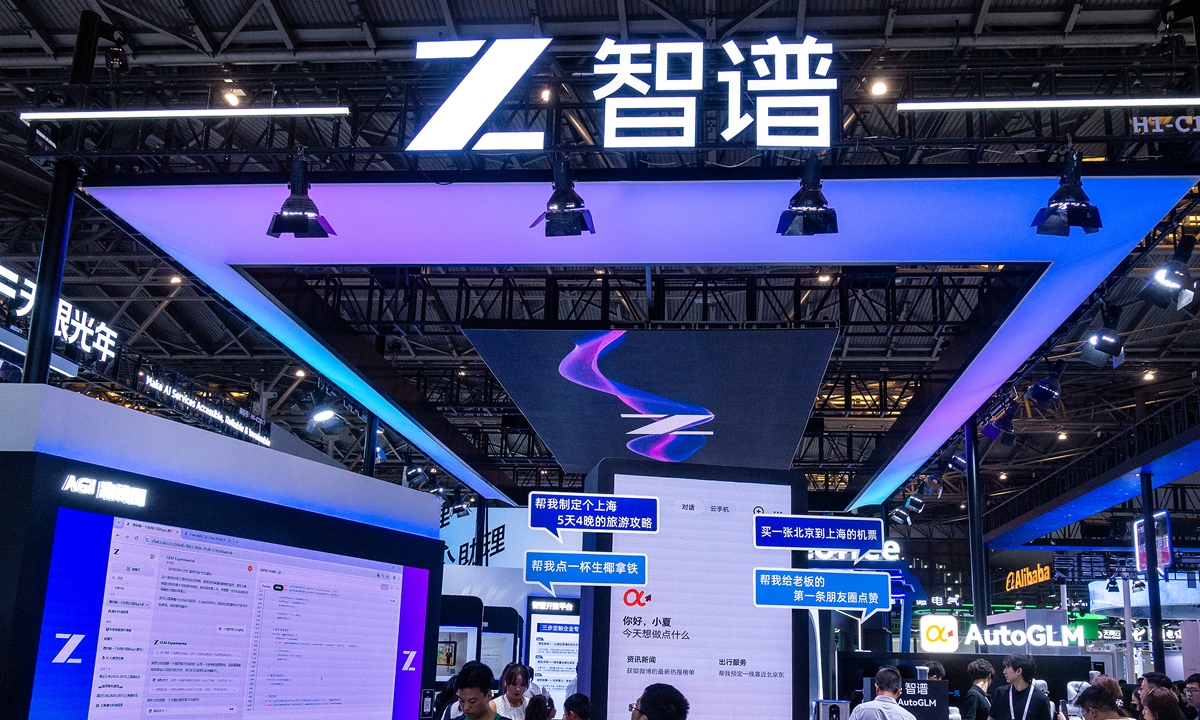
The fundamental catalysts for this rally centered on a wave of new AI model and agent releases across the Chinese AI ecosystem. Zhipu AI launched GLM-5, an open-source large language model featuring improved coding and agent-task capabilities that the company claims matches Anthropic’s Claude Opus 4.5 and outperforms Google’s Gemini 3 Pro on certain benchmarks [1]. Simultaneously, MiniMax released its updated M2.5 open-source model with advanced AI-agent tools, demonstrating the rapid pace of innovation among China’s emerging AI leaders [1]. These product developments were reinforced by encouraging policy signals, as Chinese Premier Li Qiang provided upbeat comments encouraging AI adoption across diverse scenarios, providing additional tailwinds for the sector [1].
The broader market context reveals a striking divergence: while the Technology sector globally declined 0.95% on February 11 and Financial Services was the worst-performing sector at -2.26%, AI-specific stocks dramatically outperformed [4]. The Shanghai STAR AI Industry Index climbed 1.7% before trimming gains, while the Hang Seng Tech index fell 1.7% [1]. Major Chinese tech names including Tencent (700.HK) declined 2.6% and Alibaba (9988.HK) fell 2.1%, indicating the rally was narrowly concentrated in pure-play AI companies with visible product catalysts rather than reflecting broad-based sector strength [1]. This divergence suggests the price appreciation is fundamentally speculative, driven by investor enthusiasm for AI innovation narratives rather than improvements in underlying business fundamentals.
The performance trajectory of these newly public AI companies reveals the extraordinary investor appetite for China’s domestic AI capabilities. Zhipu AI has generated a 196.58% year-to-date return and approximately 225% appreciation since its January 2026 IPO, while MiniMax has delivered a 148.94% return since listing [0]. These gains have significantly exceeded their already-strong IPO performances, with MiniMax having doubled on its debut day [3]. The market capitalization figures—$171.68 billion for Zhipu AI and $183.79 billion for MiniMax—position these companies among the world’s most valuable AI firms despite their limited operating histories as public companies and ongoing substantial losses [0].
The IPO proceeds provide important context for understanding these companies’ strategic positioning. Zhipu AI raised over HKD 4.3 billion in its listing, while MiniMax raised HKD 4.8 billion (approximately $620 million), providing substantial capital resources to fund research and development, talent acquisition, and market expansion [2][3]. The timing of these offerings in January 2026 coincided with intensifying investor interest in Chinese AI alternatives to U.S. leaders, creating favorable conditions for premium valuations despite the companies’ pre-profitability status.
The competitive dynamics within China’s AI landscape are accelerating rapidly, as evidenced by concurrent releases from multiple players. Ant Group open-sourced Ming-Flash-Omni 2.0, a unified multimodal model capable of generating speech, music, sound effects, and visuals, while DeepSeek upgraded its flagship model with larger context windows and newer knowledge bases [1]. This competitive intensity suggests a bifurcated market emerging in China, with well-capitalized leaders pulling away from smaller competitors while collectively advancing the country’s AI capabilities. UCloud Tech, a Shanghai-listed supply-side AI service provider to Zhipu AI, surged 20% on the news, illustrating the ripple effects of successful AI model releases across the broader ecosystem [1].
The valuation metrics for both companies reveal extreme concern levels that warrant serious investor attention. Zhipu AI exhibits a P/E ratio of -51.22x, P/B ratio of -38.29x, and EV/OCF of -66.89x—traditional valuation frameworks simply do not apply to these securities [0]. More troubling, the fundamental profitability metrics show net profit margins of -946.82% and operating margins of -812.50%, indicating these companies are burning substantial cash while generating minimal revenue relative to their market valuations [0]. The current ratio of 0.38 for Zhipu AI suggests potential near-term liquidity challenges that could necessitate future capital raises on potentially unfavorable terms [0].
The concentration of gains in AI-specific names while broader Chinese technology indices decline represents a classic warning sign of speculative excess. The rally occurred during a period of sector weakness, suggesting investors are rotating into narrow AI themes rather than responding to company-specific fundamentals that would support broader sector participation [1][4]. Both stocks are trading within weeks of their IPOs, meaning limited historical price data exists to establish meaningful technical support and resistance levels, increasing the potential for elevated volatility [0]. Additionally, Chinese AI companies remain subject to regulatory and policy shifts that could materially impact their operational trajectories, introducing exogenous risk factors beyond company-specific fundamentals [1].
For investors willing to accept significant volatility and capital loss risk, these companies represent potentially compelling exposures to China’s domestic AI development trajectory. The Chinese government’s clear policy support for AI adoption, as evidenced by Premier Li Qiang’s comments, suggests a favorable regulatory environment for industry growth [1]. Both companies demonstrated meaningful product innovation with their recent model releases, suggesting genuine technical capabilities that could translate into commercial success as the AI market matures [1]. The substantial IPO proceeds provide multi-year runway to execute on growth strategies without immediate profitability pressures [2][3].
The extraordinary market valuations, while reflecting speculative excess in some interpretations, could also signal investor recognition of the strategic importance of AI capabilities in the emerging technology landscape. As pure-play AI companies with visible product roadmaps and substantial capital resources, Zhipu AI and MiniMax offer exposure to China’s answer to U.S. AI leaders that may appreciate significantly if the companies successfully monetize their technological investments [1][3]. However, investors should approach these opportunities with clear understanding that current prices assume successful execution across multiple complex dimensions over extended time horizons.
The February 11-12, 2026 rally in Chinese AI stocks represents a speculative surge driven by product innovation, policy support, and IPO momentum rather than fundamental business improvements. Zhipu AI’s 30% surge and MiniMax’s 11% gain occurred amid new model releases (GLM-5 and M2.5) and encouraging Chinese government comments on AI adoption [1]. Both companies remain deeply unprofitable with negative margins exceeding -800%, extreme valuation multiples that render traditional metrics inapplicable, and liquidity characteristics that suggest potential capital needs ahead [0]. The rally’s concentration in pure-play AI names while broader Chinese tech declined indicates sentiment-driven buying concentrated in specific narratives rather than broad-based sector appreciation [1][4]. Zhipu AI is trading at its 52-week high with volume above average, suggesting institutional participation, while MiniMax’s below-average volume indicates momentum-driven buying [0]. Key technical levels to monitor include Zhipu AI’s $418.00 resistance and $241.15 20-day moving average support, and MiniMax’s $607.50 52-week high and $472.68 20-day moving average [0].
Insights are generated using AI models and historical data for informational purposes only. They do not constitute investment advice or recommendations. Past performance is not indicative of future results.
About us: Ginlix AI is the AI Investment Copilot powered by real data, bridging advanced AI with professional financial databases to provide verifiable, truth-based answers. Please use the chat box below to ask any financial question.