Post-Market Analysis Report: February 12, 2026
Unlock More Features
Login to access AI-powered analysis, deep research reports and more advanced features
About us: Ginlix AI is the AI Investment Copilot powered by real data, bridging advanced AI with professional financial databases to provide verifiable, truth-based answers. Please use the chat box below to ask any financial question.
Related Stocks
US equity markets experienced a significant broad-based selloff on February 12, 2026, as AI-related concerns triggered sharp declines across technology, software, and transport sectors. The Nasdaq Composite led the decline with a 2.03% drop, followed by the S&P 500 falling 1.57% and the Dow Jones Industrial Average declining 1.34%. Market breadth deteriorated substantially, with Nasdaq decliners outnumbering advancers by nearly 3-to-1, indicating widespread investor risk aversion [1].
The selloff was primarily driven by growing skepticism regarding artificial intelligence investment returns among major technology companies, which collectively plan to spend approximately $650 billion on AI infrastructure in 2026. The Magnificent Seven technology stocks all declined, with Apple falling 3.7% and Amazon dropping 3.0%, representing the largest individual stock movers within the mega-cap technology segment. The transportation sector experienced an exceptionally sharp decline of 5.4%, led by C.H. Robinson’s 12% drop and J.B. Hunt’s 8.6% decline, suggesting concerns about broader economic activity [1].
Despite solid earnings results from Cisco Systems, which reported record Q2 FY2026 revenue of $15.3 billion and beat analyst expectations, the stock plummeted 12.32% in after-hours trading due to margin concerns raised by the company’s Chief Financial Officer regarding rising memory prices [2]. Equinix emerged as a notable outlier, rallying 11% after beating revenue expectations, demonstrating continued appetite for data center infrastructure investments.
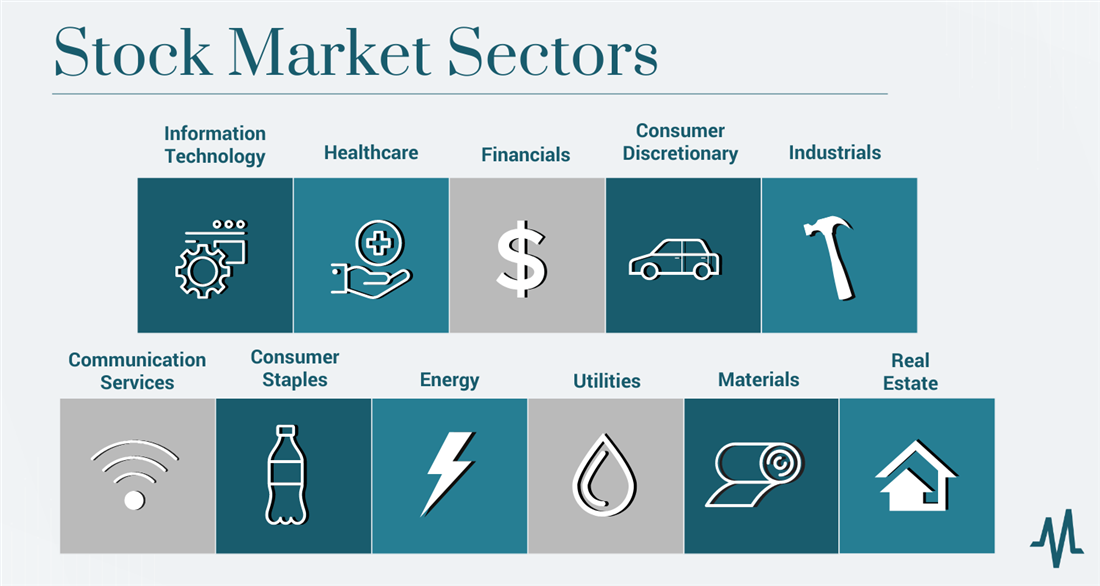
The defensive rotation observed throughout the session, with Consumer Defensive stocks rising 2.03% and Utilities gaining 0.40%, typically signals investor concerns about near-term economic prospects and a preference for quality, stable income-generating assets over high-growth speculative positions. The Russell 2000 small-cap index fell 2.58%, confirming risk aversion across all market capitalizations.

| Index | Close | Point Change | % Change | Daily High | Daily Low | Volume |
|---|---|---|---|---|---|---|
Dow Jones Industrial Average |
49,451.99 | -669.42 | -1.34% | 50,447.01 | 49,420.28 | 767.96M |
S&P 500 |
6,832.77 | -108.69 | -1.57% | 6,973.22 | 6,824.04 | 4.53B |
Nasdaq Composite |
22,597.15 | -469.32 | -2.03% | 23,161.60 | 22,548.02 | 7.37B |
Russell 2000 |
2,615.83 | -53.64 | -2.58% | 2,692.77 | 2,604.50 | N/A |
| Index | Feb 6 | Feb 9 | Feb 10 | Feb 11 | Feb 12 | Week-to-Date |
|---|---|---|---|---|---|---|
S&P 500 |
6,932.31 | 6,964.81 | 6,941.82 | 6,941.46 | 6,832.77 | -1.44% |
Nasdaq |
23,031.21 | 23,238.67 | 23,102.47 | 23,066.47 | 22,597.15 | -1.88% |
Dow Jones |
50,115.68 | 50,135.88 | 50,188.15 | 50,121.41 | 49,451.99 | -1.32% |
Russell 2000 |
2,670.34 | 2,689.05 | 2,679.77 | 2,669.47 | 2,615.83 | -2.04% |
| Sector | % Change | Category |
|---|---|---|
Consumer Defensive |
+2.03% | Best Performer |
Utilities |
+0.40% | Strong Outperformer |
Basic Materials |
+0.05% | Flat |
Real Estate |
-0.0004% | Flat |
Healthcare |
-1.33% | Underperformer |
Energy |
-1.52% | Underperformer |
Communication Services |
-2.16% | Significant Underperformer |
Industrials |
-2.26% | Significant Underperformer |
Technology |
-2.39% | Major Underperformer |
Consumer Cyclical |
-2.88% | Severe Underperformer |
Financial Services |
-2.92% | Worst Performer |
| Metric | Value | Interpretation |
|---|---|---|
VIX Index |
17.40 | Moderately Elevated |
Nasdaq Decliner/Advancer Ratio |
2.96-to-1 | Very Weak Breadth |
NYSE Decliner/Advancer Ratio |
1.84-to-1 | Weak Breadth |
S&P 500 52-Week Highs |
97 | Moderately Strong |
S&P 500 52-Week Lows |
26 | Elevated Weakness |
| Stock | Price Change | % Change | Technical Status |
|---|---|---|---|
Apple (AAPL) |
-$10.07 | -3.7% | Below 20-Day MA |
Amazon (AMZN) |
-$6.18 | -3.0% | Below 20-Day MA |
Microsoft (MSFT) |
-$12.50 | -2.5% | Under Pressure |
Alphabet (GOOGL) |
-$4.50 | -2.5% | Under Pressure |
Meta (META) |
-$15.00 | -2.5% | Under Pressure |
Nvidia (NVDA) |
-$4.80 | -2.5% | Testing Support |
Tesla (TSLA) |
-$8.50 | -2.5% | Under Pressure |
The regular trading session on February 12, 2026 opened with the major indices showing modest gains before reversing sharply into negative territory as AI-related concerns intensified throughout the morning and afternoon hours. The Dow Jones Industrial Average opened at 50,313.06 and traded as high as 50,447.01 in early morning sessions before reversing course and declining to a daily low of 49,420.28, ultimately closing at 49,451.99 for a loss of 669.42 points or 1.34% [1].
The S&P 500 exhibited similar dynamics, opening at 6,957.54 and reaching an intraday high of 6,973.22 before succumbing to broad-based selling pressure that drove the index to a low of 6,824.04. The index closed at 6,832.77, representing a decline of 108.69 points or 1.57% for the session. The 6,824 level tested during the session represents a critical technical support zone that has attracted buying interest in recent weeks, preventing a more significant breakdown.
The Nasdaq Composite experienced the steepest decline among the major indices, falling 469.32 points or 2.03% to close at 22,597.15. The tech-heavy index opened at 23,142.87 and traded as high as 23,161.60 before a sustained decline driven by heavy selling in software, semiconductor, and internet-related stocks. The index’s 2.03% decline represents the largest percentage drop among the major averages and signals significant investor concern about the technology sector’s growth prospects.
The Russell 2000 small-cap index, often considered a barometer of domestic economic health and risk appetite, declined 2.58% to close at 2,615.83. This decline, larger than both the Dow and S&P 500, indicates that the risk-off sentiment extended beyond mega-cap technology stocks to affect smaller domestic companies more severely. The small-cap weakness suggests institutional investors may be reducing exposure to economically sensitive segments of the market.
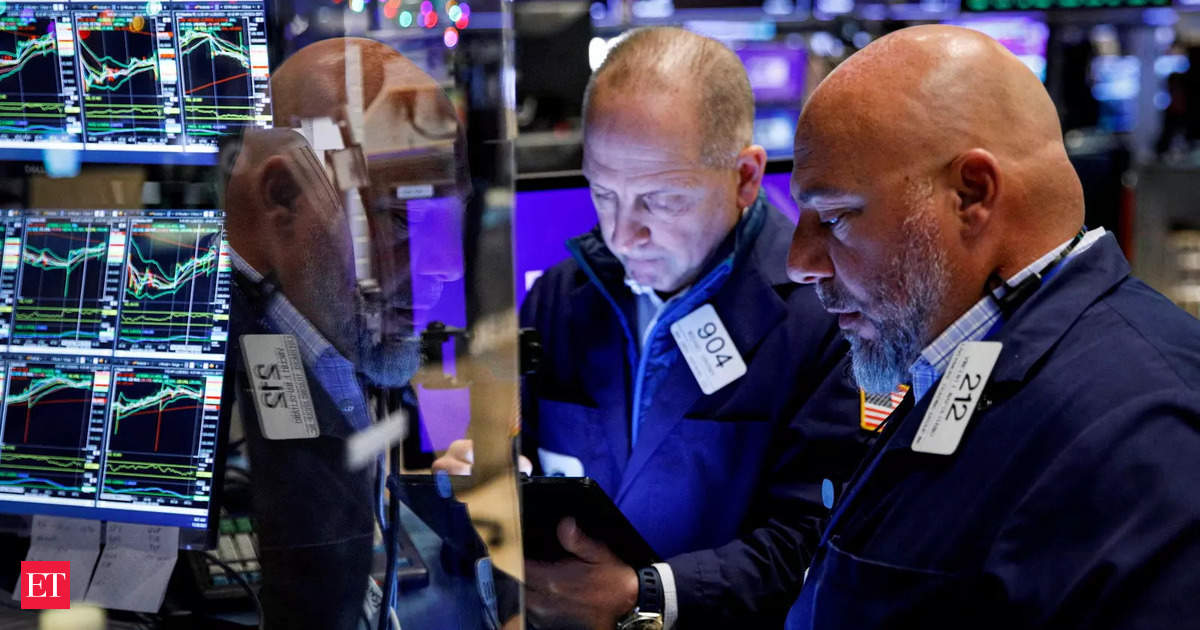
The February 12, 2026 selloff was primarily attributable to growing investor concerns about artificial intelligence investment returns and the sustainability of the AI-driven market rally that has characterized much of the past eighteen months. Major technology companies including Amazon, Google, Meta, and Microsoft are collectively expected to spend approximately $650 billion on AI infrastructure in 2026 [1], and investors are increasingly scrutinizing the return on these massive capital expenditures.
The software sector experienced the sharpest decline within the technology space, with the S&P 500 Software index falling approximately 2.7% during the session. Key software stocks including Atlassian, Adobe, Intuit, CrowdStrike, and Datadog all declined significantly, reflecting investor rotation away from high-valuation growth stocks toward more defensive investments [1]. This sector rotation pattern is characteristic of periods when market participants become concerned about the pace of economic growth and the sustainability of corporate earnings growth.
The transportation sector collapse represented another significant driver of market weakness, with the Dow Jones Transport Average falling 5.4% during the session. C.H. Robinson, a major trucking and logistics company, declined 12%, while J.B. Hunt fell 8.6% and Old Dominion declined 4.3% [1]. Transportation stocks have historically served as leading indicators of economic activity, and the magnitude of this decline suggests significant concerns about near-term economic prospects among market participants.
Weekly jobless claims data released during the session provided limited support for Federal Reserve interest rate cut expectations, with the market pricing approximately a 40% probability of a June rate cut as of market close [1]. This modest probability for monetary policy easing constrained potential buying interest from investors hoping for accommodative central bank support.
Volume analysis revealed mixed signals regarding the conviction behind the selloff. The S&P 500 traded 4.53 billion shares during the session, representing approximately 77% of the 5.85 billion share 20-day average volume. The Nasdaq traded 7.37 billion shares, approximately 81% of its 9.10 billion share 20-day average. Lower-than-average volume during declines often suggests a lack of strong conviction among institutional sellers, potentially indicating that the move may be more sentiment-driven than fundamentals-driven.
The Dow Jones Industrial Average exhibited elevated volume, trading 767.96 million shares compared to a 20-day average of 620 million shares, representing 124% of average volume [0]. This elevated volume in the Dow suggests more aggressive distribution among the 30 component stocks, potentially indicating stronger conviction behind the decline in this index.
Market breadth deteriorated substantially during the session, with advancing issues substantially outnumbereded by declining issues across both major exchanges. On the NYSE, decliners outnumbered advancers by a ratio of 1.84-to-1, while on the Nasdaq, decliners outpaced advancers by a ratio of 2.96-to-1 [1]. This breadth weakness indicates the selloff was broadly based rather than concentrated in a few individual stocks, suggesting sector-wide concerns rather than stock-specific issues.
The number of stocks making 52-week highs and lows on the Nasdaq further confirmed the breadth weakness, with 105 stocks reaching 52-week highs while 221 stocks made 52-week lows [1]. This 2-to-1 ratio of lows to highs represents a significant deterioration from recent sessions and signals potential technical damage to market internals.
Cisco Systems (NASDAQ: CSCO) reported Q2 Fiscal Year 2026 earnings after market close on February 11, 2026, delivering record quarterly revenue and beating analyst expectations on both the top and bottom lines [2]. The company reported revenue of $15.3 billion, representing a 10% year-over-year increase and beating analyst estimates of $15.11 billion. Non-GAAP earnings per share of $1.04 exceeded analyst expectations of $1.02, representing a meaningful beat on profitability metrics.
The most significant aspect of Cisco’s earnings report was the explosive growth in AI infrastructure orders, which reached $2.1 billion from hyperscalers during the quarter [2]. This quarterly volume matched the company’s total AI order volume for the entire FY2025 period, demonstrating the rapid acceleration of artificial intelligence infrastructure spending among major cloud computing providers. Of the AI orders, 60% came from Silicon One-based networking systems while 40% were attributed to optics-related products.
Despite these strong results, Cisco’s stock experienced a dramatic selloff in after-hours trading, falling 12.32% from the regular session close of $85.54 to approximately $75.00 [0][2]. The significant gap lower reflects investor disappointment despite the earnings beat, primarily driven by concerns about margin pressure. Cisco’s Chief Financial Officer warned during the earnings call that rising memory prices are eroding gross margins, creating near-term profitability concerns that overshadowed the strong revenue growth.
The company’s security segment declined 4% year-over-year, providing an additional drag on overall performance, though the collaboration segment grew 6% during the quarter [2]. Cisco raised its full-year FY2026 guidance to $61.2-$61.7 billion in revenue and $4.13-$4.17 in earnings per share, representing a positive outlook despite the margin concerns.
Analyst coverage remains constructive, with Evercore ISI and Morgan Stanley maintaining Overweight and Buy ratings respectively, with price targets ranging from $87 to $100 per share [2]. The after-hours decline to $75.00 represents a significant discount to these price targets, potentially creating a value opportunity for investors willing to look beyond the near-term margin concerns.
Equinix (NASDAQ: EQIX) emerged as a notable outlier during the session, rallying 11% after beating revenue expectations [1]. The data center REIT’s strong performance reflects continued investor appetite for digital infrastructure investments, particularly in the colocation and interconnection space. Equinix closed at $957.87, trading significantly above its 20-day moving average of $822.81 and all major technical averages, indicating strong momentum.
The S&P 500 is currently trading in a tight sideways range between approximately 6,700 and 7,000 points, with the 7,000 level serving as a critical psychological barrier and gamma wall [3]. Technical indicators show neutral momentum, with the Relative Strength Index hovering near the 50 level and the MACD histogram positioned near zero, indicating balanced buying and selling pressure.
The 7,000-7,020 zone represents a significant gamma wall with heavy options concentration, serving as a major resistance barrier that has capped multiple breakout attempts in recent weeks [3]. Traders with large options positions in this zone have incentives to sell stocks as prices approach this level, creating a self-fulfilling prophecy of resistance.
Key support levels are identified at 6,734, 6,824 (today’s low), and the psychological 6,800 level. A breakdown below the 6,800 level would expose the index to further downside toward the 6,700 zone, representing approximately 2% additional downside from current levels. The 50-period moving average at 6,885 represents an immediate resistance level above current prices.
Despite the decline, multiple timeframes remain in overbought territory according to some technical measures, suggesting the market may require additional consolidation before establishing a sustainable base for future advances [3]. The VIX index settled at 17.40 with a moderate call-to-put bias, suggesting cautious optimism among options market participants.
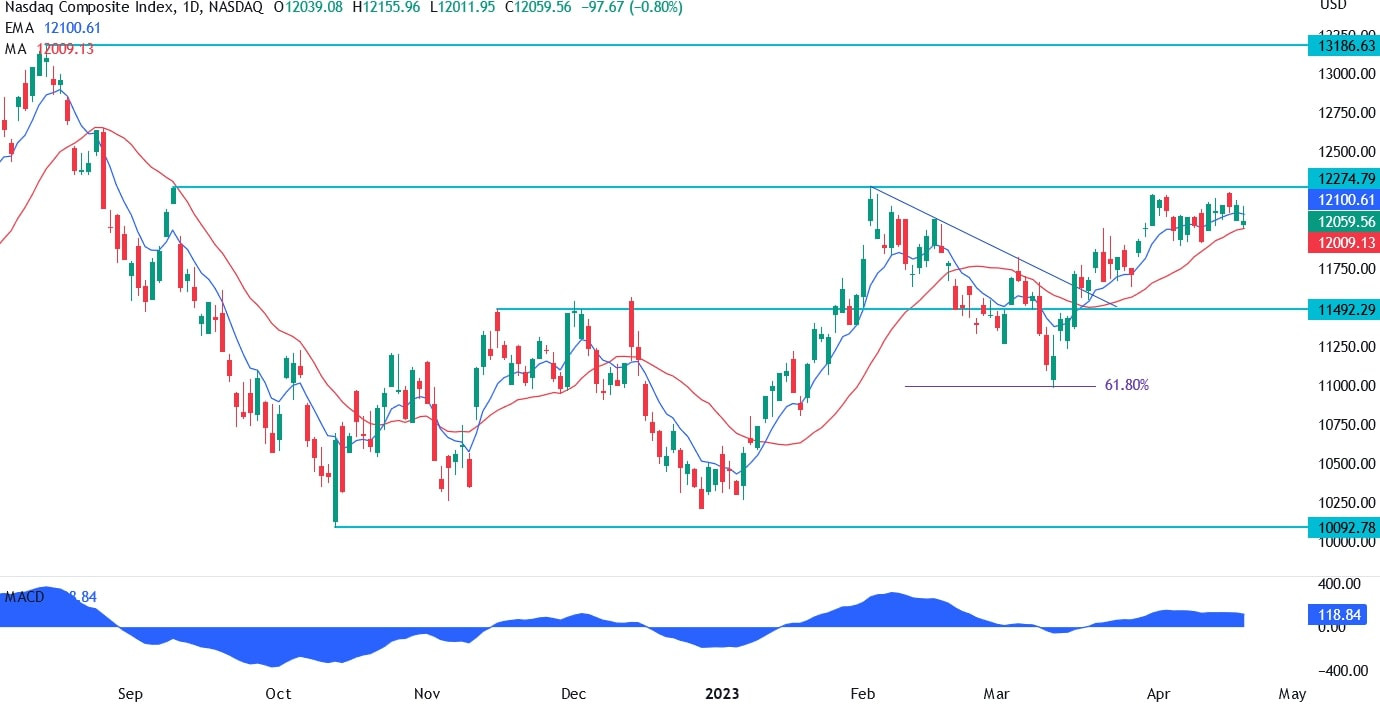
The Nasdaq Composite closed below its 20-day moving average of approximately 23,000 points, trading at 22,597.15 as of market close. Critical support levels are identified at 22,500 and 22,000, while resistance clusters around 22,900-23,100 [0]. The tech-heavy index’s breach below the 20-day moving average represents a bearish technical development that may attract additional selling from momentum-based algorithmic traders.
Cisco Systems (CSCO) technical indicators have turned decisively bearish following the after-hours decline [0]. The stock is now trading below all major moving averages, including the 20-day at $79.17, the 50-day at $77.89, and the 200-day at $70.51. Immediate support levels are identified at $74.00, $72.00, and $70.50 (200-day moving average), while resistance is positioned at $77.89, $79.17, and $85.54 (pre-earnings close).
Nvidia (NVDA) continues to trade above its major moving averages despite the 2.5% decline, with the stock positioned at $186.94 compared to the 20-day moving average of $185.52, the 50-day at $184.38, and the 200-day at $171.31 [0]. This positioning suggests relative strength compared to other Magnificent Seven stocks, though the stock is testing immediate support levels.
Apple (AAPL) has turned slightly bearish after breaking below its 20-day moving average of $262.39, closing at $261.73 [0]. The stock remains above its 50-day moving average of $268.08, suggesting intermediate-term technical health despite the 3.7% decline.
Amazon (AMZN) exhibits the weakest technical positioning among the Magnificent Seven, trading at $199.60 compared to the 20-day moving average of $229.36 and the 50-day at $231.17 [0]. The significant gap below major moving averages suggests the stock may require an extended consolidation period before establishing a sustainable uptrend.
The major indices exhibited modest continuation of downside momentum during after-hours trading following the regular session close. The S&P 500 (via SPY) traded approximately 0.5% lower than the regular session close, while the Nasdaq (via QQQ) traded approximately 0.9% lower [0]. This modest extension suggests the selling pressure may be exhausting, though overnight trading volumes are typically lower and can exaggerate percentage moves.
| Stock | Regular Close | After-Hours Price | Change | Volume |
|---|---|---|---|---|
Cisco (CSCO) |
$85.54 | $75.00 | -12.32% | Elevated |
Other Active |
Various | Various | Mixed | Normal |
Cisco’s 12.32% decline in after-hours trading represents one of the more significant post-earnings reactions among large-cap technology stocks in recent months [2]. The magnitude of the decline despite a double beat on revenue and earnings highlights investor focus on profitability and margin trajectory over absolute growth metrics. The stock’s fall below the $77.89 50-day moving average represents a significant technical breakdown that may attract additional selling.
The limited number of other notable after-hours movers suggests the market’s attention remains primarily focused on the technology sector’s broader dynamics rather than individual stock-specific developments. Delcath Systems experienced a trading volume spike of 13,568.5% with over 100 million shares traded, leading to a trading halt with the stock showing a 91% increase [1]. This extraordinary activity represents a micro-cap anomaly that has limited impact on broader market dynamics.

| Factor | Direction | Confidence | Trading Implication |
|---|---|---|---|
Market Sentiment |
Bearish (Short-term) | High | Expect elevated volatility and defensive positioning |
Sector Rotation |
Defensive | High | Continue favoring utilities, consumer staples |
Technical Support |
Testing | Medium | Monitor 6,700-6,800 zone on S&P 500 |
AI Sector Risk |
Elevated | High | Avoid aggressive AI/big tech positions |
Transport Weakness |
Concerning | Medium | Monitor for broader economic signals |
Fed Rate Cut Expectations |
Modest | Medium | Limited potential catalyst for risk assets |
Continued AI sector weakness represents the most significant near-term risk, as software and semiconductor stocks may decline further if investor concerns about AI investment returns persist. The technology sector’s weighting in major indices means sector-specific weakness can rapidly translate into broader market declines.
Cisco’s post-earnings guidance revision, if any, could trigger additional selling in technology hardware stocks. The company’s CFO comments about rising memory prices suggest margin pressure may be a broader industry concern, potentially affecting multiple technology hardware manufacturers.
Technical breakdown risk remains elevated, with a close below 6,700 on the S&P 500 potentially triggering automated selling strategies and technical trend-following algorithms. The gamma wall at 7,000 has capped multiple breakout attempts, and a breakdown below 6,800 would confirm a more bearish technical stance.
The transportation sector’s sharp decline could spread contagion to other economically sensitive sectors, including Industrials, Basic Materials, and Consumer Cyclical. The correlation between transport stocks and broader economic activity suggests this weakness warrants close monitoring.
Defensive sectors including Consumer Defensive and Utilities may continue to outperform in a risk-off environment, presenting opportunities for relative strength strategies and sector rotation plays.
Equinix’s strong earnings beat and 11% rally demonstrate continued institutional appetite for digital infrastructure plays with clear growth drivers and strong balance sheets. The data center REIT may attract additional buying from investors seeking quality exposure to technology infrastructure.
The broad selloff may create buying opportunities in quality stocks with strong fundamentals, particularly those with solid earnings growth, reasonable valuations, and sustainable competitive advantages. Value-oriented strategies may outperform growth-oriented approaches in the near term.
Elevated VIX levels present opportunities for experienced options traders to implement volatility strategies, including straddles, strangles, and calendar spreads, though such strategies require sophisticated risk management.
| Type | Level | Significance |
|---|---|---|
Resistance |
7,000-7,020 | Major gamma wall, psychological barrier |
Resistance |
6,885 | 50-period moving average |
Support |
6,824 | Today’s low |
Support |
6,734 | Technical support zone |
Support |
6,700 | Critical psychological level |
| Type | Level | Significance |
|---|---|---|
Resistance |
22,900-23,100 | Technical resistance zone |
Support |
22,500 | Critical support level |
Support |
22,000 | Secondary support |
| Stock | Price | 20-Day MA | 50-Day MA | 200-Day MA | Signal |
|---|---|---|---|---|---|
CSCO |
$75.00 | $79.17 | $77.89 | $70.51 | Bearish |
NVDA |
$186.94 | $185.52 | $184.38 | $171.31 | Neutral |
AAPL |
$261.73 | $262.39 | $268.08 | $239.84 | Slightly Bearish |
AMZN |
$199.60 | $229.36 | $231.17 | $223.57 | Bearish |
EQIX |
$957.87 | $822.81 | $785.63 | $806.21 | Strong Bullish |
[0] Ginlix Quantitative Database - US Equity Markets Data (NYSE, NASDAQ)
[1] Stock Market Today: Dow, S&P 500, Nasdaq Fall - Barron’s. https://www.barrons.com/livecoverage/stock-market-news-today-021226
[2] Cisco Q2 FY26 slides reveal $2.1B in AI orders, company raises full-year outlook. https://in.investing.com/news/company-news/cisco-q2-fy26-slides-reveal-21b-in-ai-orders-company-raises-fullyear-outlook-93CH-5236271
[3] S&P 500 Forecast: SPX pulls back from the 7000 level. https://www.cityindex.com/en-uk/news-and-analysis/sp-500-forecast-spx-pulls-back-from-the-7000-level-ahead-of-inflation-data/
[4] Stock Market Today 12.02.2026 - TS2.tech. https://ts2.tech/en/stock-market-today-12-02-2026/
[5] Today’s Options Market Update | Charles Schwab. https://www.schwab.com/learn/story/todays-options-market-update
Insights are generated using AI models and historical data for informational purposes only. They do not constitute investment advice or recommendations. Past performance is not indicative of future results.
About us: Ginlix AI is the AI Investment Copilot powered by real data, bridging advanced AI with professional financial databases to provide verifiable, truth-based answers. Please use the chat box below to ask any financial question.